49 works in this view — arrow keys or swipe to move between them.
Dance in Art
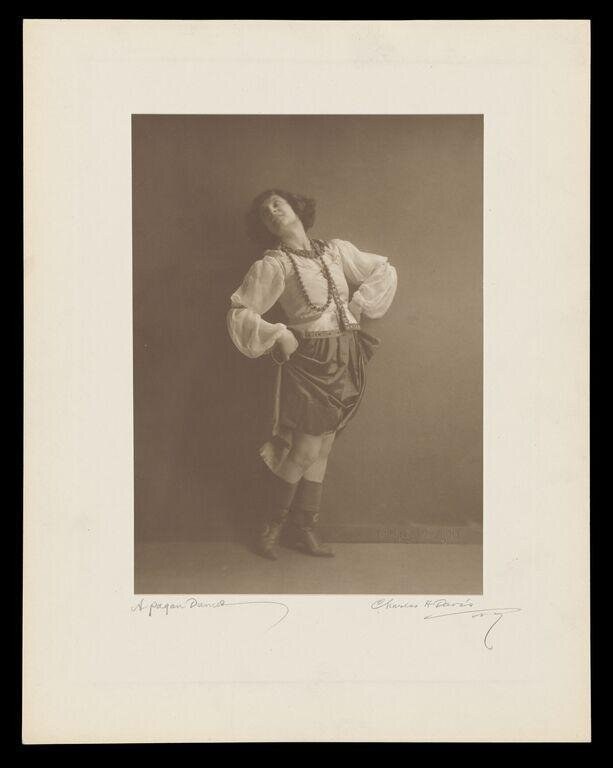
A Pagan Dancer
Davis, Charles Henry
- Collection:
- Photograph
- Source:
- Victoria and Albert Museum
- Rights:
- Rights vary by item — check the source record before reusing this image. Source record ↗
- Recorded as:
- V&A — check rights per item
This work is crucial evidence of how dance circulated and was understood in the 1890s, before cinema. The formal studio photograph became the primary way audiences encountered dancers, shaping how movement was imagined and how dancers constructed their public identities. The image also documents the period's complex relationship to classicism, exoticism, and the performing body—categories that defined theatrical dance for decades to come.
What you are looking at
A solitary female figure stands in a studio setting against a neutral brown backdrop, her body caught mid-movement in a pose of classical contrapposto. She wears a white blouse with voluminous puffed sleeves gathered at the wrist, and a darker (likely rust or brown) skirt that falls to mid-calf, with what appears to be decorative beading or embroidery at the bodice. Her head is tilted back with her gaze directed upward, and her posture suggests a moment of lyrical abandon—one arm is positioned expressively while the other hangs or gestures. The lighting is soft and even, typical of studio photography of the period, creating subtle modeling across the figure without harsh shadows. The overall composition emphasizes the solitary dancer against emptiness, focusing all attention on the body and its attitude.
The dancing
The dancer stands in a languid, almost languorous pose with her weight shifted to one leg in a manner suggesting balletic training or classical theatrical movement. Her upturned face and arched neck convey emotional expressiveness rather than technical precision. The arm positions appear deliberately arranged for visual effect rather than functional dance purpose—they are extended with a grace that suggests tableau rather than action. The overall frame is frontal and presentational, as if the photographer has asked the dancer to hold a meaningful attitude rather than to move through a sequence.
The dance depicted
The title 'A Pagan Dancer' and the theatrical costume suggest this is likely a posed study of interpretive or theatrical dance from the 1890s, a period when such 'pagan' or 'classical' themes were fashionable in artistic and dance circles. The pose and costume do not match any specific codified dance form; instead, this appears to be part of the broader Aesthetic Movement or fin-de-siècle fashion for orientalist and classical fantasy tableaux. The dancer's expression and posture emphasize emotional or spiritual transport rather than technical virtuosity, which aligns with contemporary performance practices where theatrical dancers embodied classical or exotic personas.
How it was made
This is a photograph, almost certainly a gelatin silver or platinum print given the tonal range and dating to 1892. The photographic medium allowed for unprecedented documentary capture of the human figure in motion (or posed stillness), and studio photography became an essential tool for dancers and choreographers to study and market their work. The formal studio setting, controlled lighting, and careful composition suggest this was a professional artistic photograph, likely created for publication or promotion rather than as a candid record. The signature of the photographer, Charles Henry Davis, appears below the image.
About this work
This photograph documents a moment in late-nineteenth-century theatrical dance when performers drew freely on classical, oriental, and fantasy themes to create tableaux vivants and interpretive performances. The 'pagan' title is characteristic of the period's fascination with exoticism and antiquity, imagined through contemporary costume and the expressive body. The photograph preserves both a specific dancer's performance persona and a broader cultural moment when photography became the primary means of circulating images of dance to audiences who could not attend live performance.
How to look at it
Attend to the dancer's face and gaze—the upturned, dreamy expression is the emotional center of the composition and indicates a performance mode focused on interiority and feeling rather than technical display. Notice how the photographer has positioned the body in profile-three-quarter view to emphasize the line of the neck and torso. The stillness of the pose is itself significant: this is not a moment captured mid-leap or mid-turn, but a held attitude that the dancer could sustain for the camera—a fundamental difference between photographic and live dance documentation.
The artist
Charles Henry Davis was an American photographer active in the late nineteenth century, known for theatrical and portrait photography. His work from the 1890s captures the aesthetic conventions of the period, including the fashion for studio studies of performers in character or costume. Davis's photographs were part of the broader documentary project of studio photography in this era, which served both artistic and commercial purposes.
The period
The 1890s saw a proliferation of 'art dance' and interpretive performance that rejected the rigid conventions of classical ballet in favor of more expressive, emotional movement vocabularies. Dancers like Loïe Fuller and Isadora Duncan were beginning to establish alternatives to academic ballet, though the forms were still heavily inflected by classical training and Romantic aesthetics. Simultaneously, Orientalism and archaeological fantasy were dominant themes in visual culture, and theater readily drew on these sources. Photography had become the dominant medium for documenting and promoting theatrical performance, replacing woodcuts and lithographs as the primary visual record.
Where it lives
The photograph is held in the collections of the Virginia Museum of History & Culture (indicated by the source designation 'va' in the catalogue record). It was photographed by Charles Henry Davis and bears his signature. The inscription below the image reads 'A Pagan Dancer,' identifying both the work's title and its theatrical subject.
Dance in this work
Questions about this work
Why is she called a 'pagan' dancer?
The 1890s saw intense fascination with classical antiquity and non-Western cultures, both of which were called 'pagan' in period usage. Dancers performed in costumes and poses meant to evoke ancient Greece, Rome, Egypt, or the Orient, creating a fantasy of cultural otherness. The title is marketing as much as description—it promises the audience an escape into an imagined classical or exotic past.
Is this a specific dance or a generic pose?
This appears to be a theatrical attitude or tableau rather than a step or movement sequence from a codified dance form. Studio photographs of the period often showed performers in character costumes holding meaningful poses, rather than documenting actual choreography. The goal was to convey the dancer's persona and emotional register.
How do I know this is from 1892?
The catalogue record dates the photograph to 1892, and the style of dress, photographic technique, and aesthetic conventions support a dating to the 1890s. The puffed sleeves and silhouette are consistent with 1890s fashion, and the soft-focus studio lighting is typical of platinum or gelatin prints from this decade.
More dance artwork





