49 works in this view — arrow keys or swipe to move between them.
Dance in Art
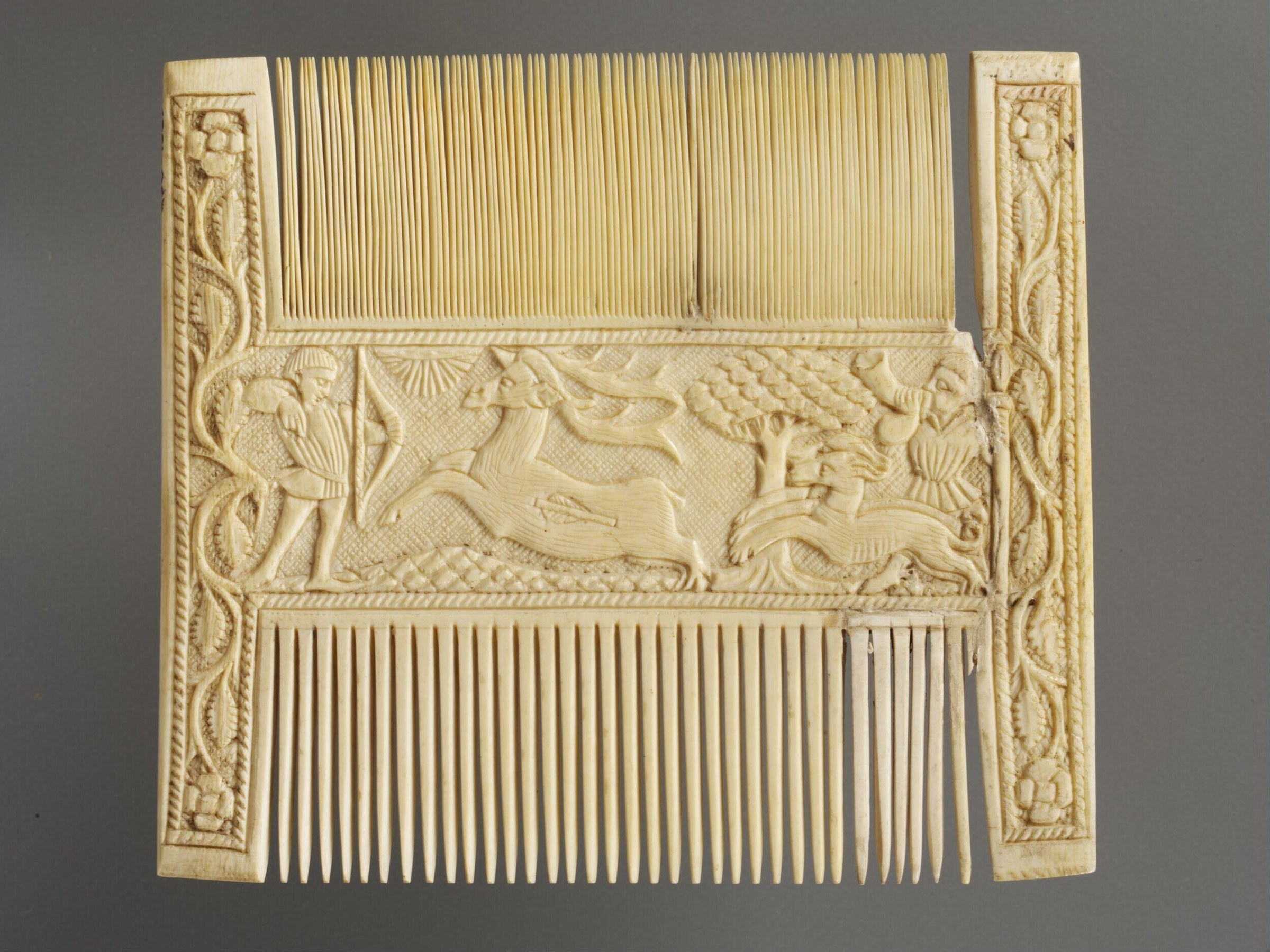
Hunting scene and dancers
Unknown
- Collection:
- Comb
- Source:
- Victoria and Albert Museum
- Rights:
- Rights vary by item — check the source record before reusing this image. Source record ↗
- Recorded as:
- V&A — check rights per item
This comb documents an otherwise difficult-to-verify aspect of 15th-century court dance—the actual posture and movement quality of the bodies performing it. While written dance manuals survive from this period, they describe steps and figures; this image shows the dancer's physicality. The object also demonstrates that dance was not confined to specialized performance spaces but was integral to aristocratic daily life and leisure, celebrated alongside hunting and other courtly pursuits on objects of everyday use.
What you are looking at
This is an ivory comb divided horizontally into two registers of dancing figures separated by a band of carved ornament. The upper section shows a hunting scene with mounted and standing figures among trees and animals; the lower section depicts a row of dancers in animated poses. The comb's functional teeth extend below both registers. The figures are rendered in high relief against a finely hatched background that creates subtle depth and texture. The entire object demonstrates sophisticated Gothic carving technique, with delicate details in the figures' dress and an intricate decorative border framing both registers.
The dancing
In the lower register, the dancers are shown in profile and three-quarter view, bodies leaning forward with knees bent in a playful, energetic posture. Their arms are raised and extended, with some figures appearing to leap or spring. The dancers wear fitted garments typical of the period, and their bodies demonstrate the flexible, animated quality of 15th-century court dance. The spacing suggests couples or small groups moving together, though the composition emphasizes the rhythmic repetition of the dancing figures rather than formalized partnering.
The dance depicted
The lower register shows what appears to be a basse danse or related court dance of the Northern European tradition, likely German or Flemish given the comb's provenance. The forward-leaning posture, bent knees, and raised arms are characteristic of the energetic courtly dances that followed the more stately pavane. The hunting scene above—a common decorative theme on Renaissance combs—shares the festive, celebratory character, suggesting this object commemorates a courtly entertainment or banquet where both hunting and dancing featured prominently. The two registers work as complementary expressions of aristocratic leisure and pleasure.
How it was made
This is carved ivory, a luxury material reserved for the wealthy. The comb demonstrates the technique of high relief carving, where figures project substantially from the background, allowing for considerable modeling of drapery and bodily form. Ivory's fine grain permits the delicate hatching visible in the background and the precise rendering of decorative borders. Objects of this type—mirror backs, combs, and small boxes—were produced in specialized workshops, likely in Paris, Bruges, or other major craft centers, and required highly skilled carvers. The technique's limitations—the need to work within the material's dimensions and to avoid undercutting that would weaken the structure—shaped how the composition was organized into distinct registers.
About this work
This is a 15th-century ivory comb showing two registers of aristocratic leisure: hunting above and courtly dancing below. Ivory combs were luxury objects produced in specialized workshops for wealthy patrons, and this one exemplifies the Gothic International style that dominated Northern Europe in the decades around 1440. The dancing figures in the lower register offer a valuable record of court dance practice and costume at a moment when the basse danse and its variants were central to courtly entertainment and social display.
The work sits at the intersection of functional object, precious material, and artistic documentation. It is simultaneously a grooming tool, a demonstration of the carver's skill, and a record of how aristocratic bodies moved and dressed. For historians of dance, it provides visual evidence of posture, gesture, and the integration of dance into courtly life; for art historians, it exemplifies the sophisticated small-scale carving that flourished in the International Gothic period.
How to look at it
Look at the dancers' posture: the forward lean of the torso, the bend in the knees, the height and angle of the raised arms. This is not the upright, processional bearing of the pavane or other earlier court dances, but something more springy and buoyant. The artist has frozen a moment of energetic movement, with bodies caught mid-leap or mid-turn. Notice also how the carver has used the comb's rectangular format by organizing the dancers into a frieze—a horizontal procession that mirrors the rhythm of the dance itself. The connection between the hunting scene above and the dancing below is not narrative but thematic: both are expressions of courtly pleasure and aristocratic leisure.
The period
This comb dates to the mid-15th century, a period when the basse danse and its relatives were the dominant forms of courtly entertainment across Northern Europe. Dance was central to aristocratic identity and social ritual—it demonstrated grace, nobility, and education. The same period saw the production of the earliest printed dance manuals, beginning with Domenico da Piacenza's work in Italy, reflecting growing interest in codifying and teaching dance technique. In the visual arts, the International Gothic style—characterized by refined detail, graceful elongated figures, and interest in courtly themes—was at its height. Ivory carving flourished as a luxury craft, with workshops in Paris, Bruges, and other centers producing combs, mirror backs, and small boxes for wealthy patrons. These objects combined precious material, skilled execution, and aristocratic subject matter, making them markers of status and taste.
Where it lives
The object is held as a comb in a collection (specific location not recorded in the catalogue). The catalogue entry is minimal, providing only a title, attributed date, and material classification. The source is listed as 'va,' likely referring to a museum or collection database code.
Dance in this work
Questions about this work
What dance are these figures doing?
The posture and movement suggest a basse danse or a related energetic court dance of the 15th century, rather than the more stately pavane. The forward lean, bent knees, and raised arms indicate a dance with more bounce and spring. Without a written inscription or additional context, identification remains probable rather than certain, but the physical vocabulary matches what we know of Northern European court dances from around 1440.
Why is hunting shown above the dancers?
Both hunting and dancing were central to aristocratic leisure and identity. On luxury objects like this comb, they often appear together as complementary expressions of courtly pleasure and the cultivated pastimes of the nobility. The two scenes work thematically rather than narratively, celebrating the pleasures available to the wealthy.
How do we know this is really from 1440?
The style of the carving, the costume details, and the character of the figures are consistent with Northern European ivory work of the mid-15th century. However, without documentation of the comb's provenance or technical analysis of the material, the date must be understood as a stylistic attribution rather than a certainty.
Was this comb actually used, or was it purely decorative?
Luxury combs of this type were functional objects—the teeth would have worked—but they were far too precious for everyday use. They served primarily as demonstrations of the owner's wealth and taste, and were likely used only on special occasions or displayed as treasured possessions.
More dance artwork





