49 works in this view — arrow keys or swipe to move between them.
Dance in Art
The Red Dancer of Moscow
Kitaj, R.B.
- Collection:
- Source:
- Victoria and Albert Museum
- Rights:
- Rights vary by item — check the source record before reusing this image. Source record ↗
- Recorded as:
- V&A — check rights per item
For historians and dancers, this work matters because it shows how modernist visual artists engaged with dance history as a crucial twentieth-century innovation, and specifically how the figure of the experimental female dancer became a site for exploring artistic freedom and cultural rupture. Kitaj's collage method itself mirrors the way dance history is constructed—through fragments, photographs, recordings, and mythologized accounts—making the form inseparable from the content.
What you are looking at
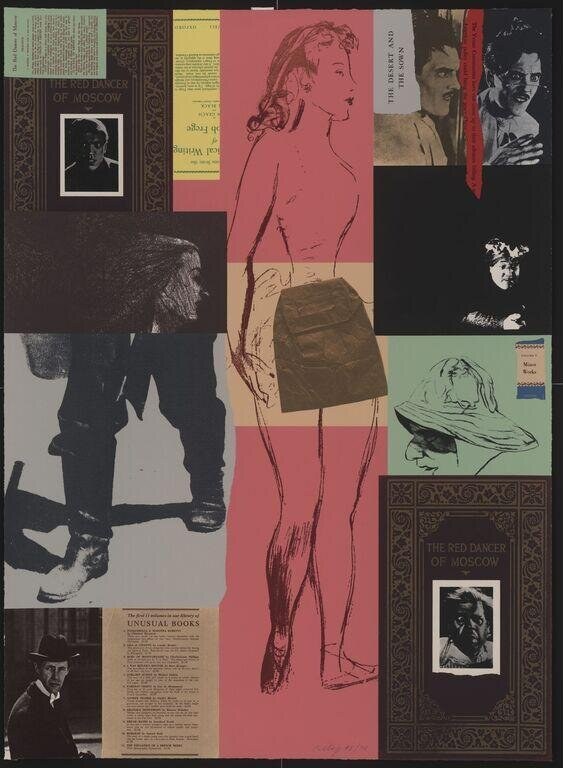
This collage-based work layers photographs, printed texts, and drawn or painted elements across a dark ground. A central figure dominates the composition: a woman rendered in line drawing against a vivid pink panel, shown from behind in a three-quarter pose, her body arched and legs extended in an attitude that suggests movement or arrested motion. Her upper torso is bare; a brown skirt or wrap sits low on her hips. Around this central figure, Kitaj has assembled a dense field of imagery—photographs of faces (some appearing to be historical portraits or stills), fragments of text in various typefaces and colors (cream, yellow, tan), what appear to be book covers or title pages with ornamental borders, and additional photographic or printed material in black and white. The overall effect is archaeological: a layering of cultural and artistic references that suggests both archival research and personal memory. The composition reads as a constructed narrative rather than a single scene, with the drawn female figure as the anchor around which documentary and textual materials orbit.
The dancing
The central female figure is depicted in a classical contrapposto stance, weight shifted, one leg extended and the other supporting. Her body is outlined in continuous line, creating an almost sculptural presence against the colored ground. The pose suggests balletic or theatrical training—the extension is controlled, the back arched with deliberation. No other dancers are visible; instead, surrounding faces and partial figures in photographs read as witnesses, subjects of study, or historical references rather than co-performers. The figure's nakedness in the upper body, combined with the formal extension of the legs, creates a tension between vulnerability and technical command.
The dance depicted
The title *The Red Dancer of Moscow* invokes Isadora Duncan, the American modern dancer celebrated for her revolutionary barefoot performances in early 20th-century Russia. The central figure's pose—classical yet individualistic, nude yet dignified—echoes Duncan's aesthetic rejection of ballet technique in favor of a more 'natural' movement vocabulary rooted in ancient Greek ideals. The pink/red tonality and the assembly of historical references suggest Kitaj is constructing a meditation on Duncan's legacy and the avant-garde ferment of early Soviet culture. However, the work is not illustrative in a literal sense; rather, it uses the figure as a point of departure for exploring how modernist dance intersected with visual art, photography, and the archive of the twentieth century. The pose itself could suggest Russian Imperial ballet training as much as Duncanist free dance, leaving the specific dance practice ambiguous by design.
How it was made
The work appears to be a mixed-media collage, likely incorporating photomontage and screen printing or lithography alongside hand-drawn elements. The flattened picture plane, the bold color fields (particularly the hot pink), and the integration of photographic and typographic elements suggest Kitaj was working within the post-war pop art and assemblage traditions. This technique allowed for layering of temporal references—the collage form itself enacts the archaeological, memory-laden quality of the subject. The durability and reproducibility of a print or painted collage meant the work could circulate among museums and serious collectors of contemporary art, positioning it within the gallery system rather than as a unique object.
About this work
This 1975 work by R.B. Kitaj uses the figure of a female dancer—likely an invocation of Isadora Duncan and the myth of the 'Red Dancer'—as the organizing center of a dense, layered composition that mixes drawing, photography, and text. The work sits at the intersection of modernist dance history and contemporary visual art, using collage to explore how the body, particularly the dancing body, carries historical and cultural meaning. Kitaj's practice was deeply invested in the idea that art could be 'literary'—that it could hold multiple temporal and cultural references simultaneously—and this work exemplifies that commitment. The dancer is not merely depicted; she is positioned within a field of documentation, memory, and artistic quotation that refuses simple narrative in favor of associative, archival logic.
How to look at it
Look first at the central drawn figure: notice how the artist has chosen a moment of extension and exposure, a classical pose rendered in a modern idiom. The pose is incomplete—we see the body from behind, the face absent, which emphasizes the physical act over personality or narrative. Then attend to the surrounding field: the photographs, the text fragments, the ornamental borders. None of these elements tells a unified story; instead, they accumulate, suggesting research, reference, and the layering of memory. The pink panel on which the figure is drawn stands out chromatically and texturally from the darker, more densely documented areas around it, creating a visual hierarchy that asks: what is primary, the figure or the archive? The work invites a slow, archaeological reading rather than a glance—it repays attention to detail and to the relationship between image, text, and historical reference.
The artist
R.B. Kitaj (1932–2007) was an American painter and printmaker working primarily in London from the 1950s onward. He was associated with the Pop Art movement and with a return to figuration and narrative in painting during an era dominated by abstraction. Kitaj's work was consistently 'literary'—it drew on historical sources, literary texts, and cultural memory, and often incorporated collage, photomontage, and mixed media. He was interested in Jewish identity, twentieth-century political history, and the recovery of obscure or marginal figures and moments. His practice emphasized the artist as researcher and archivist, and he frequently worked in series exploring particular historical themes or individuals. By the mid-1970s, when this work was created, Kitaj had fully developed his idiosyncratic approach to figuration as a vehicle for intellectual and emotional complexity.
The period
In 1975, the art world was in the midst of a broad reassessment of figuration, narrative, and historical reference after decades of abstraction's dominance. Simultaneously, there was growing scholarly and artistic interest in dance history, particularly in reassessing modernist pioneers like Isadora Duncan. Duncan had died in 1927, but her legacy—as liberator, tragic figure, and proto-feminist—was undergoing revival and reinterpretation. Soviet and Russian dance history was also a subject of renewed Western interest as Cold War tensions created complex fascinations with Russian culture. Kitaj's work participates in this moment: it takes a figure from dance history and subjects it to the formal and conceptual innovations of contemporary visual art, treating the archive of dance (photographs, texts, historical accounts) as material to be recombined and interrogated.
Where it lives
The work is held as a print in the collection listed as 'va' (indicating a likely institutional holding, possibly the Victoria and Albert Museum, though the catalogue record is sparse on this point). It is catalogued as a print rather than a unique painting, suggesting it is a multiple or reproducible work, though the specific printing technique and edition are not recorded.
Dance in this work
Questions about this work
Who was the 'Red Dancer of Moscow'?
The title likely refers to Isadora Duncan, the American modern dancer who revolutionized dance in the early twentieth century and performed extensively in Russia and the Soviet Union. Duncan rejected classical ballet technique in favor of barefoot, emotionally expressive movement inspired by ancient Greek art. She became a legendary, somewhat mythologized figure in modernist culture. However, the title may also evoke other real or imagined dancers associated with the Russian avant-garde and Soviet culture. Kitaj does not make the reference explicit; instead, he uses the evocative title as a point of departure for visual and associative exploration.
What is a collage and why would Kitaj use one to depict a dancer?
A collage assembles fragments—photographs, printed text, painted or drawn elements—onto a single surface. By using collage, Kitaj mirrors the way dance history itself is fragmentary: we know the past through photographs, written accounts, films, and memory rather than through direct experience. The technique allows multiple temporal layers to coexist on a single plane, which is fitting for a work that engages with the archive of modernist dance. It also emphasizes that the dancer, as a historical figure, is constructed through representation and documentation.
Why is the figure drawn rather than photographed or painted realistically?
The line drawing gives the figure a classical, almost sculptural quality while also emphasizing that this is an artistic *interpretation* rather than a documentary representation. The spare, continuous line recalls classical drawing and Greek art—references central to Isadora Duncan's own aesthetic philosophy. By drawing rather than photographing, Kitaj asserts the artist's hand and intention, distinguishing his creative act from mere archival reproduction.
What do the photographs and text surrounding the figure represent?
They function as an archive or research field surrounding the central figure. The photographs may be portraits of historical figures, stills from films or performances, or generic images suggesting the visual culture of the twentieth century. The text fragments suggest scholarly or historical sources. Together, they create a context of historical reference and documentary evidence, implying that the dancer cannot be understood in isolation but only through the dense network of cultural memory, artistic precedent, and historical documentation that surrounds her.
More dance artwork





