49 works in this view — arrow keys or swipe to move between them.
Dance in Art
The Dancer
David Bomberg
- Collection:
- Watercolour
- Source:
- Victoria and Albert Museum
- Rights:
- Rights vary by item — check the source record before reusing this image. Source record ↗
- Recorded as:
- V&A — check rights per item
This work is essential to understanding how modernist abstraction and avant-garde dance developed in parallel. It shows that the artists leading the revolution in visual art—Bomberg and the Vorticists—were not indifferent to the body and its movement, but rather saw abstraction as the only adequate means to represent the intensity and inner life of the dancing figure. For historians of twentieth-century dance, this painting is evidence that the concerns of modern choreography (expressionism, the dissolution of classical form, the primacy of inner impulse over external technique) were being pursued simultaneously across the arts.
What you are looking at
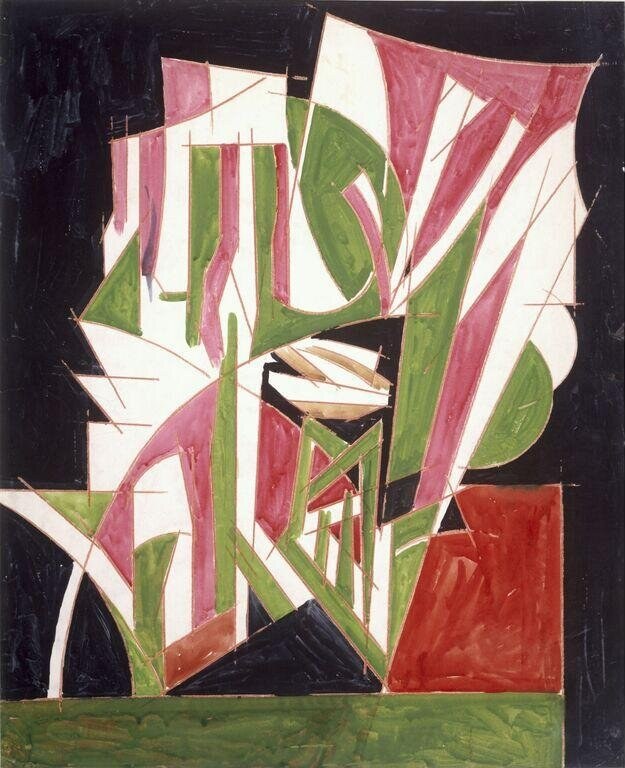
A dynamic, fragmented composition depicting a dancer in motion, rendered in bold strokes of pink, green, white, and black against a dark background. The figure is abstracted into geometric planes and angular forms that suggest movement and energy rather than naturalistic representation. Sweeping curved and straight lines in deep pink and vibrant green intersect across the composition, creating a sense of spiraling, turning motion. The lower portion of the canvas grounds the work with warm ochre and deep green suggesting a stage or floor. Sharp black angular shapes penetrate the composition, adding tension and momentum. The overall effect is one of kinetic intensity—a body captured not as it appears but as it moves, with the painting itself seeming to rotate and pulse around an unseen center.
The dancing
A single dancer dominates the composition, their body dissolved into planes of color rather than rendered as anatomically coherent. The curving pink and green forms suggest the spiral of a torso and limbs in rotation; the sharp angles and intersecting lines convey speed and the centrifugal force of turning. The dancer appears to be captured mid-spin or mid-leap, with weight distributed dynamically across the canvas rather than anchored to a single point. The fragmentation of the form makes it impossible to read a specific foot position or classical hold, but the overall gesture is one of abandonment and velocity—a body given over to movement.
The dance depicted
This work captures the modernist moment when avant-garde art and theatrical dance collided, likely depicting an interpretive or experimental dance rather than classical ballet. The abstraction and emotional intensity suggest the influence of the modern dance pioneers who were performing in London and Europe during the 1910s—figures like Isadora Duncan, whose free, expressionist movement broke decisively with ballet convention. The painting prioritizes the *feeling* of motion and the body's internal energy over external form, a concern shared by contemporary choreographers who were beginning to reject the rigid vocabulary of classical technique. Without additional documentation, the specific dance cannot be identified, but the work testifies to a moment when visual artists and dancers were investigating how to represent the moving body in radically new ways.
How it was made
A watercolour on paper, executed with rapid, confident brushwork and bold colour juxtaposition. The watercolour medium allowed Bomberg to achieve both translucent layers and crisp, saturated washes of colour—the technique is visible in the way the pink and green planes shift in density and transparency. Unlike oil painting, watercolour demands decisiveness; the artist cannot easily conceal or revise, which suits the urgent, gestural quality of the composition. The work belongs to a moment when watercolour was being reclaimed by avant-garde artists as a medium capable of serious abstraction, not merely topographical recording or decorative accomplishment.
About this work
This watercolour from 1913 places the dancing body at the centre of early twentieth-century artistic modernism. David Bomberg, a key figure in the Vorticist movement, deploys abstraction to capture not the dancer's appearance but the kinetic energy and emotional intensity of dance itself. The work registers a seismic shift in how artists were beginning to think about representation—abandoning the illusion of a stable, legible figure in favour of fragmentation, velocity, and colour-induced movement. For galleries dedicated to dance in art, this painting is a cornerstone: it documents the moment when modernist painting and modernist dance recognised themselves as allies, both committed to dissolving nineteenth-century conventions and discovering new languages for the moving body.
How to look at it
Look at how Bomberg uses colour and line to suggest motion rather than describe a body. The eye is pulled into the spiral of pink and green, following the implied rotation of the torso and limbs. Notice how the sharp black angles and geometric planes disrupt any restful reading of the composition—the painting keeps moving. The fragmentation of the figure is not a failure of representation but a deliberate strategy: it forces the viewer to complete the dancer imaginatively, much as we complete a dancer's movement by anticipating what comes next. The dark background intensifies the luminosity of the figure's colours, giving the dancer an almost spiritual intensity. This is a painting that asks you to feel motion, not merely see it rendered.
The artist
David Bomberg (1890–1957) was a British painter and a central figure in the Vorticist movement, the radical avant-garde group that dominated London's artistic avant-garde in the years immediately before the First World War. Vorticists, influenced by Cubism and Futurism but distinct from both, were obsessed with dynamic form, angularity, and the representation of force and motion. Bomberg's work from this period frequently explored the human figure—not as a stable representation but as a site of energy and abstraction. He was interested in the structural underlay of form and in how modern art could capture psychological and physical intensity. His engagement with dance, evident in works such as *The Dancer*, reflects a broader avant-garde conviction that dance and visual art were sister arts in the project of modernism.
The period
In 1913, European modernism was in ferment. Cubism had already fragmented the classical figure; Futurism celebrated violence, speed, and dynamic force. In dance, this was the moment of the Ballets Russes, whose revolutionary productions under Sergei Diaghilev were introducing London and Paris to non-classical movement vocabularies. Isadora Duncan, though slightly earlier, had already challenged the hegemony of ballet. The modernist moment created an opening in which abstraction and dance could be understood as vehicles for expressing the inner life—emotion, energy, the unconscious—rather than mere technical display. Bomberg's *Dancer* belongs to this constellation: it is a painting that thinks like a modernist choreographer.
Where it lives
Held in the Victoria and Albert Museum collection (abbreviated as 'va' in the source field). The V&A's collection of dance-related works on paper includes prints, watercolours, and drawings spanning several centuries and cultures.
Dance in this work
Questions about this work
Is this a portrait of a specific dancer?
The work is not known to be a portrait of a named dancer. It is a subject piece—an exploration of the dancing figure as a motif for abstraction. The work's title is simply *The Dancer*, not the name of a performer, which suggests Bomberg was interested in the universal or archetypal quality of the dancing body rather than individual likeness.
Why is the figure so fragmented?
Fragmentation was a deliberate technique of modernist art, influenced by Cubism and Vorticism. By breaking the dancer into geometric planes, Bomberg could represent multiple viewpoints and moments of movement simultaneously, and could prioritise the *energy* of dance over anatomical accuracy. The fragmentation also conveys speed and the difficulty of apprehending a moving body—the eye cannot hold it still.
What is the connection between Vorticism and dance?
Vorticists were fascinated by dynamism, force, and angular form. They saw parallels between their own artistic revolution and the revolution happening in dance at the same moment. Several Vorticist and near-Vorticist artists engaged with dance as a subject: it embodied modernity, emotional intensity, and the dissolution of stable form—all Vorticist preoccupations.
How does this compare to other paintings of dancers from this period?
Most paintings of dancers in the early twentieth century were either academic or representational, depicting recognisable ballet poses or theatrical moments. Bomberg's abstraction is far more radical. Comparable works would be found among Cubist and Futurist investigations of the figure—though even among those, the commitment to pure abstraction in service of representing dance is unusual.
More dance artwork





