49 works in this view — arrow keys or swipe to move between them.
Dance in Art
Dancer
Colescott, Warrington W.
- Collection:
- Serigraph
- Source:
- Victoria and Albert Museum
- Rights:
- Rights vary by item — check the source record before reusing this image. Source record ↗
- Recorded as:
- V&A — check rights per item
This work is crucial for understanding how mid-twentieth-century visual artists engaged with dance as a subject beyond narrative or representation. In 1955, when abstract expressionism dominated American art, Colescott's choice to make the dancer itself abstract rather than figurative shows that dance had become a metaphor for modernist practice itself: process, embodied gesture, and the constant negotiation between order and expression.
What you are looking at
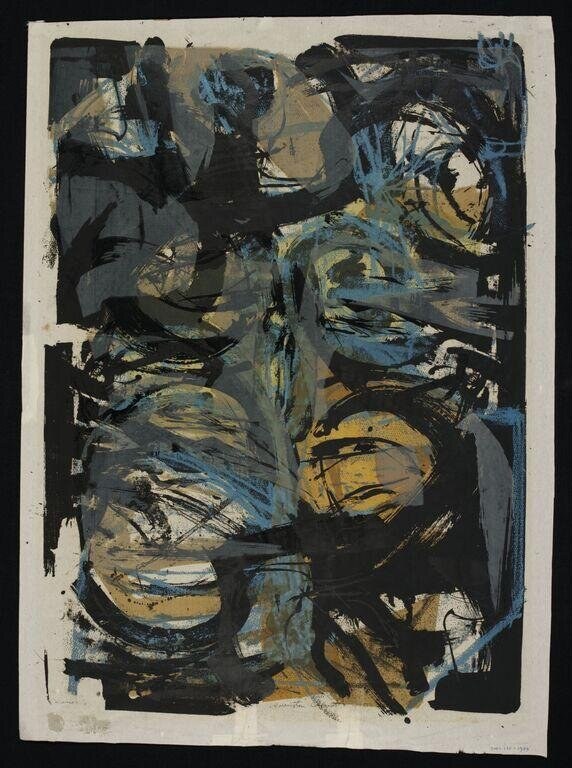
A serigraph rendering of a single figure rendered in bold gestural abstraction, dominated by deep blacks, grays, and ochre yellows. The composition is vertically oriented and densely packed with overlapping forms that suggest a torso, limbs, and head, though the anatomy is deliberately fragmented and reconstructed. The figure emerges from and dissolves back into areas of heavy black, creating a sense of movement and instability. The work uses expressive brushwork and layered application typical of serigraphic printing; areas of flat color are interspersed with gestural marks and scratched or scraped texture. The background remains largely neutral, allowing the dynamic internal structure of the figure to dominate. There is no setting or spatial context—the dancer exists in a void of the artist's own making.
The dancing
A single standing or nearly upright figure compressed into a vertical format. The body is rendered through overlapping planes and curves rather than anatomical accuracy; we read a sense of weight and potential movement through the composition's internal tensions rather than through clear limb position. The suggestion of arms, torso, and head are all present but deliberately ambiguous. There is no clear indication of formal dance posture—the hold and frame are internal to the abstract structure rather than external and social. The figure appears caught between states: neither fully resolved into classical form nor entirely dissolved into pure abstraction.
The dance depicted
This is an abstracted representation of dance itself rather than a depiction of a specific dance or style. The title *Dancer* and the vertical, gravity-resisting composition suggest modern or contemporary dance practice, where the body explores movement beyond ballroom or theatrical convention. The fragmented, gestural approach—building the figure from marks and planes rather than outlining it—parallels the way contemporary dancers move through space, prioritizing internal dynamics and transformation over external line. Without costume, setting, or identifiable technique, the work captures the idea of dance as physical investigation rather than as performance of a known form.
How it was made
This is a serigraph (silkscreen print), a technique that allows for layered applications of opaque ink and creates areas of both flat color and visible texture. The catalogue record does not specify the medium, but the image itself shows the characteristic properties of serigraph: flat planes of color, crisp edges where stencils defined areas, and the visible surface quality of printed ink rather than paint. Serigraph was a particularly important medium for American artists in the 1950s because it allowed for both fine art status and multiple impressions, reaching audiences beyond the gallery market. The technique's graphic strength—its reliance on bold shapes and high contrast—suits Colescott's abstract expressionist approach to the human figure.
About this work
Warrington Colescott's *Dancer* from 1955 is an abstract serigraph that abandons representation in favor of exploring the body as a site of internal formal relationships. Rather than depicting a recognizable dance type or codified movement, Colescott constructs the figure through layers of black, gray, and ochre, using the vocabulary of abstract expressionism to suggest the energy and transformation at the heart of dance practice. The work sits at the intersection of visual modernism and performance—it asks what remains when you strip away costume, setting, and style, and the answer is pure form in tension and motion.
How to look at it
Look first at how the artist has built the figure without outline: there is no edge where the dancer stops and the background begins, only a gradual shift in density and tone. Notice how the blacks and grays create weight and the yellows suggest skin or internal warmth. The overlapping planes suggest movement not through a clear sequence of steps but through the way one form pushes against another. The viewer is invited to reconstruct the figure imaginatively, which mirrors the act of watching contemporary dance—making sense of gesture that refuses narrative clarity.
The artist
Warrington Colescott (1921–2013) was an American printmaker and painter known for his innovative work in serigraph and intaglio. Working from his base in Wisconsin, Colescott was a key figure in the postwar printmaking renaissance, exploring abstraction and figuration across multiple media. His practice often engaged with the human body and gesture as sites of modernist investigation, and he taught printmaking at the University of Wisconsin-Madison for much of his career. Colescott was part of the generation of American artists for whom printmaking was not secondary to painting but a primary vehicle for artistic innovation.
The period
In 1955, American modern dance was experiencing a period of formal innovation under figures like Merce Cunningham, whose decoupling of music and movement and whose interest in pedestrian gesture were reshaping what dance could be. Simultaneously, abstract expressionism dominated the visual arts, with artists like Jackson Pollock and Franz Kline making gesture itself the subject of painting. Colescott's serigraph reflects this convergence: the body, reduced to essential mark-making and color relationships, becomes a vehicle for abstract formal exploration. The work also participates in the broader 1950s printmaking revival, when artists like Helen Frankenthaler and Robert Motherwell brought gestural abstraction into print media.
Where it lives
The work is held in a collection documented as a serigraph (silkscreen print). The catalogue record lists the source as 'va,' likely indicating a Virginia institution, though the specific holding collection is not identified. The work's status as a multiple print rather than a unique object means it was made for distribution and viewing beyond a single museum context.
Dance in this work
Questions about this work
Is this a portrait of a specific dancer?
No. The title is *Dancer* in the singular and generic sense—the work is about the abstracted idea of dancing and the body in motion, not about a named individual. Colescott removes all identifying features and context to focus on form and gesture alone.
What dance style is being shown?
None in particular. The work predates or sits outside the codified styles of ballet, jazz, or ballroom. It reflects the period's broader interest in modern and contemporary dance, where movement itself rather than technique is the subject.
Why is the figure so fragmented?
Fragmentation is Colescott's method for capturing the experience of movement and transformation. Rather than freezing the body in a single pose, he shows it as a series of overlapping states, which is closer to how we actually perceive dance—as continuous change rather than static positions.
More dance artwork





