49 works in this view — arrow keys or swipe to move between them.
Dance in Art
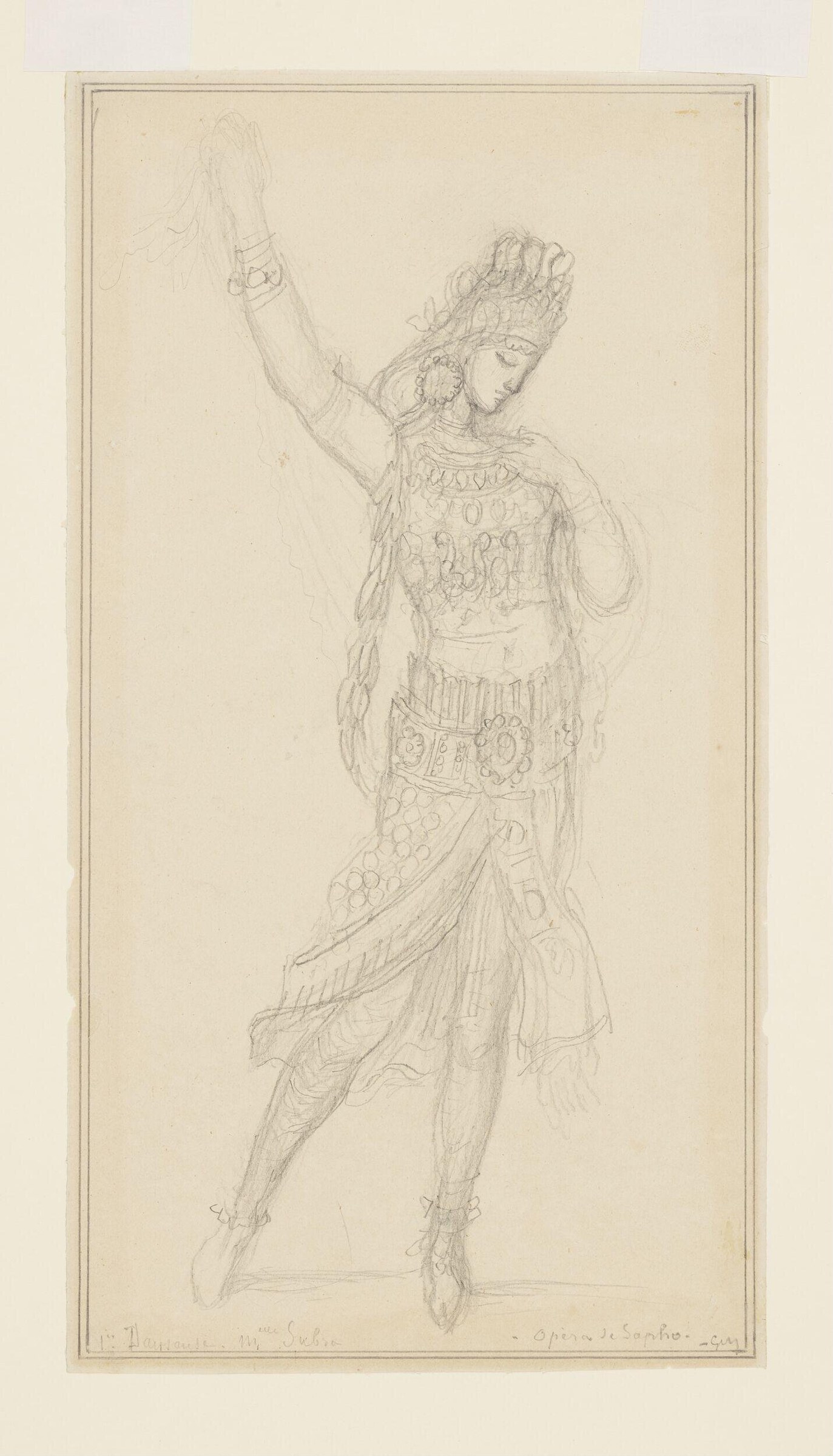
Costume design for a dancer in the opera Sapho
Moreau, Gustave
- Collection:
- Drawing
- Source:
- Victoria and Albert Museum
- Rights:
- Rights vary by item — check the source record before reusing this image. Source record ↗
- Recorded as:
- V&A — check rights per item
This drawing preserves direct evidence of how a major fine artist approached costume design for the stage, and what visual conventions governed female performers' bodies and dress in prestigious Parisian opera during the 1880s. For historians of theater design and dance, it documents both the ideal of classical grace that operatic choreography embodied and the collaborative relationship between studio artists and theatrical production.
What you are looking at
A single female figure dominates this vertical composition, rendered in graphite on cream paper with a ruled border. She stands in a contrapposto stance with her left leg bearing weight and her right leg extended, her left arm raised high overhead with an elegant upward sweep. Her head tilts away, her gaze directed downward with a composed, introspective expression. She wears an ornate classical or mythological costume: a richly decorated short tunic or peplos with geometric patterning and draped sections, layered bands at the waist, and an elaborate beaded or jeweled collar. Her hair is elaborately dressed, piled high and adorned. The figure has an ethereal, almost weightless quality; the raised arm and extended leg suggest motion arrested mid-gesture, yet her posture is controlled and deliberate rather than dynamic. The drawing emphasizes the contours of her body and the delicate folds of drapery with fine parallel lines and careful shading.
The dancing
The sole figure is a young woman posed in a classical contrapposto with her weight shifted to her left leg while her right leg extends with a gentle point. Her left arm rises vertically, creating a long line from shoulder to fingertip; her right arm hangs or curves naturally. The pose is vertical and frontal, with the torso facing slightly toward the viewer while the head turns away. The carriage suggests trained deportment—spine extended, chest open—rather than the momentum of active dance, though the raised leg and arm retain an elegance consistent with classical theatrical movement.
The dance depicted
This is a costume design rather than a scene of dance in progress. The inscription identifies it as a design for a dancer in the 1883 opera *Sapho*, likely either a principal role or a significant solo character. The classical costume—tunic, collar, and hairstyle—points to a Graeco-Roman idiom appropriate to that opera's mythological setting. The pose, while elegant and composed, does not depict a recognizable balletic or operatic technique; instead it presents the figure in a position of classical stillness that would be assumed during the opera's stationary passages or as a held tableau. The work documents stage costume and deportment in late-19th-century Parisian opera rather than a specific choreographic style.
How it was made
This is a graphite pencil drawing on laid paper, executed with fine parallel hatching to model form and suggest drapery. The ruled border is in a lighter hand, likely part of the sheet's preparation. No wash, ink, or color is visible. The technique is economical and linear rather than tonal—the artist prioritizes clear definition of contour and the silhouette of costume over atmospheric effects. This drawing was almost certainly a working design document for the theater workshop, intended for circulation among costume makers and production staff rather than for exhibition or sale; its condition and archival nature (now in an institutional collection) suggest it survived as part of the designer's working papers.
About this work
This is a costume design drawing by the 19th-century French symbolist painter Gustave Moreau for a dancer in the 1883 Paris Opera production of *Sapho*. Moreau, known for his richly decorated mythological and literary subjects, brought his distinctive visual language to theatrical design: classical drapery, intricate patterning, and an ethereal, timeless quality. The figure is drawn with elegant precision, posed in a composed classical stance that reflects the aesthetic conventions of operatic stage presence in the Gilded Age. The work is a primary document of late-19th-century opera design practice and of Moreau's engagement with performance culture.
How to look at it
Observe the artist's choice to arrest the figure mid-gesture: the raised arm and extended leg create a moment of classical poise rather than dynamic action, yet the pose remains alive and elegant. The ornamental precision of the tunic and collar reflects Moreau's obsessive decorative practice—every fold, every jeweled band is articulated. The turned-away head and downward gaze give the figure an inner focus, a psychological presence that transcends the static pose. This drawing was not meant to show how the dancer would move, but rather the visual authority and presence she would project in stillness.
The artist
Gustave Moreau (1826–1898) was a French Symbolist painter celebrated for elaborately detailed, jewel-toned mythological and literary compositions. His work was marked by an obsessive attention to ornament, precious materials, and the inner lives of legendary figures—especially women. Beyond his major paintings, Moreau designed for the theater and was deeply engaged with literary and artistic circles in Paris. His approach to costume design carried the same aesthetic principles as his easel work: an eye for decorative richness, classical reference, and psychological inwardness rendered through pose and expression.
The period
By 1883, operatic performance in Paris was at its height, with the Palais Garnier (opened 1875) as the grand showcase of the Third Republic's cultural ambitions. Grand operas often drew their plots from classical and medieval legend, and the visual presentation—set design, costume, choreography—was increasingly viewed as the equal of the libretto and score. Contemporary choreography for opera remained rooted in classical ballet vocabulary, but with a new emphasis on spectacle and the corps de ballet. Moreau's generation of fine artists (Degas, Renoir, and others) took serious interest in theater, and high-level costume design was a respected collaborative practice.
Where it lives
This drawing is held in an institutional collection and is catalogued as a working design document. The signature and inscription are visible on the sheet. The work survives as part of the historical record of Paris opera production in the 1880s.
Dance in this work
Questions about this work
Who was the dancer this was designed for?
The catalogue record does not identify the dancer. Archival records of the 1883 Paris Opera production of *Sapho* would be needed to match this design to a performer's name.
Did Moreau design many theatrical costumes?
Moreau was involved in theatrical design across his career, though such work occupied less of his time than his independent paintings. His theater designs are not as well documented as his major easel works, and many surviving examples are costume sketches like this one.
What does the pose tell us about late-19th-century operatic dancing?
The composed, upright contrapposto and classical reference point to a balletic aesthetic that valued stillness, verticality, and the classical body. The dancer was meant to embody a statuary ideal rather than to display virtuosic movement. This reflects the taste of Parisian opera in the 1880s, which valued elegant presence and elaborate spectacle over narrative dance action.
Why is Moreau's *Sapho* design relevant to dance history?
It documents the intersection of fine art and theatrical production, and shows how a major painter imagined the body and costume of an opera performer. It also reveals what the classical ideal looked like in practice: ornamental, poised, and psychologically inward.
More dance artwork





