49 works in this view — arrow keys or swipe to move between them.
Dance in Art
Costume for dancer in Romeo and Juliet
Georgiadis, Nicholas
- Collection:
- Theatre costume
- Source:
- Victoria and Albert Museum
- Rights:
- Rights vary by item — check the source record before reusing this image. Source record ↗
- Recorded as:
- V&A — check rights per item
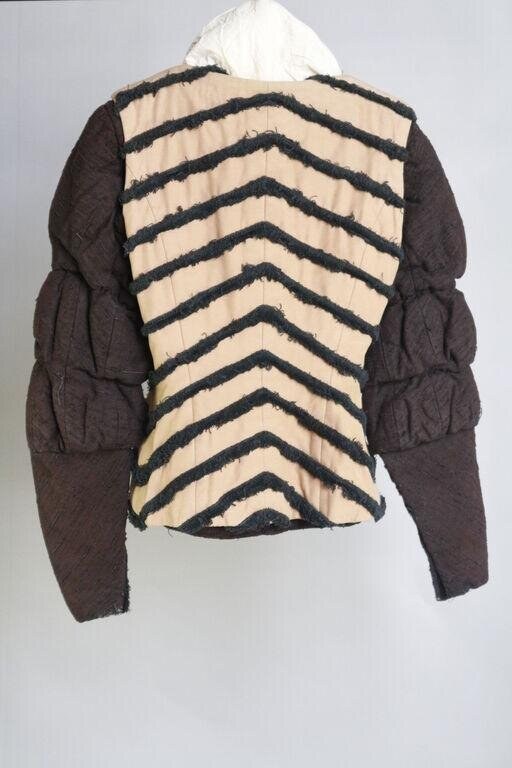
Georgiadis's costume design for *Romeo and Juliet* was a turning point in how ballet costumed Shakespeare—away from textbook Renaissance recreation and toward a more theatrical, abstracted language. This single jacket demonstrates his principle: the front may have been relatively plain (allowing the dancer's body and movement to be the primary visual focus), while the back tells a different story through bold graphic patterning. For historians of ballet design and dancers interested in how costume supports character and silhouette, it is a key artifact.
What you are looking at
A quilted jacket or doublet displayed on a dress form, shown from behind to display the back pattern. The garment is constructed in contrasting cream and dark brown or charcoal fabrics. The back features a striking geometric design of horizontal wavy or chevron stripes in dark thread or braid applied to the cream-colored lining, creating a bold visual rhythm. The sleeves are voluminous and gathered, quilted in the darker fabric, suggesting weight and structure. The shoulders are broad and structured. The garment appears designed to move with a dancer—the gathered sleeves would allow arm mobility while the corseted front (implied by the tailoring) would support the torso. A white garment or undergarment is visible at the neckline, possibly a chemise or collar piece.
The dancing
This is a costume piece rather than a depiction of a dancer in motion. The garment is cut to support an upright, formal carriage with broad shoulders and a defined waistline. The voluminous sleeves suggest a dancer who lifts and extends the arms expressively, as the gathered fabric would create visual extension and flow. The construction implies the wearer would stand with weight supported, with freedom to move the upper body—characteristic of classical ballet technique where the frame remains lifted and controlled.
The dance depicted
This is a costume for *Romeo and Juliet*, Nicholas Georgiadis's 1965 production design. The chevron-striped back panel is distinctive and theatrical, reading as heraldic or stylized armor-like patterning. The design suggests this may be a costume for a male dancer, possibly a courtier, guard, or secondary character in the Montague or Capulet households. The bold geometric back panel, visible to the audience when the dancer turns or moves upstage, indicates Georgiadis's approach to constructing character through abstract, graphic pattern—transforming fabric into visual symbol rather than representational detail. The quilted construction would provide some of the weight and rigidity expected in mid-twentieth-century classical ballet costume.
How it was made
This is a theatrical costume object, a constructed garment made by hand-stitching and quilting. The decorative striping is applied braid or cord sewn in place, creating dimensional texture. The quilting visible in the sleeves and body suggests hand-quilting or machine quilting, a labor-intensive technique that speaks to the production values of major ballet companies. The object's preservation in a theatrical collection indicates its status as a museum piece—an artifact of a specific production rather than a working costume in circulation.
About this work
This is a single costume piece from Kenneth MacMillan's 1965 *Romeo and Juliet* for the Royal Ballet, designed by Nicholas Georgiadis. It represents mid-twentieth-century classical ballet costume design at a moment when choreographers and designers were moving beyond literal historical recreation toward a more abstract, modernist vocabulary—using pattern, geometry, and color to suggest period and character rather than to copy it. Georgiadis was instrumental in this shift, designing costumes that were graphically bold and structurally inventive. This particular garment, with its striking back pattern, would have been highly visible in the formal court scenes that frame the ballet, reading instantly to an audience as aristocratic and ceremonial.
How to look at it
Look at the back panel first: the chevron striping is not naturalistic or representational, but it reads instantly as formal, hierarchical, and ceremonial. The way the pattern is applied in applied braid rather than printed fabric gives it texture and dimension—it would catch stage light and create visual interest in motion. Observe how the broad shoulders and voluminous sleeves would frame a dancer's upper body and arms, making extensions and turns more visually striking. Note the contrast between the dark quilted sleeves and the light striped back: Georgiadis used color and value to sculpt the body in space.
The artist
Nicholas Georgiadis (1923–2001) was a Greek-born British stage designer who became a dominant figure in Royal Ballet costume design from the 1950s onward. He worked closely with Kenneth MacMillan and Frederick Ashton, translating their choreographic visions into physical garments that were both historically informed and modernist in their sensibility. His approach combined scholarly attention to period detail with a graphic designer's eye for bold color, pattern, and silhouette. Georgiadis designed over 50 ballets and became known for his ability to create costumes that enhanced rather than restricted movement.
The period
The Royal Ballet's *Romeo and Juliet*, which premiered in 1965, was a watershed moment in classical ballet. MacMillan's full-length narrative ballet with Georgiadis's designs reinvigorated the form in Britain, moving away from the stylized, abstract ballets that had dominated the 1950s and reasserting the narrative and human drama at the heart of classical technique. Georgiadis's costumes for the work broke with earlier traditions of historical accuracy, instead using costume as a tool for visual and emotional storytelling. The abstracted patterning on this jacket is characteristic of the decade's broader move toward modernism in theater design—a synthesis of fine art abstraction with functional costume.
Where it lives
This costume is held in the Theatre costume collection at the V&A Museum. It is one of many pieces from major Royal Ballet productions acquired during the latter part of the twentieth century, documenting the evolution of British classical ballet design and practice.
Dance in this work
Questions about this work
What role did this costume belong to?
The costume record does not specify which character wore this jacket. Based on its formal, heraldic styling and the scale of the garment, it was likely worn by a male dancer in a courtier or guard role during the Montague or Capulet court scenes. The bold back panel suggests a character meant to be read instantly as high-status or ceremonial.
Why is the back pattern so different from what you would expect in a period costume?
Georgiadis deliberately moved away from historical literalism. The chevron striping is abstract and graphic rather than documentary—it works on stage as a symbol of formal rank and ceremony, and it catches light and reads from a distance. This modernist approach allowed ballet designers to communicate character and social status through visual language that worked in the theater rather than on the page.
How would this costume have moved?
The gathered sleeves would flare and extend with arm movements, creating visual emphasis and flow. The quilted body would maintain its shape, supporting an upright, controlled carriage—essential for classical ballet. The costume's structure would encourage the dancer to move with lift and extension, amplifying the formal, courtly bearing that the design communicates.
What makes Nicholas Georgiadis important?
Georgiadis was one of the most influential ballet designers of the late twentieth century. He proved that costume could be both historically informed and radically modern, and that a designer working closely with a choreographer could elevate narrative ballet from period spectacle to serious theatrical art. His work with MacMillan on *Romeo and Juliet* and other ballets redefined what ballet costume could do.
More dance artwork





