49 works in this view — arrow keys or swipe to move between them.
Dance in Art
Go-go dancer
unknown
- Collection:
- Costume design
- Source:
- Victoria and Albert Museum
- Rights:
- Rights vary by item — check the source record before reusing this image. Source record ↗
- Recorded as:
- V&A — check rights per item
Go-go dancing is a significant but often overlooked chapter in postwar American popular dance—a style that defined nightclub culture, youth fashion, and women's bodily autonomy on the dance floor in the 1960s and beyond. This sketch is a rare primary document of how the costume was engineered and understood by the people who made it, offering insight into the material and practical side of a performance style usually studied only through photographs or film.
What you are looking at
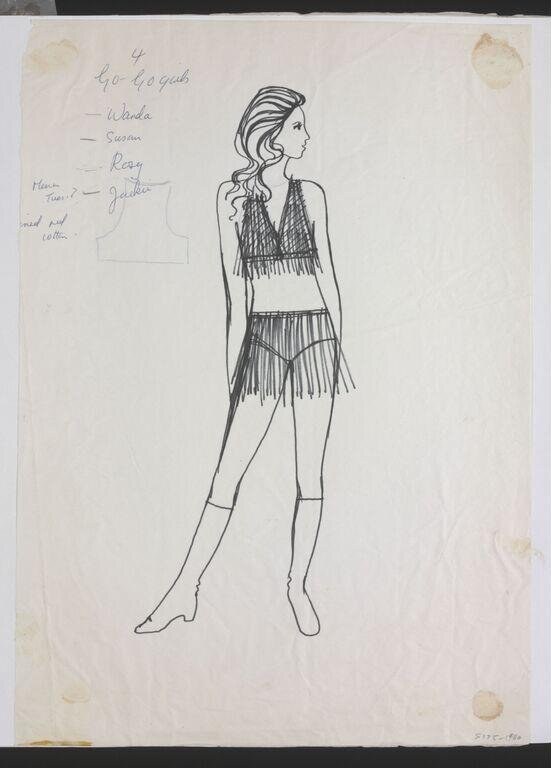
A fashion illustration of a woman in profile facing right, drawn in black ink on cream paper. She wears a fringed bikini-style two-piece costume: a halter top with long fringe and a low-slung hip skirt with prominent vertical fringing that falls to mid-thigh. Her hair is styled in a voluminous, crimped wave typical of the late 1960s–early 1970s. The figure stands with weight slightly shifted, one leg extended forward in a casual stance. The illustration is spare and graphic, with minimal shading; anatomical details are suggested through clean line work. Notations in pencil appear in the upper left margin, listing garment components ("go go boots," "blouse," "skirt," "Jacket") and fabric or construction notes ("fringe"). These working notes indicate this is a costume design sketch rather than a finished artwork.
The dancing
The single figure is drawn in a neutral contrapposto stance with weight on the back leg and the front leg extended slightly forward. The pose is frontal and display-oriented—typical of fashion illustration—rather than mid-motion. The body is long and linear, emphasizing the silhouette of the garment. The arms hang at the sides with minimal gesture. There is no dynamic movement or choreographic position; the figure presents the costume to the viewer.
The dance depicted
This is a costume design for a go-go dancer. Go-go dancing emerged in the early 1960s as a club dance style performed by women in bikini-style costumes on elevated platforms or in cages, typically in discotheques and nightclubs to energetic, repetitive pop and rock music. The costume—abbreviated two-piece with fringe, bare midriff, and go-go boots—is the defining visual marker of the style. The sketch does not depict the dancer in motion; rather, it is a technical study of the garment's construction and silhouette.
How it was made
This is a pencil and ink line drawing on paper. The sketch uses economical, confident line work to establish garment structure and anatomical proportion. Shading is minimal; the fringe is indicated through parallel lines rather than rendered tonally. The penciled notations in the margin are part of the working document, suggesting this is a preliminary or intermediate design sketch intended for a seamstress or pattern maker, not a presentation drawing. The technique is practical and functional rather than expressive.
About this work
This is a costume design sketch for a go-go dancer, dated 1970 and held in the costume design collection. It documents the visual language of go-go dancing at the height of its popularity—the abbreviated silhouette, the signature fringe detailing, the bare midriff, and the overall aesthetic of youthful, kinetic club culture. The sketch is utilitarian in intent, marked with notes on construction and materials, indicating it was part of the practical work of dressing performers. It belongs in a gallery of dance in art both as evidence of a significant subcultural dance practice and as a document of how the commercial dance costume industry served that practice.
How to look at it
Attend to the fringe: it is the dominant visual and kinetic element of the costume, and its placement and quantity are carefully notated. The fringe would move with any motion of the dancer's hips, torso, or legs, making it central to the visual effect of the dance. Notice also the proportion of the sketch—the high placement of the halter relative to the waistline, the brevity of the skirt—all choices that maximize visibility of the moving body. The penciled working notes remind us this is not art about dance but a tool for making dance possible.
The period
Go-go dancing became a mainstream phenomenon in the early 1960s, accelerated by the twist craze and the rise of discotheques as social spaces. By 1970, when this sketch was made, go-go dancing was an established form of nightclub entertainment, often performed by women in pairs or groups on platforms, sometimes in cages. The style was closely tied to the fashion and music industries and to broader shifts in sexual liberation and youth culture. The design sketch reflects the commercial systematization of the costume—no longer improvised but standardized, engineered, and documented as a technical specification.
Where it lives
This sketch is held in a costume design collection, suggesting it may have been retained by a designer, manufacturer, or company as part of a working archive. The collection identifier and source designation ("va") are recorded but provide limited information about the original context of creation or use.
Dance in this work
Questions about this work
What is go-go dancing?
Go-go dancing is a style of nightclub dancing that emerged in the early 1960s, typically performed by women in minimal two-piece costumes on elevated platforms or in cages. Dancers moved to energetic pop, rock, and soul music, often in pairs or small groups. The style became iconic of 1960s youth culture and discotheque nightlife and remains a significant subcultural dance form.
Why is this costume design significant?
It documents how the go-go costume was engineered and standardized by the commercial dance industry. The notation of specific garment components and materials shows this was a professional, repeatable design—not improvisation but industrial production. It is a rare glimpse into the practical, behind-the-scenes work of costume making for nightclub performers.
Who would have used this sketch?
The sketch was likely used by a seamstress, pattern maker, or costume manufacturer to produce the garment. The penciled notations indicate where and how the costume should be constructed, making it a working document in the production process rather than a finished artwork.
More dance artwork





