49 works in this view — arrow keys or swipe to move between them.
Dance in Art
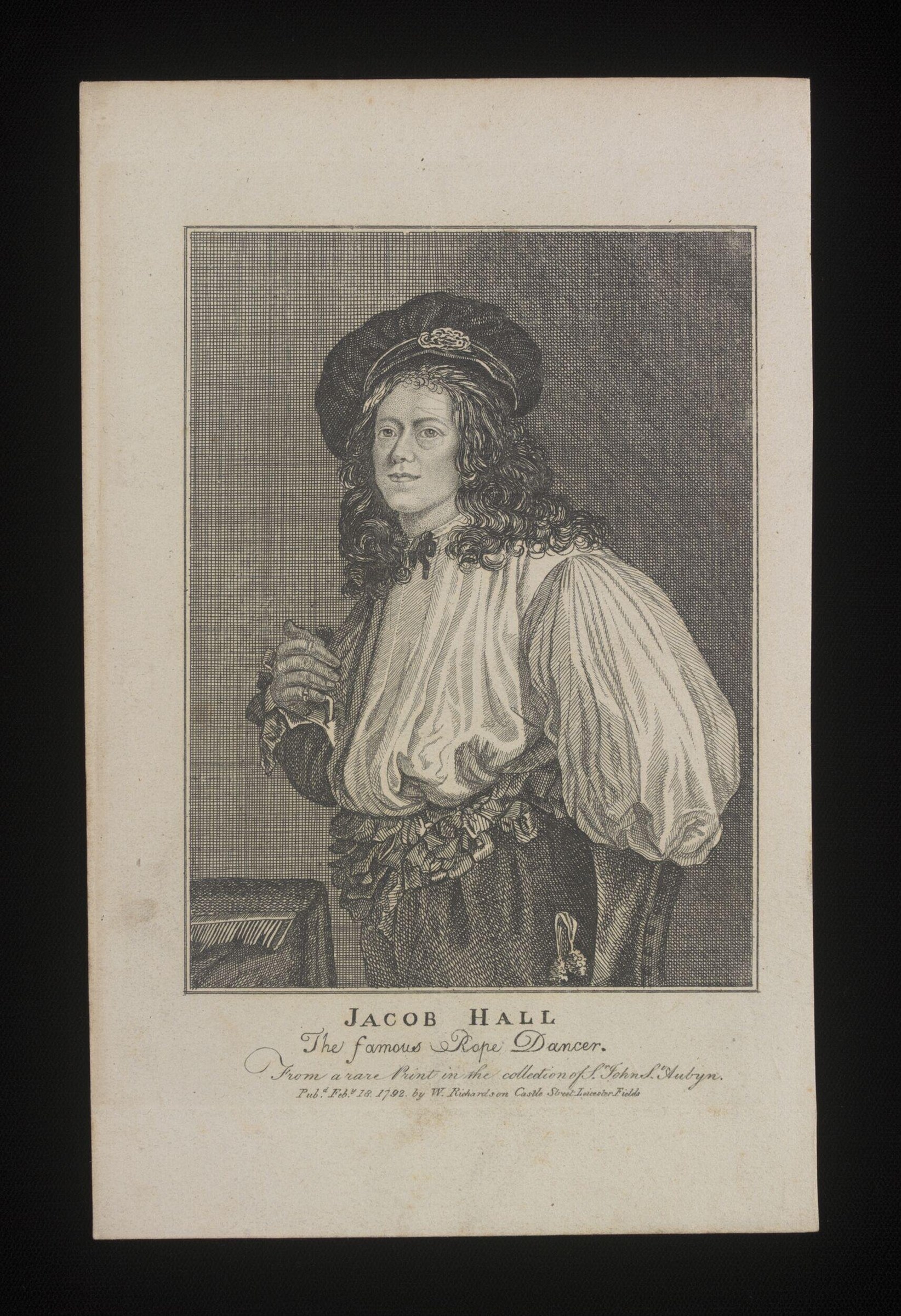
Jacob Hall/The Famous Rope Dancer
William Richardson
- Collection:
- Source:
- Victoria and Albert Museum
- Rights:
- Rights vary by item — check the source record before reusing this image. Source record ↗
- Recorded as:
- V&A — check rights per item
Jacob Hall is one of the few rope dancers from the seventeenth century whose name and face survive to the present. This engraving is among the only visual evidence of the costume, bearing, and cultural status of Restoration-era rope dancers, a performance tradition that flourished for a brief period and then largely disappeared. For historians of acrobatic arts and early modern entertainment, this portrait is irreplaceable documentation.
What you are looking at
A three-quarter-length portrait of a young man in fashionable late-eighteenth-century dress, shown against a neutral background with fine hatching to suggest depth. He wears a voluminous white linen shirt with full sleeves gathered at the wrists, dark breeches or stockings, and a dark coat or waistcoat. His long, curled hair is topped with a small dark hat adorned with what appears to be a jeweled clasp or ornament. His right hand holds a coil of rope—the attribute that identifies his profession—while his left hand rests naturally at his side. His posture is upright and composed, neither actively demonstrating movement nor frozen in an acrobatic position. The engraving is finely worked with careful attention to fabric texture, particularly the delicate rendering of the billowing shirt.
The dancing
A single standing figure, posed in a relaxed contrapposto stance. The weight appears evenly distributed, the body neither twisted nor in dramatic extension. The rope held in the right hand is coiled loosely, not taut or tense; this is a portrait pose rather than an action shot. The dancer's gaze is direct and calm, the expression composed and dignified. Nothing in the posture suggests active performance—the body is still, vertical, and formal.
The dance depicted
Jacob Hall was the most celebrated rope dancer of Restoration England, performing in the 1670s–1680s at venues including Bartholomew Fair and the Theatre Royal, Drury Lane. Rope dancing (or rope-walking) was a spectacular acrobatic feat combining balance, agility, and often music and costume; performers danced, jumped, and executed tumbling tricks along a suspended rope, sometimes at height. The subtitle describes Hall as 'famous,' indicating his renown; the 1792 publication date records him long after his death, as a historical figure of entertainment interest. This portrait presents Hall as a dignified professional rather than capturing him in performance—it is a memorial or commemorative image designed to preserve his likeness for audiences born after the age of rope dancing's great popularity.
How it was made
This is a finely worked line engraving, identifiable by the parallel hatching that creates tone and shadow, the crisp definition of contours, and the formal portrait format typical of the medium. The engraving was published in 1792 by W. Richardson of Cale Street, London Fields—information given in the cartouche beneath the image. Engraving was the dominant medium for mass-produced portraits and entertainment history in the eighteenth century, allowing multiple impressions to be made and distributed to a wide audience. The technique required considerable skill and time; the fine, regular hatching visible here demonstrates a highly trained hand. Such prints circulated among London's educated classes and are now primary documents of performance history.
About this work
This is a commemorative line engraving of Jacob Hall, the celebrated rope dancer of Restoration England, published in 1792—a century after Hall's death. The image preserves his likeness in fashionable contemporary dress, presenting him as a dignified professional entertainer rather than capturing him in the acrobatic act for which he was famous. It is a document of performance history, recording not how Hall actually danced but how the eighteenth century chose to remember him: as a celebrity worthy of printed portraiture, a founder of a now-vanished entertainment tradition.
Rope dancing was a spectacular acrobatic art form that reached its peak in England during the late seventeenth century, with Hall as its most famous exponent. This engraving is the rare surviving image of a major performer from that world, a world that has left few records. It belongs in a gallery of dance in art as a window into a lost performance tradition and as evidence of how dance and acrobatics were memorialized in popular print culture.
How to look at it
Notice that this is not an action image. The artist has chosen to show Hall standing still, holding the rope as an attribute rather than performing with it. This is the convention of portrait engraving: the subject is presented in their best light, dignified and recognizable, rather than caught in the moment of performance. The fine detail of the shirt and the careful attention to facial features are designed to make Hall memorable and to affirm his status as a celebrated professional. The rope is the only thing that marks him as a performer—without it, he would be indistinguishable from any gentleman of the period.
The artist
William Richardson was an engraver and print publisher active in London in the late eighteenth century, based in Cale Street, Chelsea. He produced portraits and historical commemorative prints for the London market; this work is part of a broader trade in engraved celebrity and entertainment history. Nothing substantial is recorded about Richardson's artistic training or practice beyond the prints that bear his name.
The period
By 1792, rope dancing as a live performance art had faded from English entertainment. The acrobatic spectacles that made Hall famous in the 1670s–1680s belonged to a world of fairs, playhouses, and street performance that changed as theatrical conventions evolved and circuses (with their own acrobatic traditions) emerged in the late eighteenth century. The decision to publish Hall's portrait in 1792 suggests antiquarian or nostalgic interest in entertainment history—a revival of curiosity about an older generation of performers. This was the era of Boswell and Johnson, when English popular history was being recorded and collected; entertainment figures were beginning to be treated as historical subjects worthy of preservation.
Where it lives
The catalogue record indicates this is a print held in a collection (source: va, likely the Victoria and Albert Museum). It was published in 1792 by W. Richardson of Cale Street, Chelsea. The inscription states it is 'From a rare Print in the collection of J. Dent, Adlwyn.'
Dance in this work
Questions about this work
What is rope dancing?
Rope dancing was a form of acrobatic performance in which a dancer walked, jumped, and executed tumbling tricks along a suspended rope. Performers often worked at height and in costume, sometimes accompanied by music. It was particularly popular in England during the seventeenth century and at fairs and playhouses, but the tradition declined by the eighteenth century as theatrical entertainment evolved.
Who was Jacob Hall?
Jacob Hall (c. 1646–1695) was the most celebrated rope dancer of Restoration England, performing in the 1670s and 1680s. He performed at Bartholomew Fair, Drury Lane Theatre, and other venues, and became a celebrity of his time. He is also remembered in the diary of Samuel Pepys. He died in 1695, making this 1792 engraving a posthumous portrait.
Why does the portrait show him standing still?
The engraving follows the convention of formal portraiture, which presents the subject dignified and recognizable rather than in action. The rope serves as his professional attribute—the symbol of his trade—much as a painter might hold a brush or a scholar a book. This formal approach was designed to give Hall respectability and permanence in print.
What is an engraving and why was it used for this portrait?
An engraving is made by incising lines into a metal plate (usually copper) and then inking and printing the plate on paper. It was the dominant medium for mass-produced portraits and historical prints in the eighteenth century. Multiple high-quality impressions could be made from a single plate, allowing the image to circulate widely and affordably among the educated public.
More dance artwork





