49 works in this view — arrow keys or swipe to move between them.
Dance in Art
Satiric Dancer
Kertész, André
- Collection:
- Photograph
- Source:
- Victoria and Albert Museum
- Rights:
- Rights vary by item — check the source record before reusing this image. Source record ↗
- Recorded as:
- V&A — check rights per item
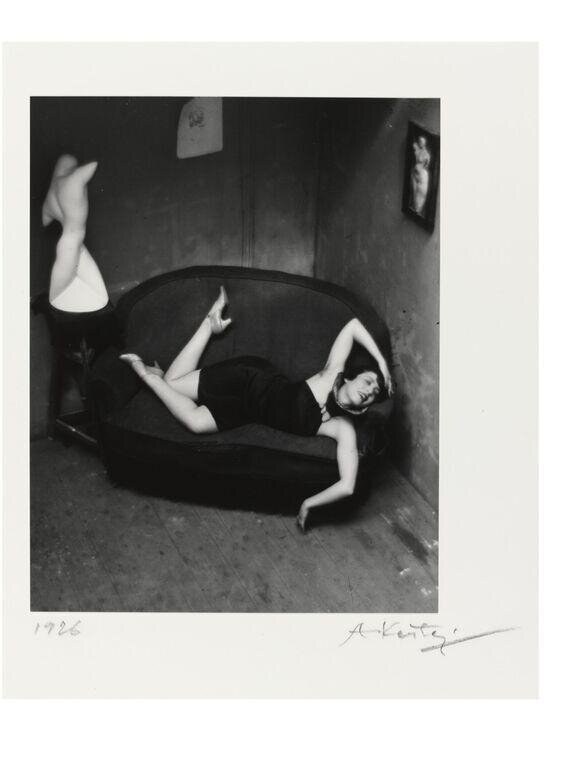
This image documents the modernist body—not classical ballet, not folk tradition, but the deliberate distortion and exaggeration of human form as artistic statement. For dancers and historians, it shows how early 20th-century photography revolutionized the way the moving or posed body could be studied and presented to an audience. The work raises a question central to 1920s experimental practice: what happens when you push the body to extremity, and what does satire of academic dance look like?
What you are looking at
A woman reclines in a large, deep armchair positioned in a stark interior space. She wears a dark dress and her body is twisted dramatically, with one leg extended upward and the other bent, her arms raised in an exaggerated, angular pose. The photograph is taken from above, emphasizing the sculptural quality of her posture. The setting appears institutional or austere—bare walls, minimal furniture, strong overhead light casting shadows. The pose is decidedly unnatural and theatrical, almost contorted, suggesting performance or deliberate artistic arrangement rather than repose. The black-and-white photograph captures a moment of extremity: the body pushed into an unusual configuration, held against the chair's geometry.
The dancing
A single female figure dominates the frame. Her spine is hyperextended or sharply arched, with her torso twisted to create a dramatic spiral through the chair. Her left leg extends nearly vertical, knee slightly bent, while her right leg curves downward; both limbs are long and the line through them exaggerates the torsion of her core. Her arms are raised and bent, elbows high, creating angularity in the upper body. The weight appears distributed unequally—the body is supported by the chair but seems to resist its geometry, creating visual tension. The pose shows facility with extreme flexibility and control of the spine, suggesting trained movement capacity rather than casual sitting.
The dance depicted
This is not a conventional dance pose, but rather a movement study or performance art rooted in the experimental theatrical movement of 1920s European modernism. The exaggerated distortion of the human figure and the title 'Satiric Dancer' suggest a critique of academic dance or body convention—the pose mocks or exaggerates the idealized body by pushing it to extremity. The early 20th-century avant-garde, particularly in Berlin and Paris where Kertész was working, explored the grotesque, the mechanical, and the anti-classical body. This appears to be contortion or movement research rather than a recognizable dance style, though it shares the spirit of expressionist and experimental theatre of the period.
How it was made
This is a photograph, almost certainly gelatin silver print from 1926, though the catalogue does not specify. The medium is crucial: photography's ability to freeze the body in an impossible moment creates an effect unavailable to painting or drawing. Kertész's photographic practice pioneered the idea of the photograph as artistic document and compositional object. The overhead angle and stark lighting are typical of his studio work from this period. Photography allowed him to capture the human body in positions impossible to hold for long and to compose them within architectural spaces with geometric precision.
About this work
This is an avant-garde movement study by the Hungarian photographer André Kertész, one of the twentieth century's greatest visual artists. Taken in 1926, it documents a contorted pose held by a female performer in an austere interior. The title 'Satiric Dancer' signals that this is performance or studied movement rather than casual posture—a deliberate exaggeration of the body's potential, likely in dialogue with the experimental theatre and dance of the 1920s avant-garde. The photograph itself is a work of composition: the body becomes a sculptural form arranged within the architectural space of the room, lit to emphasize its dramatic torsion. Kertész's photograph belongs in a gallery of dance imagery because it captures a moment when the visual exploration of the human body in extreme movement was central to modernist artistic practice.
How to look at it
Attend to the single moment of extreme torsion the photographer has frozen. Notice how the chair, a domestic and ordinary object, becomes a scaffold for the body—the pose works against the chair's geometry rather than with it. Observe the play of light and shadow: the overhead lighting casts the twisted torso into sharp relief, making the contortion unmistakable. The title 'Satiric' invites you to see this not as beauty but as exaggeration, even mockery—a deliberate pushing of the body beyond conventional limits. The composition is austere and formal, with the body filling the frame and the background reduced to bare walls, forcing all attention onto the impossible shape being held.
The artist
André Kertész (1894–1985) was a Hungarian-born photographer who moved to Paris in 1925 and became central to the modernist photography movement. He worked extensively with the human body, particularly in his studio work from the mid-to-late 1920s, often collaborating with dancers, performers, and artists. His approach was compositional and formal—he treated the body as shape and geometry rather than as a vehicle for narrative. Kertész was associated with the avant-garde circles of Paris and Berlin and worked in dialogue with modern dance, theatre, and sculpture. His photographs from this period are characterized by unconventional angles, attention to shadow and light, and a fascination with distortion and the grotesque.
The period
In 1926, European modernism was at a peak. In dance, this was the era of the Ballets Russes' late period, German Expressionist dance (Ausdruckstanz), and the early Soviet avant-garde. Photographers and visual artists were fascinated by the human body as a subject for formal experimentation—the body could be distorted, fragmented, reconfigured through the camera's lens. Satirical treatments of classical ballet and academic dance were common in avant-garde circles; there was a spirit of deliberate anti-classicism, rejection of the ethereal ideals of Romantic ballet in favor of the grotesque, the mechanical, and the exaggerated. Kertész's work sits within this broader exploration of modernist movement and the photographed body.
Where it lives
The photograph is held in a collection marked 'va' (Virginia), likely the Library of Congress or a similar public archive. The reference number 1926 on the print is likely the accession or identification number. The work is catalogued simply as a photograph by Kertész from 1926, with minimal additional description in the source record.
Dance in this work
Questions about this work
Is this a real dance?
Not a named or traditional dance style. The title 'Satiric Dancer' and the extreme contortion suggest this is an avant-garde performance or movement study—deliberately exaggerated posture intended as critique or artistic exploration rather than a dance to be learned or performed.
What can this body actually do?
The pose requires significant spinal flexibility and control, and the ability to hold an extreme arch or twist for the duration of the photograph. Whether the performer is a trained dancer, contortionist, or performer in another tradition is not documented, but the control and precision of the pose suggest training in movement.
Why is it photographed from above?
The overhead angle emphasizes the torsion and geometry of the pose, making the contortion of the spine unmistakable. It also flattens the figure against the chair, treating the body as shape and composition rather than allowing it to be read as natural or comfortable.
Who was the performer?
The catalogue record does not identify the performer. Kertész often worked with dancers and performers from the Paris avant-garde in the mid-1920s, but the name of this particular person is not recorded.
More dance artwork





