49 works in this view — arrow keys or swipe to move between them.
Dance in Art
The Mahalli Dancers
Unknown
- Collection:
- Poster
- Source:
- Victoria and Albert Museum
- Rights:
- Rights vary by item — check the source record before reusing this image. Source record ↗
- Recorded as:
- V&A — check rights per item
For dancers and historians, this poster documents a moment when Iranian and other non-Western dance traditions began to enter mainstream British theatrical venues—a shift with lasting consequences for how dance was taught, seen, and theorized in Britain. The image also reveals the visual grammar through which Western audiences were introduced to these traditions: the emphasis on individual virtuosity, colorful costume, and lyrical expressiveness, and the subordination of context, musicality, and cultural function to visual spectacle.
What you are looking at
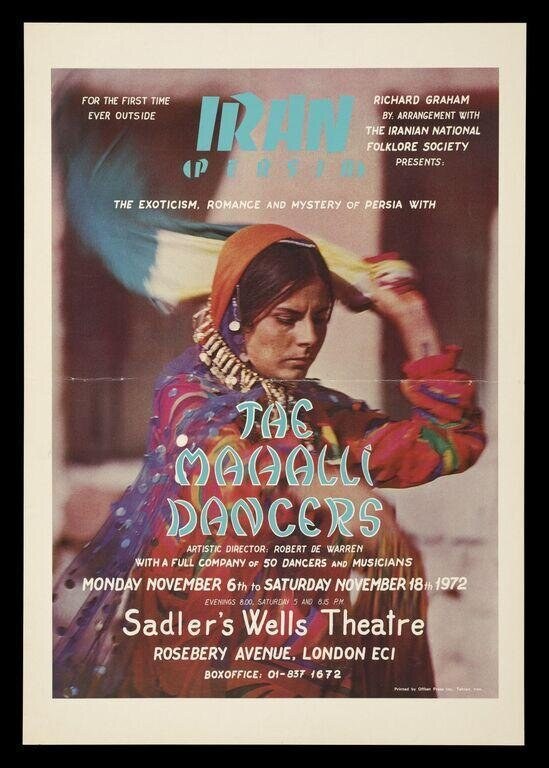
A poster advertising a theatrical performance of Persian dance. The composition centers on a single dancer in three-quarter profile, turning with raised arms. She wears a richly embroidered tunic or robe in deep crimson-red and royal blue, decorated with dense floral and geometric patterns in gold and jewel tones. A matching red headwrap frames her face, and she wears a large turquoise or blue jeweled earring. The background is a warm, muted brown-mauve, creating dramatic contrast with the vivid costume. The lighting is theatrical and soft, modeling the face and upper body to suggest the performer mid-movement. The dancer's posture—spine curved, arms lifted asymmetrically—suggests a moment of lyrical turning or rotation. The overall aesthetic is one of exoticized orientalism typical of early 1970s Western theatrical production: the image presents Persian dance as ornamental, colorful, and physically expressive.
The dancing
A single female dancer dominates the frame. Her weight appears centered over her legs, which are slightly apart in a stable stance suited to the rotation suggested by her arm position. The upper body leads the movement: her head is tilted, chin slightly forward, and both arms are raised and extended—the nearer arm higher and more bent, the far arm lower—in a gesture that reads as a spiral or turning motion through the torso. The posture is neither rigidly formal nor balletic; it suggests a more fluid, torso-centered articulation of the body. The visible musculature and the ease of the arm placement suggest training and control, though not the rigid turn-out and vertical alignment of classical ballet.
The dance depicted
This is almost certainly a theatrical presentation of Persian or Iranian folk and classical dance traditions, presented under the rubric of "The Mahalli Dancers." The term *mahalli* refers to traditional Persian dances associated with domestic or non-courtly settings, performed to traditional music. The costume—the embroidered robe, the wrapped headwear, the jewelry—is consistent with documented styles of Iranian classical and regional dance dress. The pose itself, with its emphasis on rhythmic turning and arm gestures, aligns with movement vocabularies found in Persian dance, particularly the flowing, torso-led quality visible here. The 1972 date and the involvement of the Iranian National Folklore Society suggest this was a cultural presentation aimed at introducing Western audiences to Iranian dance traditions, part of a broader 1970s trend of non-Western dance touring in Britain.
How it was made
This is a lithographic theatre poster, a medium well suited to vibrant color printing and mass distribution. The color palette—the vivid reds, blues, and golds of the costume rendered with saturated intensity against the warm, muted background—is characteristic of hand-drawn lithography or color lithography of this era. The soft modeling of the figure, the painterly quality of the background, and the way color registers slightly offset at the edges all suggest lithographic printing. As a poster for a West End theatre (Sadler's Wells), this would have been printed in a modest edition for public advertisement, making it an ephemeral document of both the performance and the aesthetics of 1970s British theatrical promotion.
About this work
This is a theatre poster for a 1972 London performance by the Iranian National Folklore Society, presenting a company of dancers and musicians in works drawn from Persian dance traditions. The poster presents a single female dancer in a moment of lyrical turning, her richly embroidered costume and controlled, flowing movement language advertising the event as an encounter with Iranian cultural aesthetics. The image is both a document of a specific historical performance and a lens on Western attitudes toward non-Western dance in the early 1970s: it frames Persian dance as visually exotic and ornamentally appealing, emphasizing color and costume over the deeper structural and musical aspects of the tradition. The poster circulated as popular advertising in London's West End and represents the moment when performances of non-European dance traditions began to find sustained audiences in British theatre.
How to look at it
Attend to the pose and what it tells you about the dance's movement vocabulary. The dancer is not standing in turnout or in a closed balletic position; instead, her stance suggests weight that can move easily through the feet, and her arm position is asymmetrical and fluid rather than geometric. The turning motion suggested by her posture—the spiral through the spine and the trailing arm—indicates a dance that values rotation and circular motion through the body. Look at the costume not as decoration alone but as evidence of a specific tradition: the weight and drape of the embroidered robe, the way the headwrap frames the face, and the prominence of jewelry all suggest a movement language that engages the whole body, including the head and neck, in ways distinct from European ballet or modern dance. Notice also what the poster omits: there is no suggestion of the music, the ensemble context (though 50 dancers are promised), or the ritual or social function of the dances.
The artist
The poster credits Robert de Warren as artistic director and notes the involvement of the Iranian National Folklore Society. Little is known from the image alone about de Warren's broader practice or the Society's institutional history. The poster's design and lithographic execution would have been handled by a commercial theatre-poster studio; no individual designer is credited. The visual idiom—saturated color, painterly light, focus on a single virtuosic figure—is consistent with mid-century Western theatrical poster design adapted for marketing non-Western performance to Western audiences.
The period
In the early 1970s, London's theatres were beginning to book performances by dance companies and ensembles from the Global South and non-Western traditions, part of a broader opening of British cultural institutions to international programming. This occurred alongside the growth of world music festivals, ethnographic dance documentation, and increased academic interest in comparative dance studies. At the same time, the visual presentation of these performances often filtered them through orientalist and exoticist lenses, emphasizing spectacle and individual beauty over structural or cultural understanding. The Sadler's Wells Theatre, as a major London venue, was a significant site for such presentations. In 1972, when this poster was printed, such cross-cultural theatrical exchange was still relatively novel and carried substantial novelty and marketing value in the West.
Where it lives
This is a printed theatre poster from the 1972 performance at Sadler's Wells Theatre on Rosebery Avenue, London. It survives as part of the V&A's collection of theatre ephemera and cultural documentation. As a commercial advertisement, it was produced in an edition likely numbering in the hundreds, making it a relatively common survivor within theatre archive collections.
Dance in this work
Questions about this work
What is mahalli dance?
*Mahalli* refers to a category of traditional Persian dances, originally associated with domestic or social settings as opposed to courtly contexts. The term encompasses a range of regional and stylistic variations within Iranian dance traditions, many of which emphasize rhythmic footwork, turning, hand gestures, and responsiveness to live music. In the 1970s, when this performance took place, Western audiences would have had very limited exposure to these traditions, making this poster a document of cultural translation.
Was this a major event in dance history?
Not in the sense of revolutionizing dance technique or theory in the West. Rather, it was one of many performances that, collectively, began to shift what British audiences understood as dance and to challenge the dominance of European ballet and modern dance aesthetics. Such events were part of a larger 1970s opening toward world dance documentation and celebration, though often filtered through orientalist framings of the kind visible in this poster's visual language.
Who designed this poster?
The poster credits Robert de Warren as artistic director of the performance, but no graphic designer or illustrator is named. The lithography would have been executed by a commercial print studio; such credits were commonly omitted from theatre posters of this era. The visual style is consistent with mid-century British theatrical poster design.
More dance artwork





