49 works in this view — arrow keys or swipe to move between them.
Dance in Art
Choi Seung-Hee
von Behr, Hans A.
- Collection:
- Photograph
- Source:
- Victoria and Albert Museum
- Rights:
- Rights vary by item — check the source record before reusing this image. Source record ↗
- Recorded as:
- V&A — check rights per item
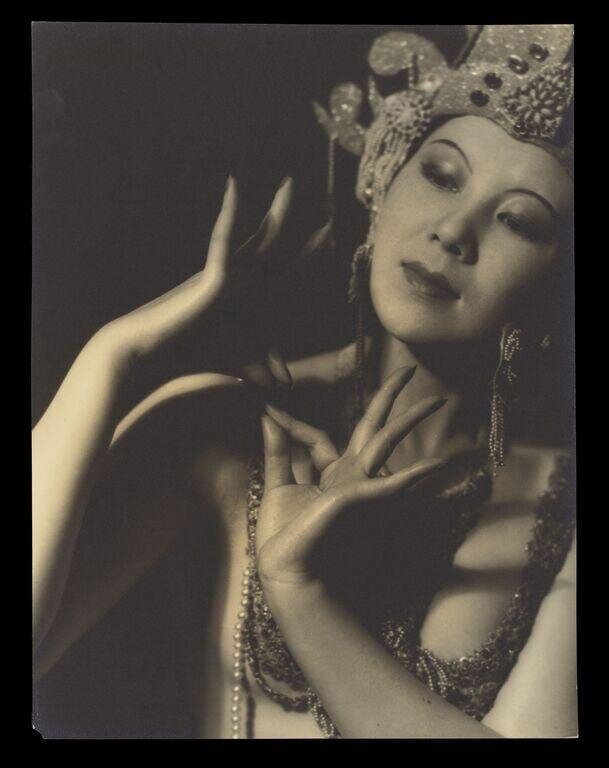
Choi Seung-Hee was one of the first Korean dancers to achieve international recognition and to successfully navigate between Korean classical traditions and European modernist aesthetics. This photograph is an important document of her presence and prominence in 1930s Europe, capturing her at a moment when she was reshaping how Korean dance could be understood and valued on the world stage. For historians of dance, photography, and cultural modernism, the image raises questions about how non-Western dancers were documented, presented, and consumed in European contexts.
What you are looking at
A female dancer in elegant repose, photographed against a dark background in a studio setting. She wears an ornate costume suggesting East Asian classical or court dance: a richly embellished bodice or jacket with beaded or sequined detail, and what appears to be a decorative headdress or crown with geometric patterning. Her posture is graceful and composed, with one arm raised in a curved, expressive gesture while the other rests near her body. Her gaze is directed downward in a serene, introspective expression. The photograph is a formal studio portrait, carefully lit to model the face and upper body. The costume and styling suggest this is a professional dancer documented in character or in performance dress rather than street clothes.
The dancing
A single dancer frames the composition, her weight settled in a standing position suggesting neither active movement nor rigid stillness but rather the poised readiness of a trained performer at rest. The raised arm curves gracefully from shoulder to hand, demonstrating flexibility and control; the forearm is slightly bent in a line typical of classical Asian dance vocabulary. The head is held with dignity, tilted very slightly downward. The torso is upright and open to the camera. Her bearing suggests training in a formal tradition that values elongation, control, and expressive arm and hand placement.
The dance depicted
The costume and carriage suggest East Asian classical dance, most likely Korean court or theatrical dance traditions given the styling of the headdress and the formal embellishment of the garment. The dancer's name in the catalogue is Choi Seung-Hee, a renowned Korean dancer who was active in the early 20th century and famous for her innovative fusion of Korean classical dance with modern theatrical presentation. The photograph documents not an active moment of choreography but rather a posed portrait of the dancer in costume, the convention by which studio photographers in this period presented performing artists to the public. The formal, contemplative pose was typical of how female classical dancers were presented in portraiture of the 1920s–1930s.
How it was made
This is a studio photograph, likely gelatin silver print or similar period photographic process, given the tonal range, grain, and vignetting. The photographer Hans A. von Behr was a Berlin-based portrait photographer active in the early 20th century, working in the German modernist tradition. The photograph's formal studio setting, careful side lighting to model the face and costume, and professional printing suggest this was commissioned portraiture intended for circulation—likely as promotional material for a dancer on international tour or for publication in theatre journals and press. The sepia toning and soft focus on the background are typical choices of the period, emphasizing the subject while suppressing the studio environment.
About this work
This is a professional portrait photograph of a dancer in costume, taken in a Berlin studio in 1930 during a period when non-Western performing artists were increasingly touring and being documented in European photographic practice. The subject is Choi Seung-Hee, a pivotal figure in early 20th-century Korean dance who brought classical Korean movement to international audiences and helped establish it as a modern theatrical art. The photograph is both a document of her presence in Germany and a work of portraiture that follows European conventions of presenting the exotic performing body—posed, composed, and carefully lit for aesthetic effect.
The image sits at the intersection of dance history, photography history, and the complex history of cultural exchange and exoticization in early modernism. It represents how non-Western dancers were made visible to European and American audiences in this period, and how photography became a primary medium for circulating and celebrating their work. The formal pose and studio context differ from action photography of European dancers, reflecting both period photographic convention and the particular cultural positioning of Asian dancers in Western exhibition.
How to look at it
Observe the costume detail—the embroidered or beaded surface of the jacket and the geometric patterning of the headdress—as markers of a specific cultural tradition rather than generic exotica. Notice how the photographer has used side and slightly overhead lighting to create depth in the face and to make the surface richness of the costume visible. The downward gaze and the curved arm position represent a deliberate choice to show the dancer in a moment of composed introspection rather than in active movement; this was a common strategy for presenting female performers as objects of contemplative beauty. The studio background, entirely suppressed into darkness, focuses all attention on the figure, a technique that emphasizes presence and removes any context that might complicate the image.
The artist
Hans A. von Behr (1891–1966) was a German portrait photographer based in Berlin, known for his formal studio portraiture of performing artists, musicians, and theatre personalities during the Weimar era and beyond. His practice was rooted in the German photographic modernism of the 1920s–1930s, which emphasized psychological presence, careful light modeling, and the expressive potential of the human face. Von Behr was among photographers who documented major non-Western performing artists during their European tours, helping to make them visible to German and international audiences.
The period
The 1920s and 1930s saw significant international touring by Asian classical dancers, including Choi Seung-Hee, who became celebrated figures in Berlin and Paris. This period coincided with European modernist fascination with non-Western movement vocabularies, evident in the work of choreographers like Mary Wigman and others who drew inspiration from Asian dance while often essentializing or romanticizing it. Simultaneously, photographers and publicists in major European cities were creating a visual archive of these performers, using studio portraiture to present them to audiences through concert programs, publications, and exhibition. The photograph reflects both the genuine artistic achievement and the Orientalist framing that typically accompanied such documentation.
Where it lives
The photograph is held in a collection listed as 'va' (likely the Vademecum archive or a similar institutional source) and is catalogued as a photograph without further specific medium description recorded. It documents a moment during what appears to have been Choi Seung-Hee's period of touring and performing in Berlin in 1930.
Dance in this work
Questions about this work
Who was Choi Seung-Hee?
Choi Seung-Hee (1911–1969) was a pioneering Korean dancer who brought classical Korean dance traditions to international audiences in the early 20th century. She studied both traditional Korean court dances and modern European dance, and became famous for her innovative fusion work. She performed extensively in Europe in the late 1920s and 1930s, including in Berlin where this photograph was taken, and was one of the first Asian dancers to achieve major international recognition. She later returned to Korea and became an important figure in establishing modern Korean dance as a theatrical art form.
What dance tradition does the costume represent?
The headdress, embellished jacket, and overall styling suggest Korean classical or court dance traditions, such as the elegant court dances preserved and performed in the Korean royal tradition. The elaborate beading and geometric patterning of the headdress and costume are characteristic of Korean classical performance dress. However, this photograph documents the dancer in a studio portrait rather than in active performance, so it shows costume presentation rather than movement technique.
Why was this photograph taken in Berlin?
Choi Seung-Hee toured extensively in Europe in the late 1920s and 1930s, performing in Berlin, Paris, and other major cities. These tours were significant moments in European modernist culture, as Western artists and audiences were fascinated by non-Western movement vocabularies. Berlin was a major cultural center during this period, and photographers like von Behr documented important visiting performers as part of the city's vibrant theatre and dance scene.
What does the downward gaze and posed arm position tell us?
The contemplative pose—downward gaze, curved arm, settled stance—was a typical convention for how female performers were posed for studio portraiture in this era. It presented the dancer as composed, graceful, and available for aesthetic contemplation rather than as an active agent. This framing reflects both the aesthetic conventions of 1930s European photography and the particular way non-Western female performers were often presented to European audiences: as objects of visual beauty rather than as skilled technicians of their traditions.
More dance artwork





