49 works in this view — arrow keys or swipe to move between them.
Dance in Art
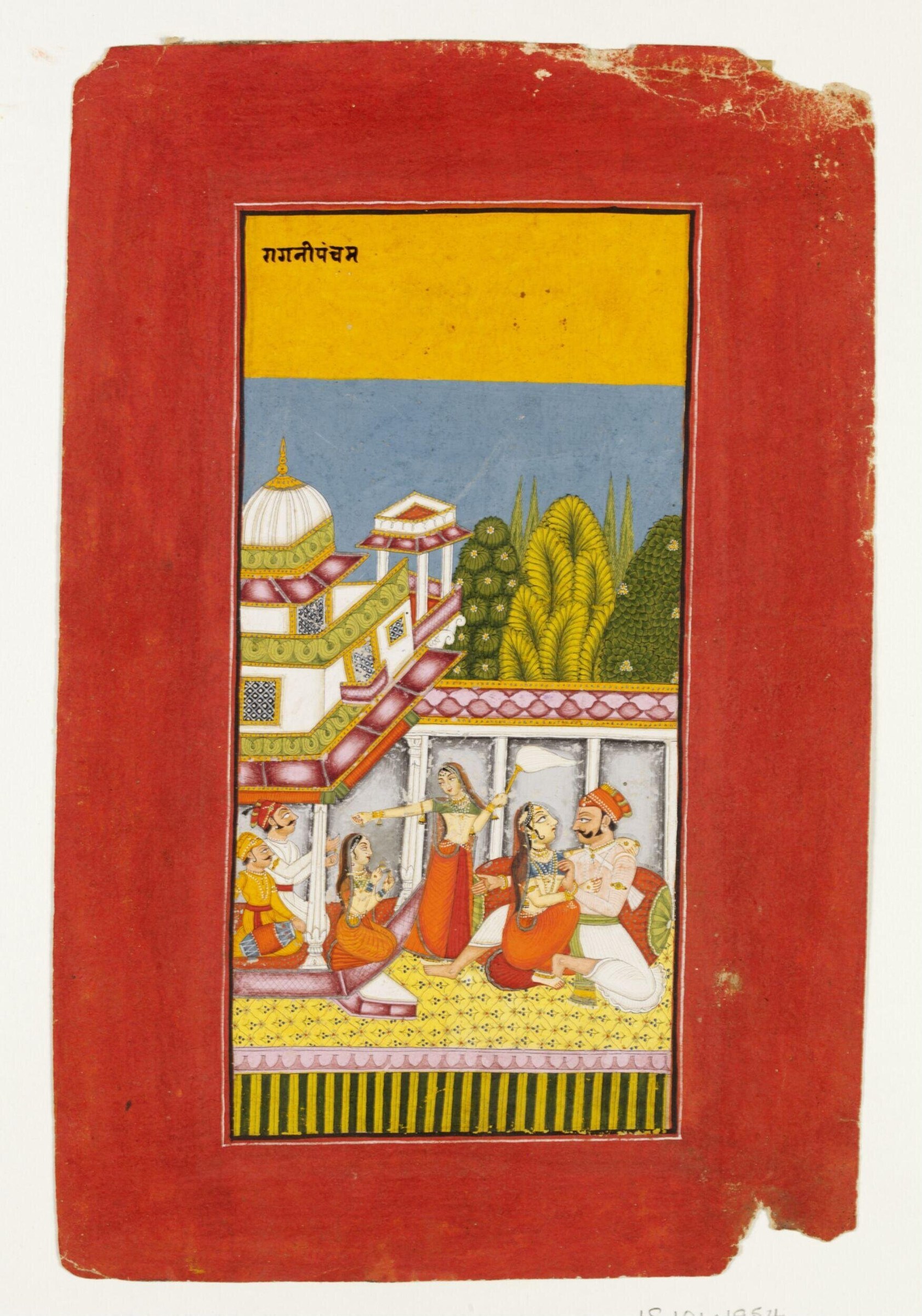
Pancham Ragini
Unknown
- Collection:
- Painting
- Source:
- Victoria and Albert Museum
- Rights:
- Rights vary by item — check the source record before reusing this image. Source record ↗
- Recorded as:
- V&A — check rights per item
This work documents a performing tradition—the rāginī cycle—that shaped South Asian dance and music for centuries and remains foundational to classical Indian forms like Kathak and Odissi. For dance historians, it is one of the few contemporary visual records of how rāginī was staged, framed, and valued in the royal courts that patronized it, and what the relationship between performer and audience looked like in a pre-modern courtly setting.
What you are looking at
A royal or noble interior unfolds across two registers of a manuscript page painted in the Mughal or Rajasthani tradition. The upper half shows a palace pavilion with domed architecture, its white walls articulated with geometric tilework and crowned by a golden finial; the sky above is rendered in flat yellow-gold, establishing courtly artificiality. Below, in the main scene, a performance takes place in a columned chamber: five figures occupy the space—two seated women to the left in jeweled dress, a central male musician or dancer in red robes (possibly with a turban), and two standing or kneeling attendants to the right. The floor is tessellated in yellow with a delicate pattern; cushions are arranged for seating. The figures are densely patterned with gold leaf and pigment; their faces show the flattened perspective and precise eye-line characteristic of Mughal court painting. A servant stands at the threshold to an outer chamber. The scene reads as a moment of intimate entertainment—musical and choreographic—within the private quarters of a palace.
The dancing
The central performer (likely male, in red) appears to be demonstrating movement to an audience of seated and standing nobles. His posture is upright and formal, without the extreme contrapposto of European dance painting. The attendant figures maintain a respectful distance and observational stance; weight is distributed in standing poses suited to court formality rather than dynamic engagement. The two seated women follow the performance with attention; their own poses are composed and hierarchical. No closed holds or partnered embrace appears. The spacing and stillness of the figures suggest a performance mode in which one dancer or musician commands attention while others observe—a court entertainment structure rather than participatory social dance.
The dance depicted
This is a depiction of *rāginī* performance, a classical Indian tradition of improvised dance and music associated with a specific rāg (melodic mode) and emotional affect. The Hindi text at the top of the page identifies this as *Pancham Ragini*—the rāginī of the fifth tone—one of the systematized female personifications in the classical rāg system. The Mughal and later Rajasthani courts employed accomplished dancers (often called *devadāsī* or court entertainers) to perform rāginī cycles for the delectation of nobles. This image captures not a social or participatory dance but a staged, hierarchical performance: the dancer embodies the rāg through gesture, face, and subtle movement of the torso and limbs, while the audience receives the performance in stillness. The rāginī tradition merged music, drama, and dance into a single refined spectacle.
How it was made
This is a page from a *Ragamala* series—a manuscript cycle illustrating the rāgs and rāginīs of classical Indian music. The work is painted in opaque watercolor and gold leaf on paper, using the bright, flattened color palette and ruled compositional grid typical of Mughal and Rajasthani court manuscripts of the 16th–18th centuries. The technique allowed for rapid production of illustrated manuscripts for courtly or merchant libraries; the gold leaf would have been burnished to catch light and assert the luxury and prestige of the owner. The ruled borders and framing indicate this was a bound volume rather than a single sheet. Such manuscripts were treasured objects, handled by an educated elite familiar with both music and painting.
About this work
This is a page from a *Ragamala* manuscript depicting *Pancham Ragini*, a classical Indian rāginī performance in a Mughal or Rajasthani court setting of the 18th century. The image shows a solo performer in jeweled court dress demonstrating the rāg to a seated and standing audience of nobles within a columned palace chamber. The work belongs to a long tradition of illustrated music manuscripts that merged text, music theory, and visual representation of dance and performance as a unified courtly art. *Ragamala* cycles were prized possessions, and this painting exemplifies the sophistication of Indian court aesthetics before the disruption of European colonialism.
How to look at it
Attend to the stillness and composure of the performer's posture, which differs markedly from the dynamic movement captured in European dance paintings of the same period. The rāginī performer holds a frontal, nearly ceremonial stance; the dance unfolds in the face, the eyes, subtle shifts of weight, and small gestures of the hands and arms rather than in large spatial trajectories. The use of the ruled frame and the compressed interior space (the palace pavilion above, the performance chamber below) reflects the Mughal convention of showing layered courtly spaces in a single view. Notice also how the performer is isolated and centered—emphasized by the geometry of the architecture—while the audience members are arranged in respectful subordination, a visual language expressing the hierarchy of court performance.
The period
The *Ragamala* tradition of illustrated manuscripts flourished in Mughal and Rajasthani courts from the 16th to 18th centuries, at a time when the Mughal empire was at its height and had established a cosmopolitan artistic synthesis of Persian, Central Asian, and Indian court culture. Dance and music occupied a central place in imperial entertainment and were subjects worthy of detailed artistic attention. The rāginī system itself is ancient (mentioned in texts like the *Natyashastra*), but its visual codification in manuscript cycles reflects a post-Mughal intensification of court spectacle and connoisseurship. By the 18th century, such manuscripts were being produced for regional courts and wealthy merchants across northern and central India, indicating the prestige and market value of the rāg system as an educational and aesthetic object.
Where it lives
This work is part of a *Ragamala* manuscript, likely from a private courtly or merchant collection in northern or central India. The collection slug 'va' suggests it is held in a public institution, though the specific holding and accession are not documented in the catalogue record.
Dance in this work
Questions about this work
What is a *Ragamala* and why are these manuscripts important?
*Ragamala* means 'garland of rāgs' and refers to illustrated manuscript cycles depicting the classical rāgs and rāginīs of Indian music theory. Each rāg was understood to embody a specific emotional mood (rasa) and was associated with a time of day, season, and often a female personification (the rāginī). These manuscripts were prized educational tools in royal courts, combining visual art, music theory, and performance documentation in a single object. They reveal how Indian courts understood the relationship between music, dance, and emotion.
How is rāginī dance different from the classical Indian dances we know today?
Rāginī was a court performance tradition centered on the embodiment of a single rāg through gesture, facial expression, and subtle movement of the upper body, rather than on complex footwork or narrative drama. The tradition blended music, dance, and drama and was performed by entertainers (often called *devadāsī*) for royal audiences. Over time, elements of rāginī were absorbed into later classical forms like Kathak and Odissi, but the pure rāginī cycle as a systematic performance tradition declined after the fall of royal courts in the colonial period.
What does the text at the top of the painting mean?
The Hindi inscription reads *Pancham Ragini*, identifying this as the rāginī of the fifth tone (pancham) in the classical rāg system. In rāg theory, each of the five or six primary tones (swaras) was associated with a female personification and a specific emotional and seasonal character. By naming the rāg on the page, the manuscript functioned as both a visual and educational text for musicians and dancers learning the classical system.
More dance artwork





