49 works in this view — arrow keys or swipe to move between them.
Dance in Art
Page
Unknown
- Collection:
- Page
- Source:
- Victoria and Albert Museum
- Rights:
- Rights vary by item — check the source record before reusing this image. Source record ↗
- Recorded as:
- V&A — check rights per item
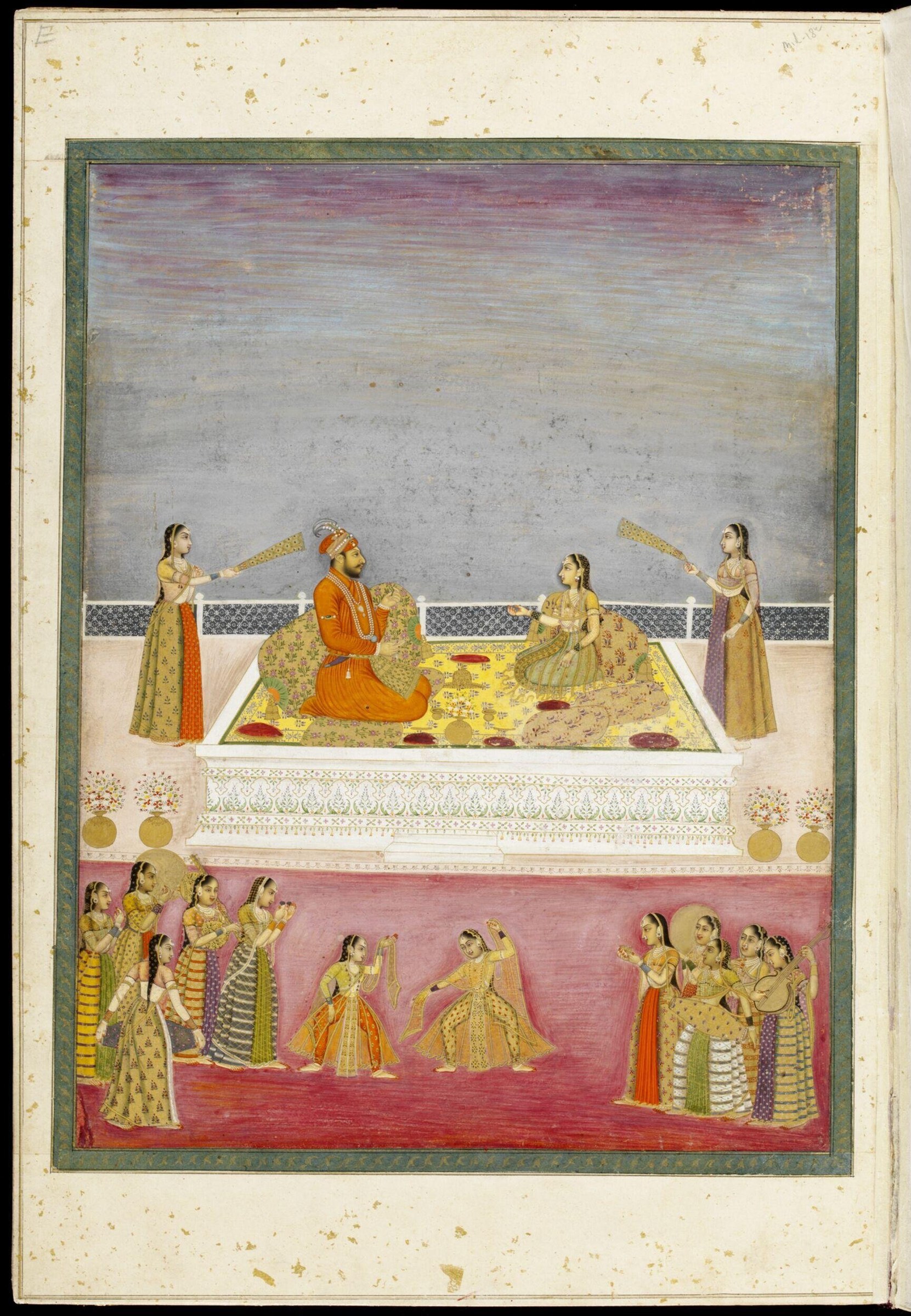
This page is primary visual evidence for the performance context and costume of court-based dance in early eighteenth-century India, before colonization disrupted these traditions. It shows dance not as an isolated technique but as part of a complete courtly ceremonial life, and it records the appearance of classical musicians and dancers in their original setting with a specificity that later written sources do not provide.
What you are looking at
This is a page from an illustrated manuscript depicting a court entertainment or celebration, likely from a royal or noble household in 18th-century India. The composition divides into two registers separated by decorative borders. In the upper section, a noble figure in orange robes sits on a yellow patterned carpet flanked by two attendants holding long fans or chauris. The seated figure wears a jeweled turban and is attended by two standing women in richly patterned silks. The lower register shows a lively scene of court musicians and dancers—approximately a dozen figures in brilliant yellows, greens, and orange silks—some playing instruments, others in active movement or conversation. The setting is a palace interior with pale blue-grey sky above, white marble or stone platform, and a deep pink/mauve ground plane below. The palette throughout is jewel-toned: deep purples, golds, reds, and greens, with fine gold leaf used for decoration and detail.
The dancing
The seated central figure dominates through stillness and formality, holding an upright posture that commands the scene. The standing attendants beside him maintain balanced, graceful poses with one arm raised holding fans in a gesture of service. In the lower register, the dancers and musicians show varied positions: some stand in clusters in conversation or observation, while others are caught in active poses—a pair appear to be in a dance hold or embrace, and individual figures show bent knees and turned bodies suggesting movement through space. The attendants flanking the noble adopt a symmetrical, formal frame; the dancers below move asymmetrically and with apparent spontaneity.
The dance depicted
This appears to document court dance and music entertainment in a royal or noble household of Mughal or Deccan sultanate India, circa 1720. The lower register shows what is likely kathak or similar North Indian classical dance in its court context—the costumes, jewelry, and setting are consistent with Mughal court practice. The figures in the lower register demonstrate the social structure of performance: some are musicians or attendants, while others engage in what appears to be ensemble or individual dance. The seated figure above may be the patron or ruler for whom the entertainment is staged. The painting records not the technical vocabulary of the dance but its courtly context and the festive atmosphere surrounding performance.
How it was made
This is a leaf from an illustrated manuscript, executed in gouache and gold leaf on paper, a standard technique for Mughal and related Indian court manuscripts of the period. The flatness of the composition, the precise line work, the decorative borders, and the use of gold throughout are characteristic of this tradition. Such pages were produced as albums (muraqqa) or bound manuscripts intended for royal and noble libraries, meaning circulation was restricted to court circles and educated elites. The technique allows for fine detail in costume and jewelry while maintaining the formal, decorative quality appropriate to royal patronage.
About this work
This is a page from an eighteenth-century Indian court manuscript illustrating a royal entertainment or celebration featuring music and dance. It captures the formal occasion and courtly setting in which classical dance was performed, showing both the patron (seated above) and the performers (active below), separated by register in the manner of Indian manuscript painting. The work documents how dance functioned in court life: as entertainment, as a marker of status, and as a practice bound to music and ensemble performance. It is a valuable record of the costumes, staging, and social context of classical Indian dance in the royal courts.
How to look at it
Observe how the composition uses vertical register to show hierarchy: the still, frontal seated figure above commands the scene through immobility and centrality, while the dancers below are shown in varied, active poses and multiple viewpoints. Notice the precision of the costume detail—the jewelry, the pleated skirts, the turbans—which suggests the artist's interest in recording the actual dress of performers. The dancers in the lower register are not arranged in a neat line but scattered and interacting, suggesting a moment of celebration captured rather than a formal pose. The gold leaf used throughout elevates the scene as a record of something precious and royal.
The period
In the early eighteenth century, the great Mughal empire was fragmenting, but major regional courts—in Hyderabad, Lucknow, Delhi, and elsewhere—maintained elaborate musical and dance traditions inherited and adapted from Mughal practice. Court dance in this period was a blend of Persian, Central Asian, and indigenous Indian forms, performed by trained professionals (often women) for the entertainment of nobility and as a mark of refined taste. The manuscript tradition of illustrated court life was at its height, with royal workshops producing albums and bound volumes documenting courtly pleasures, hunts, entertainments, and ceremonies. Dance was considered one of the refined arts alongside music, poetry, and calligraphy.
Where it lives
This page is catalogued as a single leaf from an illustrated manuscript, with source identified as 'va' in the record. It appears to be part of a larger court album or bound collection documenting royal entertainments.
Dance in this work
Questions about this work
What kind of dance is this?
The costumes, setting, and court context suggest this is kathak or a related form of North Indian classical court dance as performed in royal households in the early 18th century. The manuscript does not show specific technical vocabulary, only the social and costume context in which the dance took place.
Who made this and why?
The artist is unknown. The page was produced as part of a royal or noble manuscript collection—likely a muraqqa (album) or bound volume—intended to record the pleasures and ceremonies of court life for the patron and their heirs. Such albums were valuable possessions kept in private libraries.
Is this showing a real performance or an idealized one?
It shows an idealized record of a real courtly practice. The artist has documented actual costume and setting with specificity, but the composition—with its formal registers and decorative arrangement—presents the scene as a timeless record of court life rather than a moment-by-moment documentation.
Why are some figures still and others moving?
The stillness of the seated figure signals his status and authority; the movement and varied poses of the dancers below show the entertainers at work. The composition uses pose to show social hierarchy: rulers are still, performers are active.
More dance artwork





