49 works in this view — arrow keys or swipe to move between them.
Dance in Art
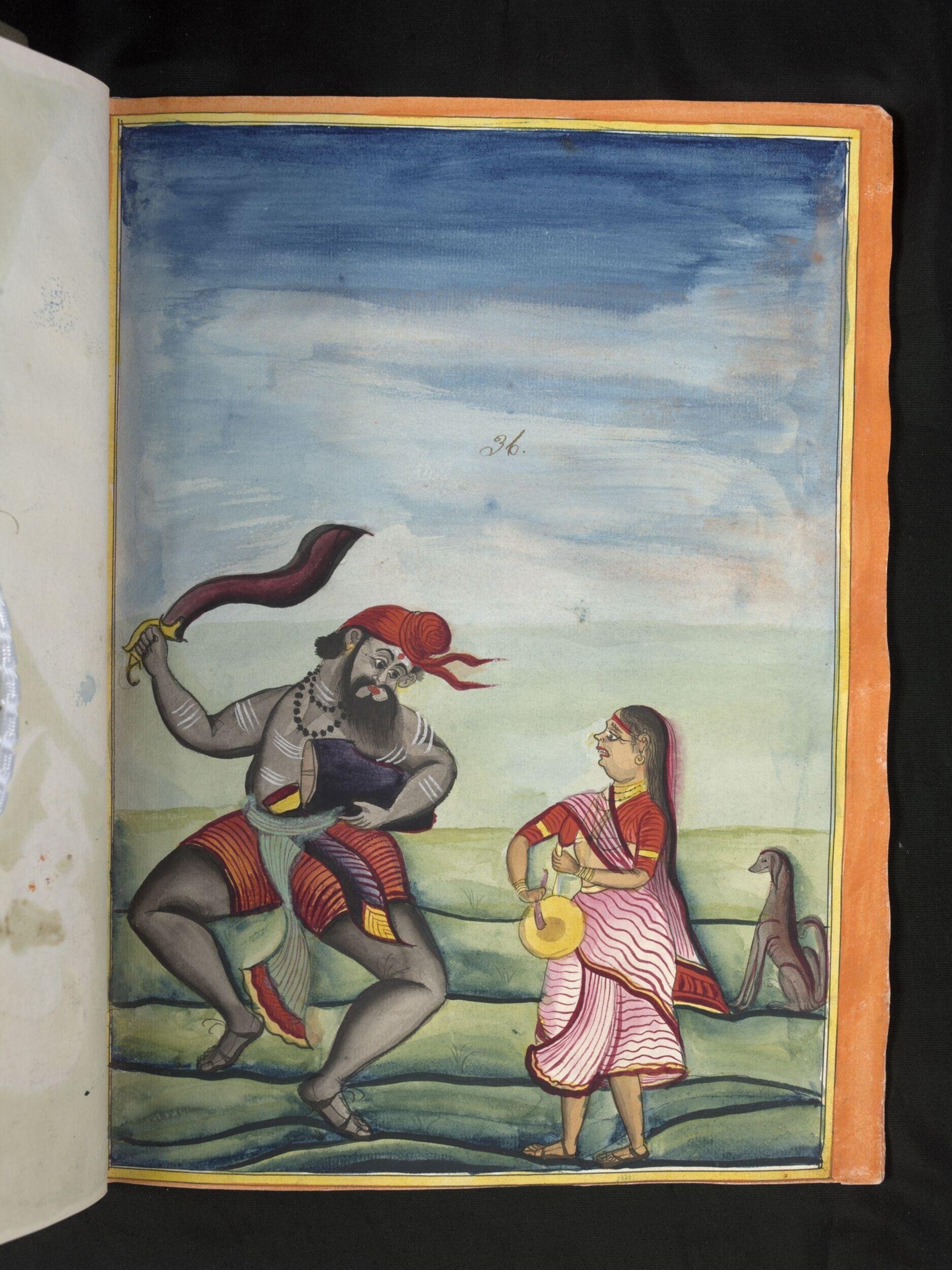
A sword-dancer
Unknown
- Collection:
- Painting
- Source:
- Victoria and Albert Museum
- Rights:
- Rights vary by item — check the source record before reusing this image. Source record ↗
- Recorded as:
- V&A — check rights per item
Sword dances in South Asian courts are poorly documented in European archives, and visual records from the period are rare. This image captures not only the physical technique—the extreme flexibility and weapon control—but also the gendered and social structure of courtly dance performance. For dancers and historians studying pre-modern Asian dance traditions and how they were transmitted and understood across cultures, this work is a primary visual source.
What you are looking at
A sword-dancer performs for a woman in a landscape setting, rendered in a watercolor or gouache technique on what appears to be a manuscript page with an orange-tan border. The dancer, a dark-skinned man with a red head-wrap, executes a dynamic pose with his body deeply flexed, one leg extended and the other bent, his torso arched backward in a dramatic curve. He holds an unsheathed curved sword (likely a talwar or shamshir) aloft in his right hand with the blade streaming horizontally, the dark metal contrasting sharply with his pale garment. His lower body is wrapped in striped red and orange fabric with gold trim; his upper body wears a pale blue or grey tunic. The woman watching him wears a pink and gold striped garment typical of Indian court dress and holds what appears to be a gold vessel or cup. To the right, a small peacock stands in profile. The landscape is rendered simply with green ground, a pale horizon, and a soft blue-grey sky with white clouds. The page is numbered 96 in script at upper center.
The dancing
The primary figure is a solo male dancer in a deeply dynamic, arched position—weight thrown onto one bent leg while the other extends, the spine hyperextended and the torso presented frontally. The sword arm extends upward and back, creating a line of force that pulls the entire body into dramatic tension. The dancer's frame is open and expansive, with weight clearly shifted and the body elongated through the arch. The woman is stationary, facing the dancer in profile-three-quarter view, her posture upright and her gaze directed toward the performer. The spatial relationship is that of performer and witness, with no physical contact between them.
The dance depicted
This is a sword dance (talwar raqs or shamshir raqs), a form documented in Indian and Indo-Persian courts from at least the 16th century onward. The arched body position, the dramatic flexion, and the elevated blade are hallmarks of courtly sword performance, which combined acrobatic feats, weapon handling, and sensual body movement. Such dances were performed by male professionals—often called natch or nautch dancers—for court audiences and were valued both as demonstrations of physical control and as entertainment. The artist has captured the moment of maximum extension and dramatic tension, when the dancer's body forms an opposing curve to the lifted sword.
How it was made
This is a hand-painted gouache or watercolor on a manuscript page, indicated by the precise borders, the numbering typical of a bound album or series, and the combination of wet pigment washes with fine linear details. The technique allowed for subtle color gradations in the sky and landscape, crisp contour lines defining the figures, and careful attention to textile patterning—visible in the striped wrapping and gold trim of the dancer's costume. The presence of this work within what appears to be a numbered folio sequence suggests it was part of a larger documentary series, possibly a Mughal or late-Mughal court album or trading record meant for circulation among European audiences or collectors.
About this work
This is a depiction of a South Asian sword dance as performed in a court or patronage setting, likely recorded in an 18th-century Indian or Indo-Persian illustrated manuscript. The work documents both the physical form of the dance—the extreme body flexibility and weapon skill required—and the social context in which it was practiced: professional male performers entertaining an elite female witness. The artistic choice to capture the moment of maximum arch and extension emphasizes the acrobatic and sensual dimensions of the form. This is one of relatively few visual records of Indian court dance from the Mughal and post-Mughal periods, and the precise rendering of costume and setting anchors it to a specific cultural and temporal context.
How to look at it
Notice the moment the artist chose: the maximum extension of the spine and the highest point of the sword arc, when the dancer's body forms a dramatic opposing curve. Observe how the artist has rendered the weight distribution—the bend in the supporting leg, the tension in the lifted leg, the elongation through the torso—to suggest real physical control and strength. The stillness of the watching woman and the attention of the peacock direct your eye to the dancer as the point of action. The careful rendering of textile patterns and gold trim situates this as a court or elite performance, not a street or village practice.
The artist
The artist is unknown. The style, technique, and subject matter suggest training in Mughal or Indo-Persian manuscript painting traditions, likely from the 18th century. The presence of the work in a European collection (indicated by the record source) and its documentary attention to costume and setting suggest it may have been created for export to or commission by European collectors or merchants, or copied from earlier court records by an artist working in a hybrid tradition.
The period
In the 18th century, Indian court dances—including sword dances, acrobatic forms, and the refined movement vocabularies later codified as Kathak—were performed by professional (often lower-caste or outsider) dancers for elite and royal audiences. Simultaneously, European interest in Indian arts and customs was growing through trade, travel, and collecting. Illustrated manuscripts documenting Indian court life, textiles, and performance were produced both for Indian patrons and increasingly for European collectors. This folio number suggests the work is part of a larger series, possibly a documentation of Indian customs, dances, or court entertainment meant for circulation or archival purposes.
Where it lives
The work is held in a collection marked 'va' in the record and numbered as page 96 in what appears to be a bound album or manuscript series. This numbering and the material support suggest it is part of a larger documentary or artistic series, likely created in India in the late 18th century and acquired or preserved in a European collection.
Dance in this work
Questions about this work
What kind of sword is the dancer holding?
The curved blade is consistent with an Indian talwar or shamshir (a type of saber or scimitar). Sword dances in South Asian courts often featured such curved blades, which allowed for dramatic arcing movements and required significant upper-body strength and control to manipulate safely.
Was sword dancing a common court entertainment in 18th-century India?
Yes, sword dances and other acrobatic movement forms were regular features of Mughal and post-Mughal court entertainment, performed by professional male dancers. These dances combined athletic skill, weapon handling, and sensual body movement, and were valued as both spectacle and demonstration of physical mastery.
Why is the woman just standing and watching?
This depicts the social structure of court performance in the period: a professional male performer (likely of lower social status) dancing for an elite female audience member. The woman's stillness and formal dress establish her as the patron or witness, not the dancer.
How do we know this is from the 18th century?
The catalogue record dates it to 1785. The style of the woman's dress, the technique and color palette of the painting, the folio numbering, and the manuscript support all align with late 18th-century Indo-Persian and Mughal painting practices.
More dance artwork





