49 works in this view — arrow keys or swipe to move between them.
Dance in Art
Spanish dancer Antonio
Sommerlad, Gilbert
- Collection:
- Caricature
- Source:
- Victoria and Albert Museum
- Rights:
- Rights vary by item — check the source record before reusing this image. Source record ↗
- Recorded as:
- V&A — check rights per item
The work provides evidence of how Spanish flamenco dancers were marketed and visualized for English-speaking audiences in the mid-twentieth century, and of the conventions of theatrical caricature as a genre of dance documentation. The combination of exaggerated facial features with accurate costume detail reveals the tensions between entertainment, caricature, and cultural representation in midcentury theater.
What you are looking at
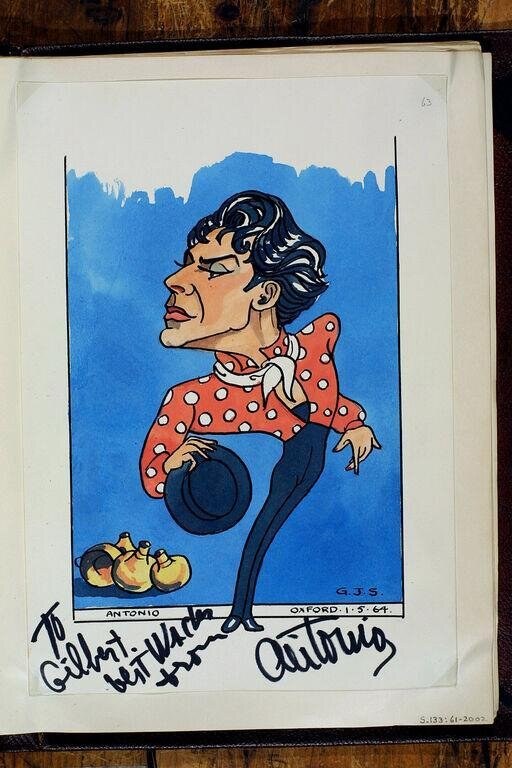
A caricature in bold line and watercolor depicts a Spanish dancer in profile, rendered with exaggerated features characteristic of the genre. The figure wears a striking red polka-dotted jacket with a white collar and neckerchief, paired with navy trousers; the face is drawn with an extended nose and pursed lips in an expression of concentration or intensity. The dancer holds a black hat low at the hip with one hand. The background is a flat, bright blue, creating strong chromatic contrast. At the figure's feet lies a cluster of what appear to be citrus fruits—lemons or oranges—rendered in yellow and brown. The composition is tightly framed within a rectangular border, and the page bears handwritten signatures and annotations in ink, suggesting this is a presentation or autographed piece.
The dancing
The dancer is caught in a moment of controlled stillness rather than active movement: the body is upright with weight centered, the free arm extended naturally, the hat held at the level of the hip in a posed gesture rather than mid-motion. The exaggeration of the facial features—the prominent nose, the tightened mouth—suggests Spanish caricature convention rather than naturalistic anatomical study. There is no visible footwork or evidence of a turn, leap, or dynamic weight shift; the pose suggests a moment of stillness or a formal presentation stance.
The dance depicted
The work is titled as depicting a Spanish dancer named Antonio, and the costume—the red jacket with white collar and the hat held in the hand—aligns broadly with flamenco or Spanish theatrical dance practice of the mid-twentieth century. However, the pose itself is not distinctively flamenco in character; it reads more as a formal portrait of a performer in costume than as a capture of flamenco movement, which typically emphasizes rapid footwork, arm extensions, and dynamic torsion. The presence of citrus fruits at the feet may be a personal emblem or reference, or a studio convention for caricature subjects.
How it was made
This is a caricature executed in pen and watercolor on paper, likely from a theatrical or variety program or as a souvenir piece. The bold outlines and flat color are typical of mid-twentieth-century caricature and printed theatrical ephemera. The style suggests commercial production—possibly a published print or hand-colored reproduction—rather than a unique artwork; the handwritten signatures and annotations indicate it was intended for presentation or collecting. The technique is economical: the face dominates through distortion rather than detail, and the costume is rendered in flat, vivid washes that prioritize immediate visual impact over modeling.
About this work
This is a caricature of the Spanish dancer Antonio, dated 1964 and executed in pen and watercolor. It exemplifies mid-twentieth-century theatrical caricature practice, in which exaggerated facial features and bold color serve both comic and commemorative functions. The work belongs to a tradition of performer portraiture—often issued as lobby cards, program illustrations, or souvenir items—rather than to fine art practice. Within a gallery of dance in art, it documents how Spanish and flamenco dancers were publicly presented and celebrated during the postwar variety and cabaret era, and how visual exaggeration could function as a tool for both celebrity and cultural stereotype.
How to look at it
The viewer should note the deliberate contrast between the accurate rendering of the costume and the extreme distortion of the face: this is not a naturalistic portrait but a coded commentary on both the performer's identity and the viewer's expectations. The pose—formal, contained, not in motion—is itself a choice; the artist has opted for a presentation stance rather than a moment of dance, which tells us something about how this performer was marketed and understood. The bright blue background and vivid red jacket create theatrical lighting effects characteristic of stage design, anchoring the image in the world of professional performance rather than fine art.
The artist
Gilbert Sommerlad was a British caricaturist and illustrator active in mid-twentieth-century theatrical and entertainment circles. Little is widely documented of his biographical practice, but the style and subject matter of this work suggest he worked in the tradition of theatrical lobby and program illustration, producing quick, economical portraits of performers for commercial circulation. The annotations on this example suggest it was either a commissioned portrait for a performer or a gallery piece sold or given to collectors of theatrical memorabilia.
The period
In 1964, Spanish flamenco and regional dance held significant currency in British and international popular entertainment. Flamenco had been increasingly staged and formalized for theatrical presentation throughout the twentieth century, and dancers like Antonio were featured in variety shows, cabarets, and concert tours across Europe and North America. Simultaneously, caricature remained a dominant mode of theatrical illustration and promotion, particularly in program design and lobby cards. The exaggerated physiognomy visible here reflects both the conventions of the caricature tradition and, potentially, racial and ethnic stereotyping practices of the era—an aspect worth noting critically.
Where it lives
The work is catalogued as a caricature held in a collection designated 'va' (likely Victoria and Albert Museum or a similar British institutional holding). The handwritten signatures and annotations suggest it was a presentation piece, possibly signed by the artist and the performer, or inscribed by a previous owner. The catalog designation "Caricature" indicates it is classified within the institution's theater, entertainment, or decorative arts collection rather than as a fine art print.
Dance in this work
Questions about this work
Is this a portrait of a real dancer?
The title identifies the subject as a Spanish dancer named Antonio, and the signatures on the page suggest this was a presentation piece, possibly autographed by the performer. However, without additional documentation, we cannot verify the specific identity or career of this individual. The work appears to have been commissioned or created for theatrical promotion or collecting purposes in the mid-twentieth century.
What dance style is depicted?
The title and costume suggest flamenco or Spanish theatrical dance, but the pose itself is static and formal rather than demonstrative of flamenco technique. The artist has chosen to show the performer in costume rather than in the midst of movement, which limits what we can conclude about actual flamenco practice from the image alone.
Why are there citrus fruits at the dancer's feet?
The presence of lemons or oranges is unclear and may be personal to Antonio, a studio convention for caricature subjects, or a symbolic reference. It adds a distinctly Spanish association (Spanish citrus) but its specific meaning is not documented in the available record.
What is the artistic tradition here?
This is a theatrical caricature, a distinct genre of illustration used for program design, lobby cards, and theatrical souvenirs from the late nineteenth through mid-twentieth centuries. The form combines exaggerated physiognomy with accurate costume detail to create a memorable and often comic portrait of a performer.
More dance artwork





