49 works in this view — arrow keys or swipe to move between them.
Dance in Art
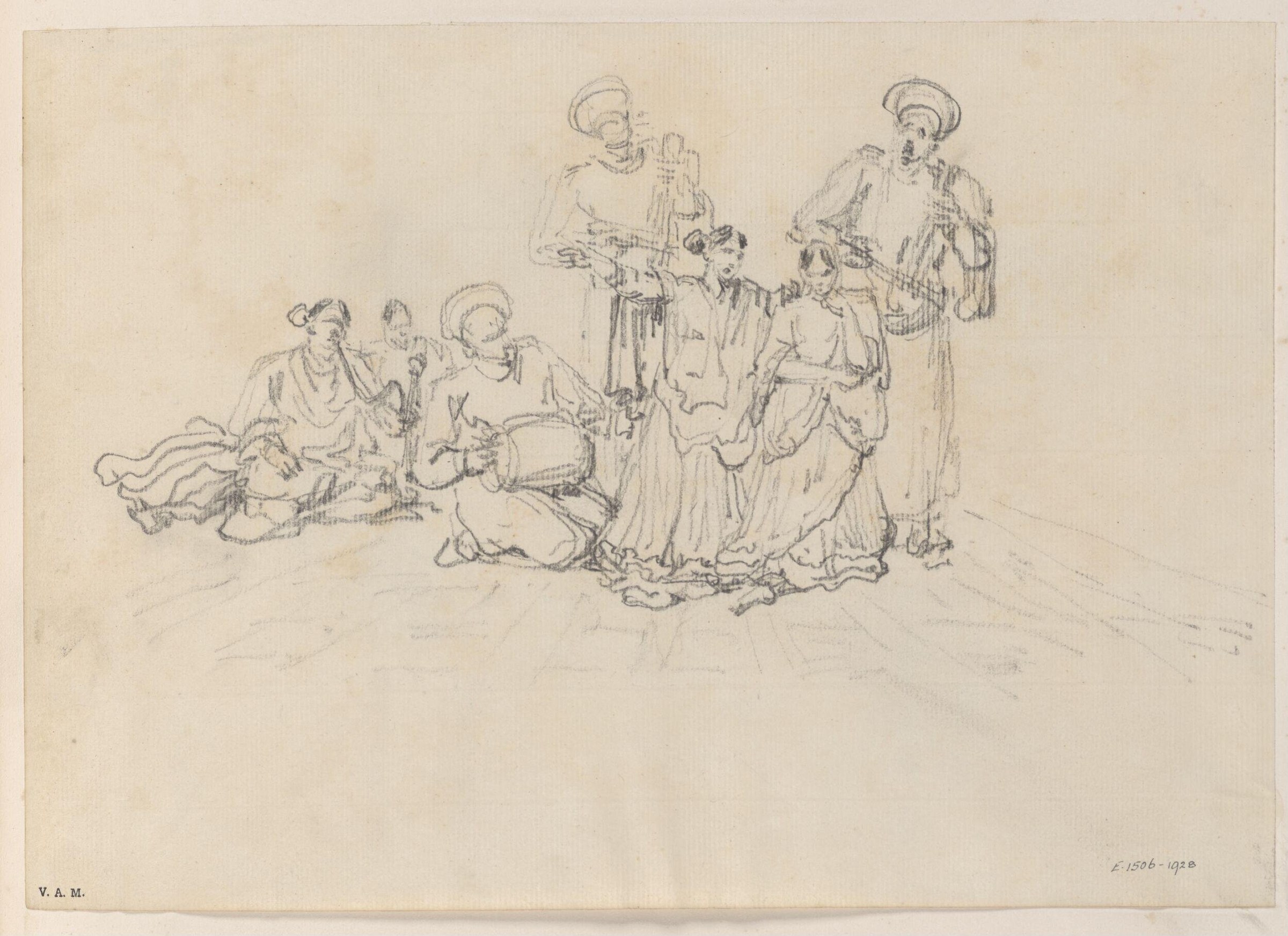
A group of Indian musicians and dancers
George Chinnery
- Collection:
- Drawing
- Source:
- Victoria and Albert Museum
- Rights:
- Rights vary by item — check the source record before reusing this image. Source record ↗
- Recorded as:
- V&A — check rights per item
This work is evidence of how European artists in the late 18th and early 19th centuries visually recorded non-Western performance traditions, and of what information they chose to capture or omit. It also documents the appearance of Indian court musicians and dancers during a period of significant cultural and political transition.
What you are looking at
A loose gathering of figures in flowing dress arranged across the page in a shallow, undefined space with perspective lines suggesting recession. At left, two seated figures in turbans and draped robes lean toward each other; one holds what appears to be a stringed instrument. To their right stand three more figures, and at right two taller figures in voluminous garments and tall cylindrical hats stand nearly upright. The whole group occupies the lower half of the sheet. The drawing is executed in rapid pen strokes with minimal cross-hatching, leaving most of the paper blank; the figures emerge through outline and gestural line rather than modeled form. The dress—turbans, long robes, draped fabrics—and the instruments suggest South or Central Asian context. The composition has the informal, observational quality of a sketch made from life or memory, with figures at different scales and in varied postures of attention and interaction.
The dancing
The bodies are rendered as loosely articulated forms defined by outline; weight and volume are suggested through drapery folds rather than anatomical structure. Seated figures lean inward with arms gesturing; standing figures maintain upright postures with arms held at mid-body. No clear dance hold or frame is evident. The scale variation—some figures much larger than others—suggests spatial recession rather than compositional hierarchy. Postures are relaxed and conversational rather than formally arrayed. The drawing technique prioritizes swift indication of silhouette and dress over articulation of joints or footwork.
The dance depicted
The title identifies this as Indian musicians and dancers, but the image alone does not clarify which dance or music tradition is depicted. The presence of instruments (a stringed instrument is visible) and the gathering suggest a court or courtly entertainment context. The turbans and robes are consistent with Mughal or Indo-Islamic court dress of the 18th century. Without clearer evidence of specific mudras, foot positions, or costume elements diagnostic of a particular Indian classical or folk dance tradition, the identity of the dance cannot be determined from the image. The work documents an observational moment rather than a posed dance performance.
How it was made
Pen and ink on laid paper. The drawing is economical and rapid, built from fluid outline strokes with selective shading in the form and drapery. The technique allows the artist to capture gestural information and spatial arrangement without rendering detail, suggesting this is a study or record rather than a finished work. The informality of execution and the openness of the composition—much blank paper left—indicate this was made as a working drawing, possibly during or after direct observation.
About this work
George Chinnery (1774–1852) was a British painter and draughtsman who worked extensively in Asia, including long periods in India and China. This pen sketch documents a social or courtly gathering of musicians and dancers in what appears to be an Indo-Islamic or Mughal context. The work is characteristic of Chinnery's practice of rapid figure studies and ethnographic notation, recording costume, posture, and social arrangement. It belongs to a body of work in which Chinnery observed and recorded the dress, gesture, and entertainments of Asian courts and communities.
The sketch represents the colonial-era European fascination with Asian performance and social custom, mediated through the eye of an artist trained in Western academic drawing. It is neither a record of a documented performance nor a composed theatrical scene, but rather an annotated observation—the kind of visual note a painter made to study gesture, dress, and arrangement for later use or for the interest of a European audience.
How to look at it
Attend to the informality of the composition and the variation in scale and posture, which suggest the artist was recording an observed moment rather than staging a formal performance for the viewer. The clustering of figures and the instruments hint at the social context—a musical gathering—but the sketch prioritizes dress and bearing over the specific movement or form of any dance. The rapid pen technique means the artist was interested in capturing gesture and silhouette quickly, suggesting this was made as a note or study rather than a finished artwork. The inclusion of detail like the turbans and the stringed instrument indicates the artist's attention to the particularities of Indian court culture.
The artist
George Chinnery (1774–1852) was a prolific draughtsman and painter of considerable skill who spent most of his career outside Europe, working in India (notably Madras and Calcutta) from 1802 to 1825, and then in Macau and Hong Kong from 1825 until his death. He was trained in the British academic tradition but developed a practice of rapid, observational studies of people, buildings, and landscapes in the places where he lived. His works include commissioned portraits, architectural studies, and large numbers of figure sketches and ethnographic notes. He was one of the most documenting artists of Asian life available to the British art world and museums during this period.
The period
The drawing dates to 1802, Chinnery's first year in India. This was a period of intense European fascination with Asia, driven by colonial expansion, trade, and the circulation of travel narratives and visual records. In art, the period saw growing interest in ethnographic or orientalist subjects—depictions of non-European costume, custom, and performance aimed at a European audience. In Indian musical and dance traditions, court patronage was shifting during the Mughal decline and the consolidation of British rule; many traditions were being documented for European audiences for the first time, often through the eyes of foreign observers. Chinnery's sketch belongs to this moment of colonial observation and recording.
Where it lives
The work is held in the collection listed as 'va' in the catalogue record, indicating a museum or archive holding. It is catalogued as a drawing and dated 1802. The accession number or catalogue reference is E1208-1928.
Dance in this work
Questions about this work
What instruments are being played?
A stringed instrument is visible in the hands of one of the seated figures at left, but the sketch is too rapid and the detail too minimal to identify it with certainty. It could be a sitar, sarangi, or similar plucked or bowed instrument common in Indian court music of the period.
Is this a real performance or Chinnery's imagination?
The sketch has the character of an observed study rather than an invented scene. The loose grouping, the variation in scale, and the informal postures suggest Chinnery was recording what he saw. However, without knowing the exact circumstances of its making, we cannot confirm whether he sketched this from life or from memory.
Why are some figures much larger than others?
The scale variation likely indicates spatial recession—figures at right are meant to be further away—rather than importance. This suggests Chinnery was attempting to record the spatial arrangement of the gathering as he saw it.
What does this tell us about dance in this period?
The sketch documents the social context of performance—music and dance as part of courtly entertainment—and the dress and bearing of performers. However, it does not provide detail about the specific movements, forms, or traditions of dance; Chinnery's interest was in the gathering and its visual character rather than the technique of the performance.
More dance artwork





