49 works in this view — arrow keys or swipe to move between them.
Dance in Art
The Dancer
Cataldi, Amleto
- Collection:
- Photograph
- Source:
- Victoria and Albert Museum
- Rights:
- Rights vary by item — check the source record before reusing this image. Source record ↗
- Recorded as:
- V&A — check rights per item
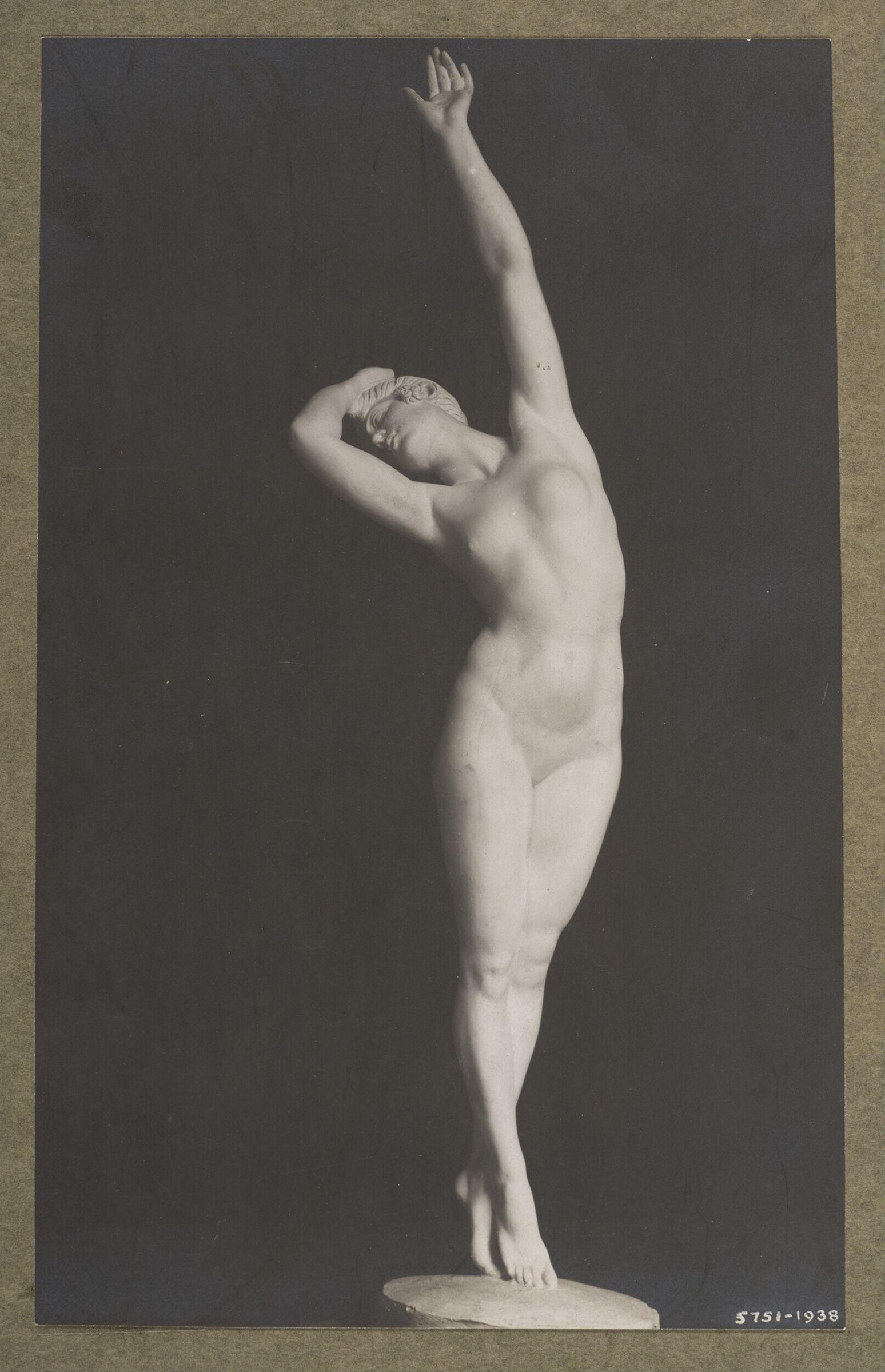
This photograph preserves a specific moment in the history of how dance was documented and visualized in early twentieth-century art. It demonstrates the formal and technical mastery of early studio photography applied to the dancer's body, and reflects the period's fascination with capturing the ideal form—the stillness and perfection underlying the ephemeral movement of dance. For historians and dancers, it offers insight into the aesthetic values, training, and idealization of the female dancer during this era.
What you are looking at
A single female figure stands alone against a dark background, captured in a moment of vertical extension and controlled grace. She stands on one leg on a small circular base, her supporting leg straight and her body lifted to its full height. Her free leg is bent at the knee, drawn upward and inward toward her torso. Her left arm is raised high above her head with the palm open, fingers relaxed, while her right arm is bent and positioned across her body, cradling or supporting her raised knee. Her head is tilted back slightly, her gaze directed upward, her expression serene and composed. The photograph is rendered in high-contrast black and white, with dramatic side lighting that sculpts the musculature and contours of her body against the void of the background. The image appears to be a platinum print or gelatin silver print of exceptional tonal range and technical refinement. The isolation of the single figure and the stillness of the pose suggest a formal study rather than a captured moment from performance.
The dancing
The dancer stands in a vertical line of energy, with the weight fully committed to a straight supporting leg. The raised leg creates a frame of geometric clarity: the knee bent at approximately 90 degrees, the thigh lifted to hip height or slightly higher. The upper back is arched gently and the head tilted in counterpoint to the body's axis. The raised arm extends from the shoulder with the elbow slightly bent, creating an open, upward-reaching gesture. The positioning suggests refinement and control rather than dynamic movement—this is a held pose, not a moment caught mid-motion. The asymmetry of the arms (one high and open, one lower and protective) creates a tense balance that reads as deliberate and composed.
The dance depicted
This appears to be a classical ballet or modern dance study, most likely from the early twentieth century. The posture—the straightness of the supporting leg, the lifted chest, the precise carriage of the head—aligns with academic ballet vocabulary, though the specific pose does not correspond exactly to a named classical position. The raised arm and uplifted gaze suggest the Romantic sensibility visible in paintings and photographs of that era, particularly the late nineteenth and early twentieth-century documentation of classical and early modern dance. The photograph itself is a formal study of the female body in dance, a genre that emerged with photography's capacity to capture and freeze movement for aesthetic and educational scrutiny. Without documentation of the specific title, context, or artist intention, the exact dance vocabulary cannot be certain, but the image speaks to classical ballet training and the artistic values of that tradition.
How it was made
This is a photograph, most likely a gelatin silver print or platinum print created by Amleto Cataldi, an Italian photographer documented in the record. The technique allows for precise rendering of form, texture, and the subtle gradations of tone that reveal musculature and the three-dimensional quality of the dancer's body. The dramatic side lighting—a hallmark of early twentieth-century studio photography—creates sharp definition between the illuminated form and the dark ground. The absence of visible background detail and the isolation of the figure suggest a controlled studio setting with deliberate lighting arrangement. This approach to dance photography was common among art photographers of the period who sought to elevate the dancer's body to the status of sculptural study. The print's archival quality and tonal range indicate careful craftsmanship in both exposure and processing.
About this work
This photograph documents a female dancer in a classical ballet or modern dance pose, rendered by an unknown photographer (or photographer Amleto Cataldi, according to the catalogue record). The image belongs to a tradition of early twentieth-century studio photography that treated the dancer's body as a subject for formal aesthetic investigation. The photograph sits at the intersection of dance documentation, fine art photography, and the emerging modernist sensibility that sought to strip away performance context in favor of pure form and line. It represents a moment when photography began to be understood as a medium capable of capturing and preserving the ephemeral art of dance, and when art photographers began to treat dancers as sculptural subjects worthy of the same careful study traditionally reserved for classical sculpture and painting. The work is significant not as evidence of a particular choreographic tradition or performance, but as a record of how the female dancer's body was photographed, framed, and aestheticized in early modernist art.
How to look at it
Attend to the geometry of the pose: the straight line of the supporting leg, the right angle of the raised knee, the diagonal of the extended arm, the curve of the arched back. Notice how the photographer has chosen a moment of absolute stillness and control rather than a fleeting instant of movement. The dramatic lighting carves the body into planes of light and shadow, emphasizing its three-dimensionality and musculature. The upturned gaze and open arms create a sense of spiritual aspiration or aesthetic transcendence—a Romantic sensibility rendered through modernist photographic technique. This is a moment designed to be contemplated rather than read as narrative or action.
The artist
Amleto Cataldi was an Italian photographer active in the early twentieth century. Little is documented about his practice beyond this work, which appears to be part of a series or collection of dance studies. The precise style and technical refinement of this photograph suggest he was a skilled practitioner of studio photography working within the art photography movement of the period, which valued careful control of lighting, composition, and printing technique to achieve artistic effect.
The period
This photograph was created during a period of intense interest in the documentation and aestheticization of dance in Western art. The early twentieth century saw the rise of modern dance (Martha Graham's early work, the innovations of Isadora Duncan) alongside the continuing dominance of classical ballet, which was undergoing its own renewal through figures like Serge Diaghilev's Ballets Russes (founded 1909). Simultaneously, art photography was establishing itself as a legitimate fine art medium, with photographers like Edward Weston and others creating formal studies of the human body. This photograph sits at the intersection of these movements: it documents a dancer in a classical idiom while employing the photographic techniques and aesthetic values of art photography. The formal, sculptural approach to the body reflects the influence of modernism's emphasis on form over narrative or literal representation.
Where it lives
The photograph is held by a source marked 'va' in the catalogue record, which may indicate the Visual Arts collection or a similar institutional holding. It carries an archival reference number (5151-1938) suggesting systematic cataloguing within an institutional collection.
Dance in this work
Questions about this work
Is this a ballet dancer or modern dancer?
The posture and carriage suggest classical ballet training—the straightness of the supporting leg, the lifted chest, and the precise arm placement all point to an academic ballet vocabulary. However, the photograph is presented as a formal study rather than as evidence of a specific choreographic tradition. Early twentieth-century dance was increasingly fluid between classical and modern forms, and this image may reflect that hybrid moment.
What pose is the dancer in?
The pose does not correspond exactly to a named classical ballet position. It appears closest to attitudes or arabesques, but modified: the supporting leg is straight and vertical rather than in a classical plié, and the raised leg is drawn inward and upward rather than extended to the back. This may suggest either a transitional moment in a sequence or a pose designed specifically for the photograph as a formal study.
Why is the background so dark?
The dark ground isolates the dancer's body and emphasizes its form against the void. This was a deliberate choice in art photography of the period—it removes all competing visual information and forces the viewer's attention onto the geometry, musculature, and line of the figure itself. It also reflects a sculptural approach to the body.
Who is the dancer?
The catalogue record does not identify the dancer. The photograph appears to be a formal study rather than a portrait of a named individual, which was common in dance photography of the period—the body itself, not the personality or identity of the performer, was the subject of aesthetic interest.
More dance artwork





