49 works in this view — arrow keys or swipe to move between them.
Dance in Art
A male dancer or reciter
Unknown
- Collection:
- Painting
- Source:
- Victoria and Albert Museum
- Rights:
- Rights vary by item — check the source record before reusing this image. Source record ↗
- Recorded as:
- V&A — check rights per item
This image is one of the few surviving visual documents of courtly male performance in South Asia from the pre-photograph era, capturing costume, adornment, and ensemble structure that historical texts alone do not convey. For historians of South Asian dance and music, it provides material evidence of how performers were dressed, grouped, and visually presented in formal court contexts of the late Mughal or early colonial period. It also demonstrates how European artists of the 19th century saw and represented non-Western performance traditions—often schematically, but sometimes with enough specificity to reconstruct elements of the original practice.
What you are looking at
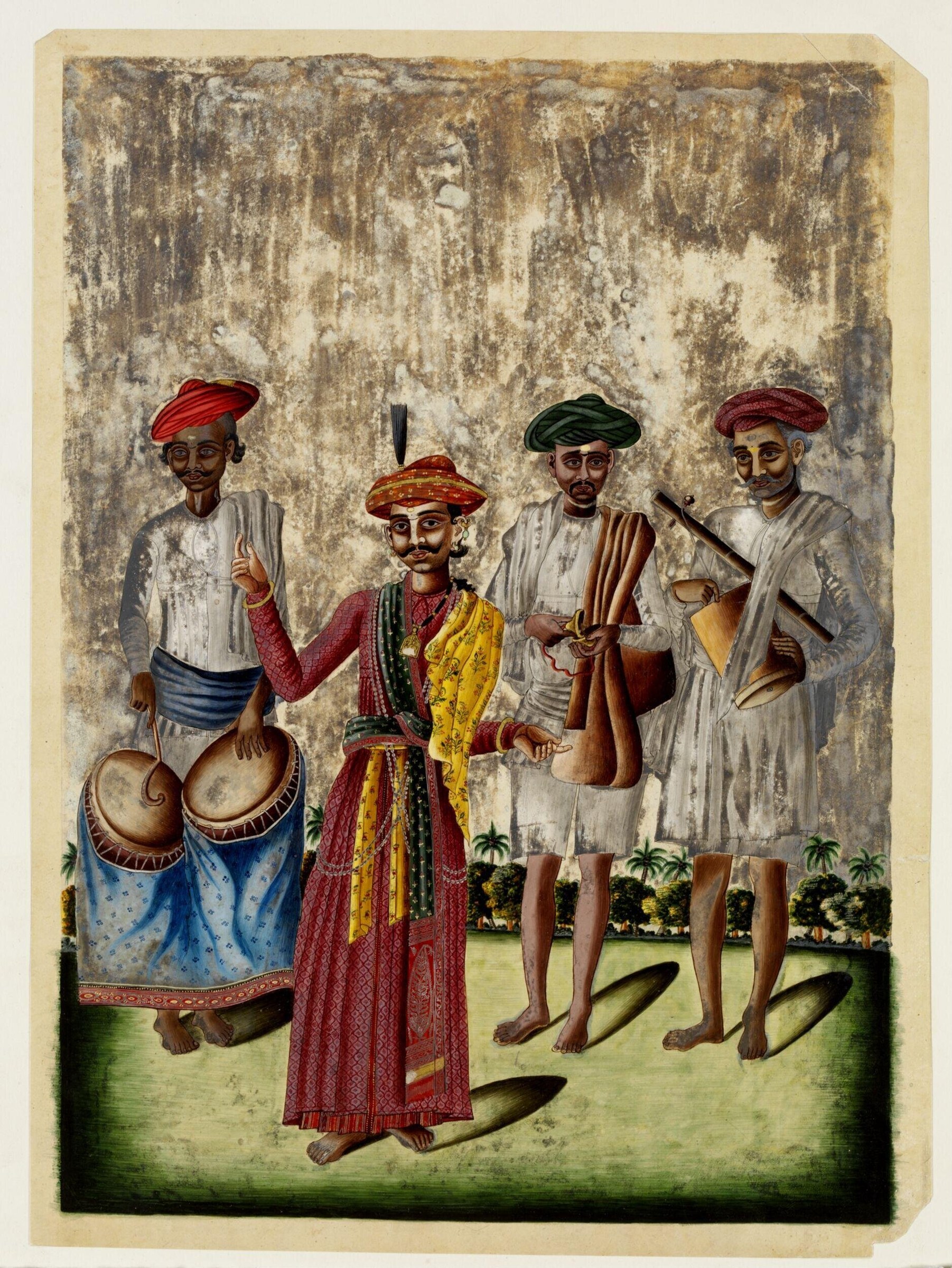
Five male figures in light linen or cotton garments stand in a tropical landscape, three of them holding large hand drums. The central figure, dressed more elaborately in a red patterned robe with a yellow sash and adorned with beaded necklaces, wears a distinctive red and gold brocade turban and stands with one arm raised. Four attendants in simpler white wraps and colored turbans flank him; one at left beats a large drum, one second from right holds what appears to be a long stick or staff, one at far right cradles another large drum. The background shows a weathered whitewashed wall with dark staining, while the foreground depicts green grass with small palm trees at the horizon. The palette is muted except for the bright reds, yellows, and blues of the central figure's dress and the warm tones of the drums.
The dancing
The central figure dominates the composition, standing with raised arm in a gestural or declamatory pose rather than a strict dance posture. The drummers stand with relaxed stances, their bodies oriented toward the central figure, holding the large drums at waist height. None of the figures display the turned-out legs, lifted spine, or formal frame of European theatrical dance; instead, the posture is upright but naturalistic, with weight distributed evenly. The grouping suggests a performance hierarchy with the decorated central figure as the focal point and the musicians as supporting presences.
The dance depicted
This appears to document a South Asian or Southeast Asian court or courtly musical and performative tradition, likely from the 18th or early 19th century based on the dress and visual conventions. The catalogue title identifies this as a male dancer or reciter, and the central figure's raised arm and formal dress suggest he is a principal performer—possibly a dancer, musician, vocalist, or reciter of poetry or religious texts, roles often combined in South Asian traditions. The drums and the figure's ornate costume and jewelry point toward a tradition with roots in classical Indian court performance, perhaps Mughal-era entertainment or regional royal court music. The precise identification is limited by the schematic nature of the image, but the setting, dress, and roles align with historical accounts of South Asian courtly performance traditions that combined music, dance, and recitation.
How it was made
This is a hand-colored engraving or aquatint from the mid-19th century. The technique shows in the fine linear work defining the figures, the layered color printing in the garments and landscape, and the precise stippled background wall. The hand-coloring—visible in the subtle gradations of the tropical sky and the carefully rendered turban and sash—suggests this was produced for a European audience as an ethnographic illustration or travelogue, circulated among educated collectors and institutional libraries rather than as a fine-art print. The style is characteristic of colonial-era visual documentation.
About this work
This is a mid-19th-century hand-colored engraving documenting what the catalogue identifies as a male dancer or reciter in South Asian courtly performance dress, flanked by four musicians with large hand drums. The image preserves a record of a courtly performative tradition—whether dance, musical recitation, or a hybrid form—at a moment when such practices were being visually documented for European consumption. The figure's ornate costume, jewelry, and raised arm suggest a principal performer in a formal court setting, supported by a disciplined ensemble of drummers. The image matters not because it captures the intricacy of movement (the still image cannot show this), but because it documents the dress, the instruments, the ensemble structure, and the social roles within a performance tradition that has left few visual records from this period.
How to look at it
Attend to the posture and gesture of the central figure: the raised arm is not a classical dance arm position, but it is deliberate and formal, suggesting declamation or a moment of performance rather than a naturalistic moment. Notice the hierarchy in the composition—the central figure is taller, more ornately dressed, and visually separated from the supporting musicians, mirroring social structures within performance ensembles. The drums themselves are the largest objects in the image after the figures; they are not being played in the moment shown, but held at rest, suggesting this is a formal portrait of the ensemble rather than a snapshot of active performance. The weathered wall behind them does not clearly indicate an interior or exterior setting, a common convention in European ethnographic prints that prioritized the figures over narrative context.
The period
The image dates from a period of intense European ethnographic documentation of colonized territories, particularly India and Southeast Asia. In the 1840s–1850s, hand-colored engravings of 'native' costumes, performers, and customs were popular in European publications and private collections, serving both commercial and scholarly purposes. These prints were often compiled into costume books or travelogue collections and circulated among educated European audiences. Simultaneously, South Asian courtly performance traditions were undergoing rapid change due to colonial rule; royal patronage was shifting, and traditional courts were losing political power. The image likely documents a practice that was already becoming marginalized by the time it was printed.
Where it lives
The catalogue record indicates this work is held in a collection designated 'va' (likely an institutional archive) and is catalogued as a painting, though the visual evidence suggests it is a hand-colored print. No date beyond the approximate 1850 attribution, no artist attribution, and no detailed provenance are recorded.
Dance in this work
Questions about this work
What dance tradition is shown in this image?
The work is catalogued as a 'male dancer or reciter,' suggesting a South Asian court performance tradition—possibly from Mughal or post-Mughal India—that combined dance, music, and spoken or sung recitation. The ornate costume, large drums, and formal ensemble structure are consistent with courtly musical performance traditions documented in historical texts from this region and period. The precise style cannot be determined from the image alone.
Why is the central figure so much more elaborately dressed than the others?
The distinction in dress and adornment reflects the social and performative hierarchy within the ensemble. The central figure is the principal performer—whether dancer, vocalist, or reciter—while the other four are supporting musicians. This visual convention was common in South Asian court performance and is documented in historical accounts of such ensembles.
Is this a photograph or a print?
This is a hand-colored engraving or aquatint, not a photograph. The technique—fine linear work, careful color layering, and the stylized composition—is characteristic of mid-19th-century European ethnographic prints. Hand-coloring was applied after the print was made, giving the figures and garments their warm, naturalistic tones.
What do the drums tell us about this tradition?
The presence of large hand drums—four of them for a small ensemble—indicates that percussion was central to this performance practice. The size and prominence of the drums in the composition suggest they provided rhythmic accompaniment for the principal performer, whether he was dancing, reciting, or singing. Such drum ensembles are documented in Indian classical music and in courtly entertainment traditions.
More dance artwork





