49 works in this view — arrow keys or swipe to move between them.
Dance in Art
Design for 'The Truth about the Russian Dancers'
Nash, Paul
- Collection:
- Set design
- Source:
- Victoria and Albert Museum
- Rights:
- Rights vary by item — check the source record before reusing this image. Source record ↗
- Recorded as:
- V&A — check rights per item
This design captures a pivotal moment in twentieth-century theatre and dance: the meeting of high modernist visual abstraction with live performance, and the fascination with Russian dance that shaped European culture in the 1920s. For historians of dance and design, it documents how architects and painters conceived of the dancer's body—weightless, acrobatic, geometric—and how the stage itself was reimagined as an abstracted, symbolic space rather than a window onto naturalism.
What you are looking at
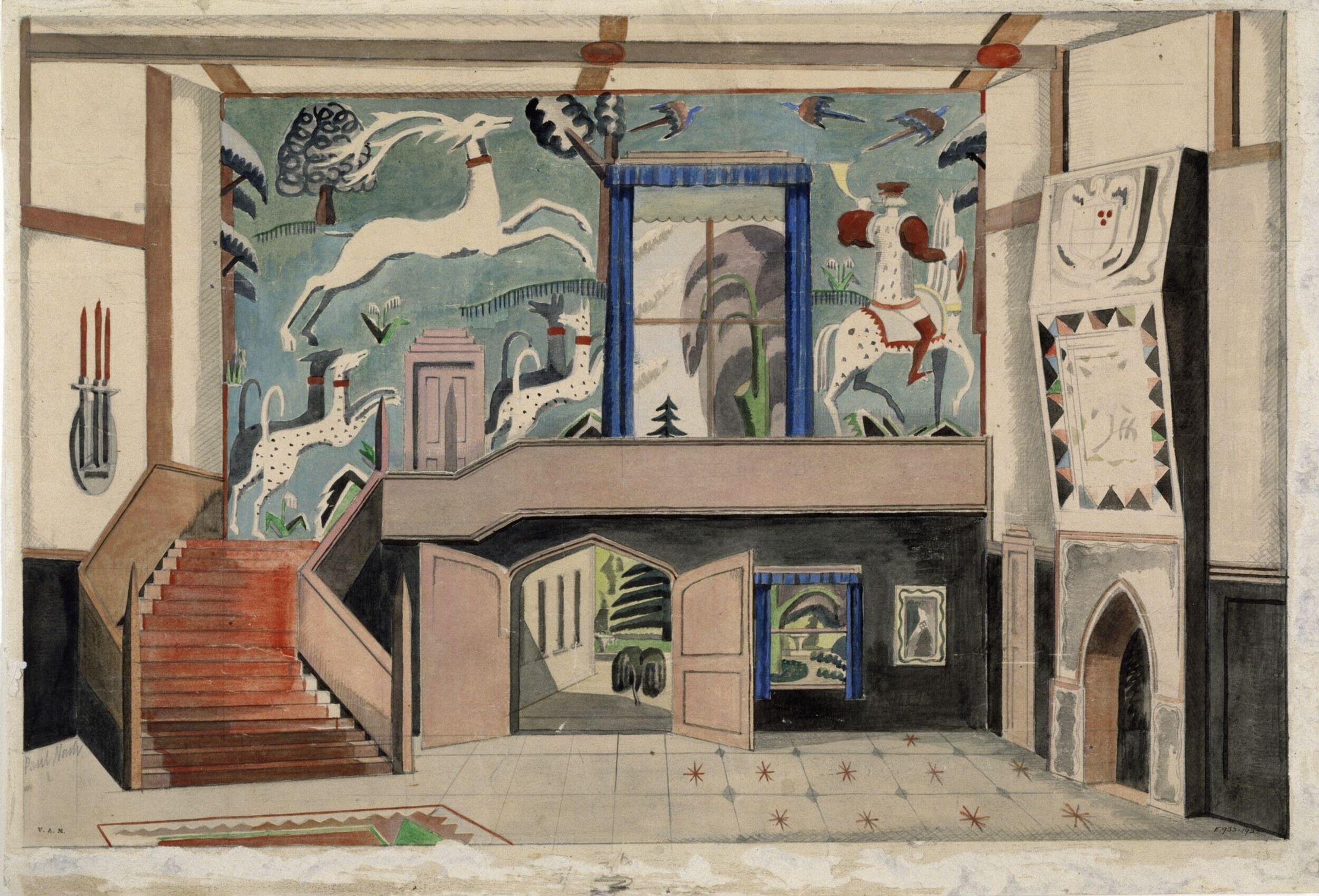
This is a design for a theatrical interior presented in isometric perspective, showing a two-story stage set with a pronounced blue color scheme. The upper level depicts an outdoor garden or landscape populated by white leaping figures—acrobatic dancers or performers—interspersed with birds in flight, stylized vegetation, and architectural fragments. A central blue-framed window or doorway frames another figure. The lower level shows an interior chamber with blue doors opening onto the same mysterious landscape; a figure in white with red-brown accents stands in the foreground. The walls are articulated with geometric panels, the floor marked by a regular grid of rust-colored stars. Candelabra hang on the left wall. The entire composition is enclosed in a timber frame overhead, establishing this as a contained theatrical space designed to be viewed frontally by an audience.
The dancing
The figures throughout are rendered in a simplified, almost geometric manner. The leaping performers on the upper level are depicted in extended, weightless arabesques—the body stretched horizontally in flight, legs trailing. The figure in the lower chamber stands in a relaxed, almost passé position. The body language is airborne and acrobatic rather than grounded; the artist has chosen moments of suspension and extension. The figures are anonymous and repeated, suggesting corps or ensemble work rather than individual characterization.
The dance depicted
The leaping figures and the title reference to 'Russian Dancers' point toward the avant-garde ballet and acrobatic performance that dominated European modernism in the early 1920s, particularly the work of the Ballets Russes and the experimental productions that followed. The weightless arabesques and impossible extensions suggest the fantastical, non-naturalistic movement vocabulary that characterized Constructivist and Modernist stage design of the period. This is not ballroom or social dance, but theatrical dance presented in a stylized, almost dreamlike setting. The 'Truth' in the title may reference a satirical or critical intent—challenging conventional representation of Russian dance or the cult of the Russian dancer in postwar Europe.
How it was made
This appears to be a pen and wash or watercolor design on paper, with the architectural framework drawn in ink and the interior scene rendered in soft color washes—predominantly blues, creams, and earth tones. The medium was standard for theatrical set design in the early twentieth century: a proposal document that could be shown to producers, collaborators, and audiences to establish the visual concept before construction. The isometric projection and the deliberate artificiality of the space—its timber frame, its divided levels, its stylized figures—signal Modernist influence, particularly the geometric abstraction and theatrical innovation of the European avant-garde.
About this work
Paul Nash was a British Modernist painter and designer who worked across fine art, illustration, and theatre design. He was invested in formal abstraction, landscape, and the symbolic potential of objects and spaces. This set design dates to 1920, a moment of intense theatrical experimentation in Europe—the years immediately following World War I saw the rise of Dada, Constructivism, and Expressionist stage design, and the glamorous international presence of the Ballets Russes and rival dance companies. Nash's design for 'The Truth about the Russian Dancers' sits at the intersection of these movements: it is theatrical, conceptual, geometrically abstracted, and engaged with the mythos of the Russian dancer that had captivated European audiences since Diaghilev's company arrived in Paris in 1909. The work is a proposal for a stage world—a space in which bodies would move, and the design itself orchestrates how they would be seen.
How to look at it
Note the artist's choice to show the space from above and at an angle—an isometric view that simultaneously reveals both levels and makes the architecture itself part of the spectacle. Observe the treatment of the human figure: elongated, weightless, often mid-leap, rendered in simplified planes of white against the blue ground. The repetition of leaping forms and the birds in flight suggest movement as a natural, almost effortless phenomenon. The geometric framing and the stylized landscape—the trees, the architectural fragments, the tiled floor—establish a world that is neither naturalistic nor purely abstract, but rather a theatrical dream-space. This is not a photograph or a sketch from life; it is a visual manifesto for how the stage could be conceived as a total abstraction in which the dancer becomes a formal element.
The artist
Paul Nash (1889–1946) was a British painter, designer, and theorist central to English modernism. He worked across oil painting, watercolor, printmaking, and stage design. Nash was influenced by Cubism and Vorticism, and he maintained a lifelong interest in landscape as a vehicle for formal and symbolic expression. He designed for theatre and ballet throughout the 1920s, and his graphic work—sharp-lined, planar, geometric—was widely reproduced in avant-garde publications. Nash was also a tutor and polemicist, writing extensively about modern design and the relationship between painting and theatre.
The period
In 1920, European theatre was in ferment. The Ballets Russes, under Sergei Diaghilev, had been established for a decade and had revolutionized the status of dance in high culture by commissioning work from leading painters and composers. The Russian Revolution of 1917 made 'Russian' culture both more exoticized and more politically charged in the West. Simultaneously, Dada, Constructivism, and Expressionism were exploring radical abstraction and the dissolution of the boundary between visual art and performance. Stage design was a prestige form for painters seeking to innovate outside the gallery: Picasso designed for the Ballets Russes, and younger modernists like Nash saw the theatre as a laboratory for integrating geometry, movement, and symbol. The title 'The Truth about the Russian Dancers' suggests a satirical or demystifying intent—a commentary on the cult of Russian dance or the spectacle of the Ballets Russes.
Where it lives
This is a set design held in the Victoria and Albert Museum, London. The V&A's collection of theatrical design documents the history of stage practice and visual culture in the theatre from the eighteenth century onward. Set designs like this one are proposals or finished working drawings, intended for use in production or presentation to collaborators and audiences.
Dance in this work
Questions about this work
What is the title referring to?
The title 'The Truth about the Russian Dancers' is likely satirical or critical. In the early 1920s, Russian dance was a fashionable phenomenon in Europe, particularly through the Ballets Russes; Nash's title may be mocking the mythologizing or exoticizing of Russian dancers, or commenting on the gap between spectacle and reality. Without a production record, the exact reference cannot be confirmed.
Did this design make it to the stage?
The archive record does not indicate whether this design was produced or whether the work it was designed for was ever performed. It may have been a proposal that was not realized, or it may have been built; theatrical designs often survive even when the productions do not.
Why the two-level structure?
The upper level—the garden or exterior space—and the lower level—the interior chamber—allow the designer to create spatial depth and contrast. The upper level is populated with acrobatic leapers and natural forms (birds, trees); the lower is more domestic and architectural. This division may reflect a narrative or thematic structure in the performance.
What dance style is this?
The design does not specify a particular technique (ballet, modern, acrobatics). The weightless leaping and extended arabesques suggest theatrical or experimental dance of the modernist avant-garde, rather than social dance or classical ballet technique. The simplified geometric style of the figures reflects the designer's priorities—form and abstraction—rather than dance specificity.
More dance artwork





