49 works in this view — arrow keys or swipe to move between them.
Dance in Art
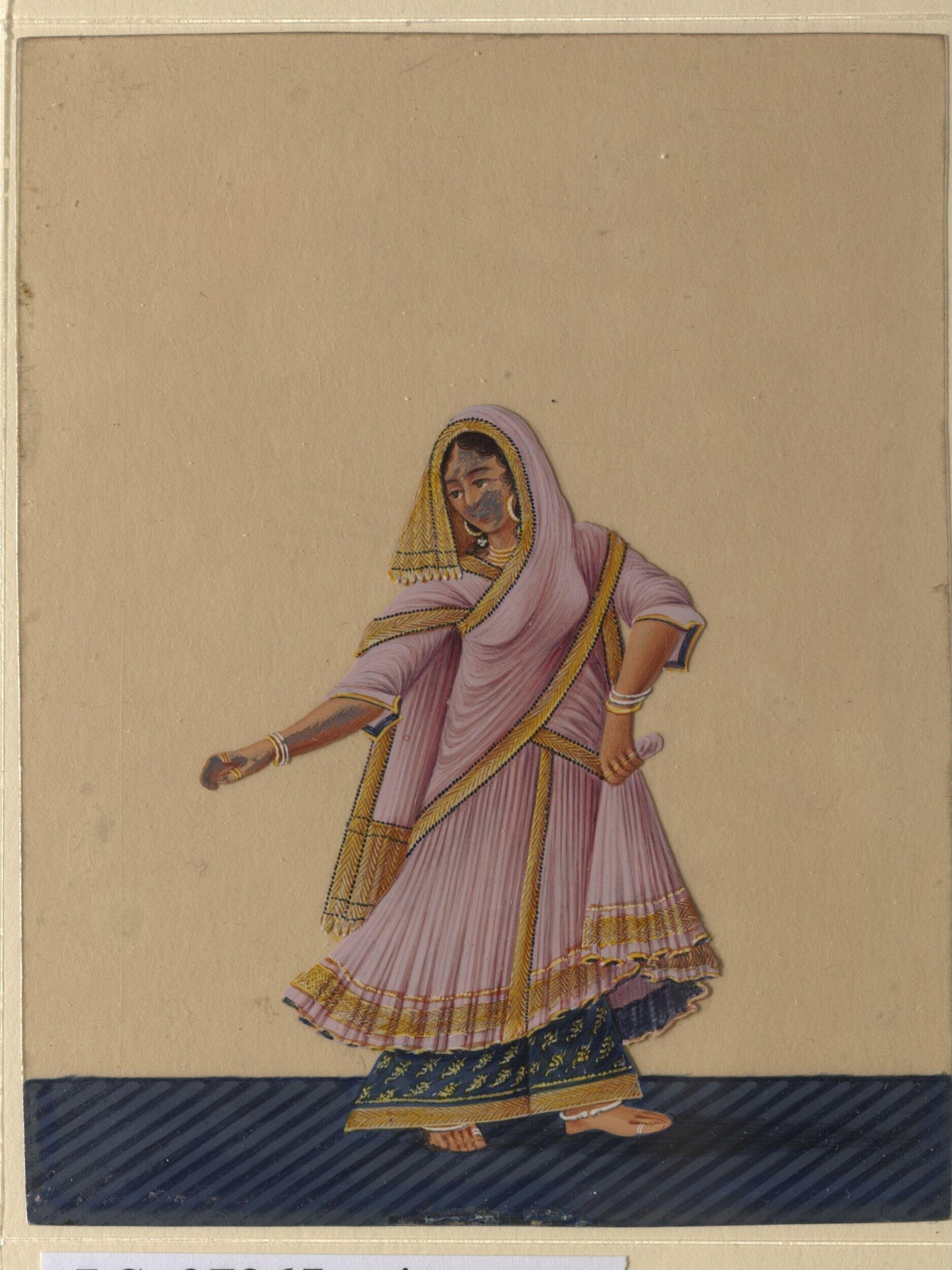
One of twelve drawings of musicians and dancing-girls.
Unknown
- Collection:
- Painting
- Source:
- Victoria and Albert Museum
- Rights:
- Rights vary by item — check the source record before reusing this image. Source record ↗
- Recorded as:
- V&A — check rights per item
This is primary visual evidence of how Kathak was performed and costumed in the mid-19th century, a period poorly documented in written sources. For historians of Indian dance, the accuracy of the costume details and the sophistication of the pose provide concrete information about training, movement vocabulary, and the relationship between fabric and choreography. For artists, the study demonstrates how a trained eye renders the physics of dance costume and the weight of a trained body.
What you are looking at
A single female figure stands against a plain pale ground, posed in a dynamic asymmetrical stance. She wears a lavender-pink draped garment with a deeply pleated skirt, edged with gold geometric patterning at hem and cuff. Her dupatta (head scarf) in the same pink fabric is drawn across her torso and over her head, its end trailing with decorative gold fringe. Beneath the outer garment, a dark patterned skirt or lehenga in deep blue-black with gold threadwork is visible at her legs and feet. She wears metal bangles on both wrists and glass bangles on her forearms. Her right arm is extended outward in a graceful diagonal line; her left arm curves across her body. Her weight is shifted, one foot stepping forward, the other anchored. The ground beneath her is rendered as a dark striped band. The figure's face is rendered in three-quarter view, with refined modeled features and a direct gaze.
The dancing
The body position shows a contrapposto stance with the supporting leg engaged and the stepping leg in motion. The arm extension is fluid and controlled, suggesting trained movement rather than casual pose. The upper body remains upright while the hips are released, allowing the pleated skirt to move freely—a silhouette characteristic of classical Indian dance where the torso acts as an anchor while the lower body carries ornamentation and action. The weight distribution and the degree of hip articulation suggest training in a form that values spinal mobility and grounded footwork.
The dance depicted
This is almost certainly a Kathak dancer, identified by the characteristic costume: the draped dupatta, the layered skirts (ghagra and choli), the ankle bangles (ghungroo would be worn but are not detailed here), and the overall silhouette. The pose captures a moment in Kathak movement—neither a fully codified mudra nor a transition, but a stance that demonstrates the dancer's control of pleated fabric and weight. Kathak was the classical court dance of North India, performed for Mughal and Hindu nobility, and by the 19th century was being taught and documented through such studies. The artist has rendered the body with knowledge of how the dancer uses space and how the cloth participates in the movement.
How it was made
This is a watercolor or gouache on paper, executed with fine detail and careful color modulation. The artist has used translucent washes for the garment and matte pigment for the decorative gold work, suggesting control over both technique and materials. The rendering of fabric folds shows understanding of how pleated material behaves and catches light. The fact that this is one of twelve studies (as stated in the title) suggests a deliberate documentary or artistic campaign—a series of performers or character studies. The medium and finish indicate circulation among educated collectors or artists rather than mass reproduction.
About this work
This is a watercolor study of a classical Indian dancer, likely Kathak, one of a series of twelve figures of musicians and dancers. It dates to circa 1860, a period when European artists and patrons were systematically documenting Indian arts under colonial administration and when Indian classical dance was undergoing significant change due to shifting patronage. The work is not a portrait of an individual but a character study—a record of a dancer's trained physicality, the costume that defined her performance, and the moment of stillness that reveals control. It belongs to a tradition of dance documentation through visual art that spans from court painting to academic study.
How to look at it
Look first at the feet and the weight distribution: where is the dancer's balance, and how does one foot relate to the other? Then trace the line of the spine and observe how the upper body remains relatively still while the lower body—especially the hip—is released. Watch how the pleated skirt suggests the underlying movement of the hips and legs. Finally, observe the arm extension: it is not decorative but connected to the core, arising from engaged shoulders and traveling through a trained torso. This frozen moment reveals the classical principle that Indian dance contains maximum ornamentation in minimum space, with the body always connected to the ground.
The artist
The artist is unknown; the work is identified only as one of twelve drawings from a series. The style and subject suggest an artist working in India during the colonial period, possibly attached to a British household or administrative office, or a traveling artist documenting Indian life for European audiences. The technical competence and ethnographic precision suggest formal training. Without signature or attribution records, the artist's identity and circumstances remain to be established.
The period
In 1860, classical Indian dance was in crisis. The decline of the Mughal court had eliminated the principal patronage of Kathak; the rise of British administration and Christian missionary education had stigmatized public performance. Women dancers (devadasis) faced increasing legal and social restriction. At the same time, European artists and scholars were beginning to document Indian arts as historical artifacts. This series belongs to that moment—before the Indian classical dance revival of the early 20th century, when such knowledge was fragmentary and largely in the hands of practitioners and scattered collectors. The technical precision of these studies suggests serious artistic interest, not mere ethnographic curiosity.
Where it lives
The work is held in a collection identified as 'va' (likely the Victoria and Albert Museum, London, a major repository of Indian art from the colonial period). It is one of twelve drawings in a bound series, suggesting it was either commissioned as a set or acquired as a complete study. The binding and preservation indicate it was valued as a coherent work from the time of creation.
Dance in this work
Questions about this work
How do we know this is Kathak and not another Indian dance form?
The costume—the draped dupatta worn in this specific way, the layered ghagra-choli (skirts and bodice), the ankle-length pleated skirt, and the overall silhouette—is diagnostic of Kathak, the classical dance of North India. The pose and body mechanics are also consistent with Kathak's vocabulary of grounded footwork and upper-body control. Other classical Indian forms (Bharatanatyam, Odissi, Kuchipudi) have distinctly different costumes and body positions.
Was this dancer a professional performer or someone from the artist's household?
We cannot determine this from the image alone. The costume and trained body position indicate classical training, but in 1860 Kathak dancers included both professional court or temple dancers and women trained in noble households for private performance. The inclusion in a series of twelve suggests the artist was documenting a type or character rather than a specific individual known to them.
Why is there no background or setting?
The plain ground focuses all attention on the figure and her movement, making this a costume and movement study rather than a scene or narrative. This is typical of artist's studies from the colonial period—the aim was to record the dancer's trained body and the details of dress rather than to situate her in a performance context.
What do the bangles mean?
The metal and glass bangles (churi) worn on the wrists and forearms are part of Kathak costume and also signal social status and marriageability in Indian culture. In dance, they also catch light and create sound during movement, adding another sensory dimension to performance.
More dance artwork





