49 works in this view — arrow keys or swipe to move between them.
Dance in Art
Dancing Boys
Raverat, Gwen
- Collection:
- Source:
- Victoria and Albert Museum
- Rights:
- Rights vary by item — check the source record before reusing this image. Source record ↗
- Recorded as:
- V&A — check rights per item
The work documents a pivotal moment in early twentieth-century art when visual artists and dancers collaborated to reimagine what dance could be and how the body could express ideas. It shows how modernist printmaking—economical, bold, reproducible—became a vehicle for avant-garde ideas about movement and freedom.
What you are looking at
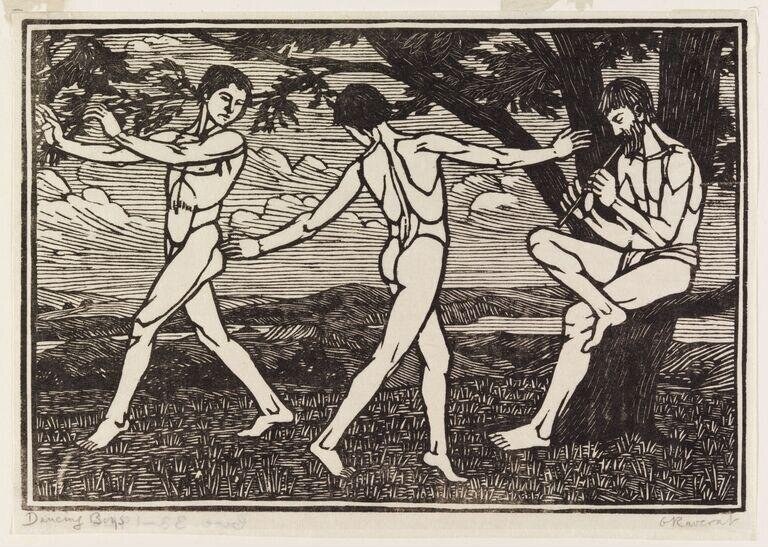
Three nude or semi-nude male figures dance in a wooded landscape, their bodies rendered in bold, high-contrast line work typical of early twentieth-century woodcut and engraving. The composition is organized in a shallow stage-like space bounded by dark tree trunks on either side. The ground is marked with dense linear hatching suggesting grass or earth. The central figure strides forward with one leg extended, arms raised in an open gesture; the figure on the left mirrors this motion with arms spread wide; the figure on the right is seated or crouching, one arm extended outward. The bodies are lean and youthful, depicted without anatomical realism but with expressive, elongated limbs. The light creates a stark play of white bodies against dark background, a visual effect that emphasizes movement and energy over naturalism. The setting is arcadian and timeless—no clothing, architecture, or props locate the scene in a specific place or era.
The dancing
All three figures are male and nude. The two standing figures move with arms fully extended and legs in active stride, suggesting contemporary modern dance or eurythmic movement rather than balletic alignment. The left-hand figure faces left in profile with both arms stretched wide; the central figure moves forward with arms raised and legs in a wide stance; the right-hand figure, seated, reaches one arm outward while the other rests on the knee. The bodies show no turned-out positioning or pointed foot work. Weight appears grounded and athletic rather than lifted. The spacing and body angles suggest these may be individual dancers moving in parallel rather than a partnered or group formation with formal structure.
The dance depicted
The image depicts an idealized, modernist vision of nude male dancers in nature, likely inspired by early twentieth-century aesthetics of eurythmic movement, classical revival, or expressionist modern dance. The subject belongs to the broader avant-garde exploration of the body and movement that engaged painters, sculptors, and dancers in the early 1900s. The lack of narrative costume or formal balletic vocabulary, combined with the emphasis on open, expansive gestures and grounded posture, suggests the influence of Duncan isadora or post-Duncanian contemporary dance philosophy—movement as natural, uninhibited expression rather than trained technique. However, without inscription or title, the precise choreographic identity cannot be determined. The work is more about the idea of dance than a specific dance form.
How it was made
This is a woodcut or engraving (linocut or wood engraving) printed from a single block. The bold, high-contrast black line and dense hatching are characteristic of Germanic Expressionist printmaking of the 1920s. The technique allowed rapid reproduction and circulation in publications, exhibitions, and collections—making such works widely accessible to the modernist avant-garde. The deliberate flatness and graphic boldness emphasize the spiritual or philosophical content rather than representation. The coarse, energetic line work conveys movement itself rather than describing form with precision.
About this work
Raverat's 'Dancing Boys' is a modernist print that fuses the aesthetic of Germanic Expressionism with early twentieth-century ideas about the body, nature, and dance. The work depicts three nude male figures in arcadian landscape, their poses and gestures suggesting contemporary modern dance or eurythmic movement rather than classical technique. The stark woodcut or engraving technique—bold black line, dense hatching, high contrast—amplifies the sense of raw energy and emotional immediacy. The image belongs to a broader movement in which visual artists engaged with dance and the moving body as vehicles for ideas about freedom, nature, and spiritual expression.
Raverat herself (1885–1957) was a British artist working in the orbit of modernism, and this print exemplifies the fascination with classical and mythological subjects that many modernist artists explored through the lens of contemporary movement aesthetics. The work sits at the intersection of printmaking, performance, and philosophy: it is neither a record of a specific dance nor a purely illustrative image, but rather a meditation on the aesthetics of movement itself.
How to look at it
Attend to the gesture and posture of the three bodies: the open arms, the grounded stance, the lack of turnout or pointed feet. These choices tell you the artist understood a mode of dance that rejected balletic convention. Notice the moment captured—not a leap or a lifted port de bras, but sustained expansion and reach. The dark line work and hatching create movement and energy through graphic means: the eye reads the stark contrast and bold line as conveying speed and emotion. The seated figure on the right, often overlooked, may represent rest or a different phase of the same movement sequence.
The artist
Gwen Raverat (1885–1957) was a British wood engraver and printmaker associated with the Neame and later circles of British modernism. She trained in wood engraving and was known for her bold, expressionist prints exploring mythology, nature, and the human figure. Her work often engaged with classical and contemporary themes rendered in stark, energetic graphic style. Raverat was part of the intellectual and artistic ferment of early twentieth-century Britain, where artists, dancers, and writers collaborated in exploring new forms of expression.
The period
In the 1920s, when this print was made, modern dance was establishing itself as an alternative to classical ballet. Isadora Duncan and her successors had legitimized the notion of dance as personal, expressive, and rooted in natural movement rather than codified technique. Simultaneously, visual artists across Europe—especially in Germany, where Expressionism was at its height—were fascinated by the figure in motion and by classical and mythological subjects reinterpreted through modernist aesthetics. Raverat's print belongs to this moment of cross-disciplinary ferment.
Where it lives
Held in a print collection (source listed as 'va' in the record). The work is a print, likely produced in multiple impressions, and would have circulated among collectors, galleries, and publications focused on contemporary art and printmaking.
Dance in this work
Questions about this work
Is this classical ballet?
No. The bodies are nude, the postures are grounded rather than lifted, and there is no turned-out positioning or pointed footwork. This is modern dance or eurythmic movement as reimagined through early twentieth-century artistic aesthetics.
Why are the figures nude?
Nudity was used by modernist artists and dancers to emphasize the natural, expressive body freed from social convention. It signals the influence of classical mythology and Isadora Duncan's philosophy of dance as natural human expression.
What technique is used?
This appears to be a woodcut or wood engraving, a relief printing technique that creates bold black lines and high contrast. The technique was popular with Expressionist artists and allowed for multiple reproductions and wide circulation.
Can you name the specific dance?
No. The work is a modernist meditation on movement itself rather than a record of a specific choreographed dance. It represents ideas about dance in the early twentieth century rather than a named form.
More dance artwork





