49 works in this view — arrow keys or swipe to move between them.
Dance in Art
Tamil dancing girl
Unknown
- Collection:
- Painting
- Source:
- Victoria and Albert Museum
- Rights:
- Rights vary by item — check the source record before reusing this image. Source record ↗
- Recorded as:
- V&A — check rights per item
This painting is one of the few surviving visual records of South Indian classical dance from the 18th century, predating photography and most written documentation of Bharatanatyam technique. It provides rare evidence of the appearance, costume, and social context of professional dancers in precolonial South India and shows how dance was represented in high courtly art.
What you are looking at
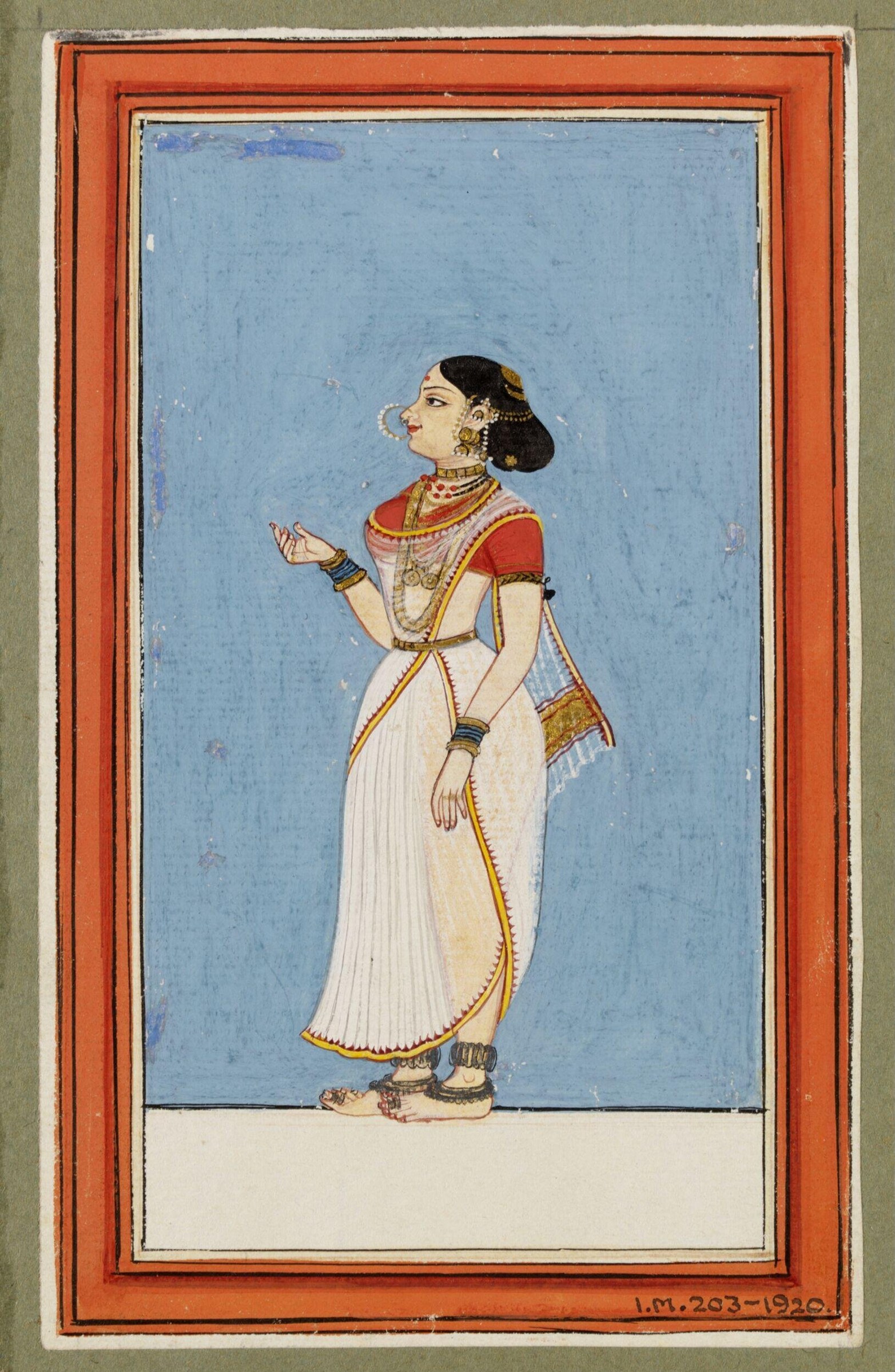
A single figure stands against a soft blue ground, rendered in the Mughal miniature style. The woman is shown in profile, facing left, wearing a fitted red silk blouse with short sleeves and a high embroidered collar, paired with a pleated white skirt that falls to her ankles. Her dark hair is gathered at the back of her head and adorned with gold ornaments. She wears multiple pieces of jewelry: a beaded necklace, bangles on both wrists, and anklets. Her right hand is raised in a gesture that suggests speech or greeting, while her left hangs at her side. A decorative scarf or dupatta drapes from her waist. The figure stands on a pale ground line against a background divided between the blue sky-like upper section and a white lower section, framed by an elaborate red and orange border typical of Mughal manuscript painting. The overall composition is formal and frontal, presenting the figure as a portrait rather than in active motion.
The dancing
The dancer is presented in a standing pose rather than mid-movement. Her posture is upright and composed, with weight evenly distributed. The raised right hand, with fingers gently extended, suggests a mudra or expressional gesture rather than locomotor movement. Her gaze is fixed to the left, and her body does not twist or turn despite the raised hand—this is a posed, presentational stance rather than a captured moment of dance.
The dance depicted
The costume and style identify this figure as a Tamil dancer, likely from South Indian temple or court tradition. The red blouse, pleated skirt, gold jewelry, and hair ornamentation are consistent with Bharatanatyam or related classical South Indian dance forms, though the static pose suggests this is a portrait of a dancer or a representation of a dancing girl as a type rather than a depiction of active performance. The raised hand could indicate a mudra (hand gesture) central to classical South Indian dance vocabulary, but the formal, almost heraldic presentation does not capture movement or sequence.
How it was made
This is a Mughal or Mughal-influenced miniature painting, executed in opaque watercolor (gouache) and gold leaf on paper. The technique employs the characteristic flattened perspective and jewel-like color palette of Indo-Persian manuscript illumination. The precise linework, careful modeling of the figure against the plain background, and ornamental border frame are typical of high-quality court or commercial Mughal studio production. The style suggests this was either a page from an album (muraqqa) of dancers and courtesans or a standalone work produced for a patron interested in documenting or collecting images of Indian dance traditions.
About this work
This is a portrait of a Tamil dancing girl rendered in the Mughal miniature tradition, a genre that flourished in 18th-century South Asia. The painting captures not the dynamic moment of performance but rather the appearance and adornment of a dancer as a figure type. The attribution of the work to Tamil dance and the date suggest it was created during or after a period of increasing cross-cultural artistic exchange in the Indian subcontinent, when Mughal and regional Indian artistic traditions overlapped. The work sits at the intersection of dance documentation, portraiture, and court or commercial art production.
How to look at it
Observe the raised hand and its delicate gesture, which may represent a specific mudra (hand position) from classical South Indian dance, though presented here in a static, formal pose rather than as part of a moving sequence. Notice the meticulous rendering of jewelry and textile detail—the embroidery on the collar, the pleating of the skirt, the gold ornaments—which demonstrates the artist's interest in documenting the material richness of a dancer's appearance. The frontal, portrait-like presentation suggests the work functions as documentation of a social type or individual rather than as a scene of performance.
The artist
The artist is unknown, as is typical for most Mughal studio works, which were often produced collaboratively or by court artisans whose individual names were not recorded. The style and execution suggest a professional workshop, likely operating in a major Mughal or Mughal-influenced court center such as Delhi, Lucknow, or Hyderabad in the 18th century. Such workshops produced albums, individual portraits, and narrative scenes for elite patrons.
The period
In the 18th century, the Mughal Empire was fragmenting into regional successor states, but Mughal artistic traditions remained influential across India. Simultaneously, European interest in Indian art and culture was growing. Miniature painting of dancers and courtesans became a commercial genre, catering to both Indian nobility and European collectors. Classical South Indian dance traditions like Bharatanatyam were undergoing changes due to social and religious upheaval; professional dancers held complex social status, and their representation in art reflected both respect for their skill and their complex positioning in society.
Where it lives
The catalogue record identifies this work as held in a collection with the source code 'va,' and it is catalogued as a painting dated 1780. The accession number L.M.283-1930 suggests it is part of an institutional collection, likely acquired in or after 1930. Without further documentation, the specific holding institution and acquisition history cannot be determined from the record.
Dance in this work
Questions about this work
What is she wearing and why does it matter?
The red silk blouse, pleated white skirt, gold necklace, bangles, and ankle ornaments are characteristic of classical South Indian dance costume, specifically the style associated with Bharatanatyam and related traditions. The precise rendering of these elements suggests the artist was documenting not an imagined or generic 'Indian dancer' but the actual costume conventions of a specific dance tradition, making this painting valuable evidence of how South Indian dancers dressed in the 18th century.
Why is she standing still if this is about dance?
This is a portrait of a dancer, not a depiction of active performance. The raised hand gesture hints at the hand vocabulary (mudras) central to South Indian classical dance, but the formal, heraldic pose and plain background indicate the work functions as a type portrait—documenting the appearance, dress, and status of a Tamil dancer for a patron's collection. Such static portraits were common in Mughal and Mughal-influenced miniature painting.
Who would have seen this in 1780?
This work was likely created for a court patron or for the commercial miniature painting market that catered to both Indian nobility and increasingly to European collectors. Such paintings were kept in albums (muraqqa) or framed individually in the homes or collections of the wealthy. It may have circulated within a Mughal or regional court, or it may have been sold to a European collector interested in Indian subjects.
How do we know this depicts a Tamil dancer specifically?
The catalogue title identifies her as a 'Tamil dancing girl,' and the costume—particularly the style of the blouse, the pleated skirt, the distinctive jewelry, and the arrangement of the hair—are consistent with South Indian rather than North Indian or Persian dance traditions. However, without an artist's inscription or documented provenance, the specific identification rests on the catalogue record and the visual evidence of costume.
More dance artwork





