49 works in this view — arrow keys or swipe to move between them.
Dance in Art
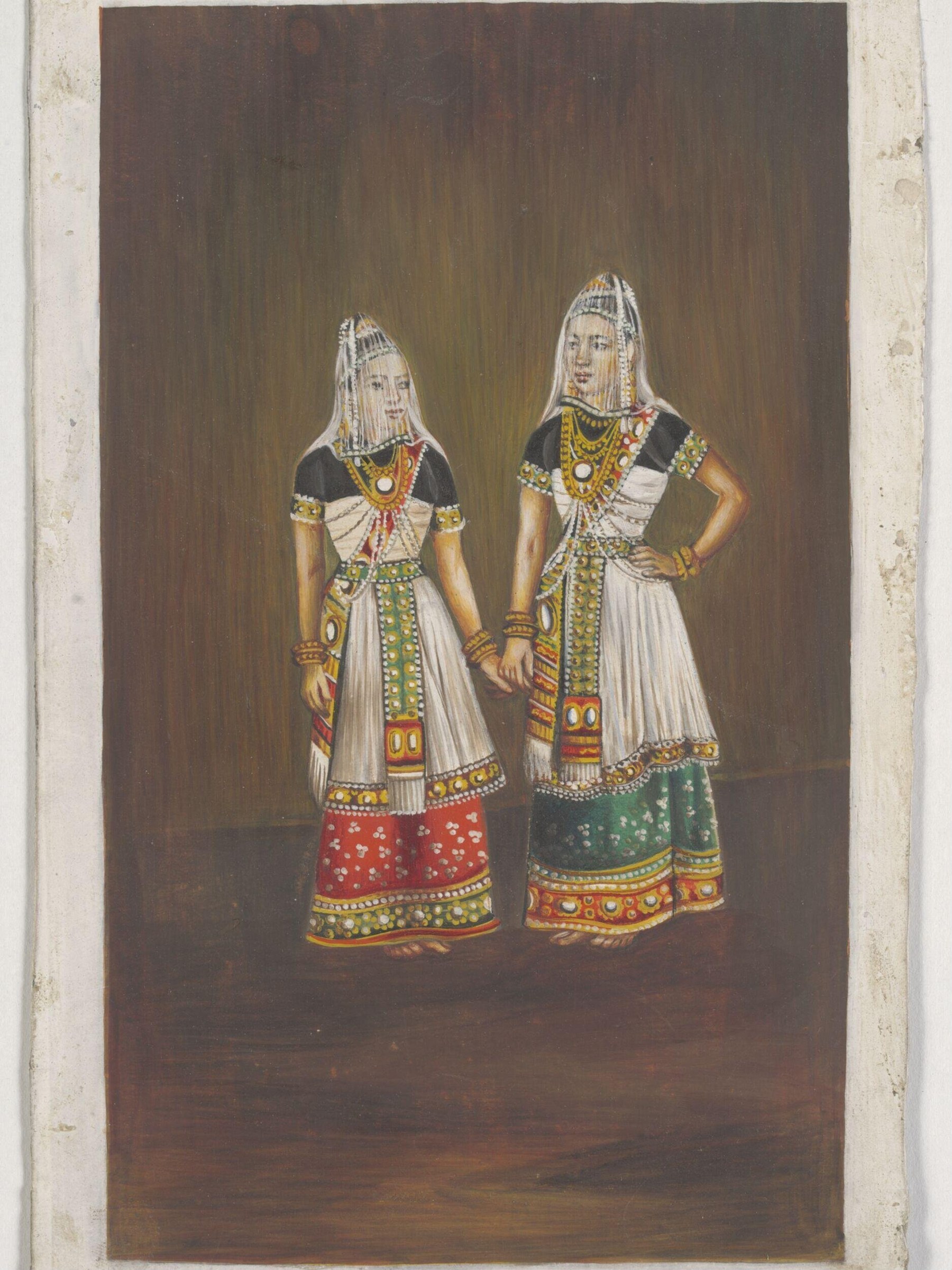
Two Manipuri dancing-girls standing together holding hands.
Unknown
- Collection:
- Painting
- Source:
- Victoria and Albert Museum
- Rights:
- Rights vary by item — check the source record before reusing this image. Source record ↗
- Recorded as:
- V&A — check rights per item
Manipuri dance was almost entirely unknown outside India in 1900, making this an exceptionally rare early European or British record of the form. The image documents a specific moment in the global circulation of Asian dance traditions, when lithographic reproduction and colonial-era collection networks made these performances visible to Western audiences for the first time. For historians of both Manipuri dance and of 19th-century cross-cultural artistic exchange, this work is primary evidence of how the tradition was presented and understood internationally.
What you are looking at
Two young women stand side by side against a dark brown background, holding hands in a gesture of companionship or narrative connection. Both wear elaborate classical Indian dance costumes: black short-sleeved blouses embroidered with gold thread, white pleated skirts, and draped scarves or orhni in cream and patterned fabrics. The figure on the left wears a red patterned skirt with gold borders; the one on the right wears a green patterned skirt. Both have ornate gold jewelry including necklaces, bangles, and waist ornaments. Their headdresses are distinctive: tall, elaborately pleated white head coverings with gold crown-like finials and draped extensions. The faces are finely detailed with serene expressions, rendered in watercolor or gouache with careful attention to skin tone and facial features. The artist has given particular attention to the textile patterns and jewelry, which are rendered in precise gold leaf or gold paint.
The dancing
The dancers stand in an upright, formal posture with heads held high and faces turned slightly toward the viewer. Their bodies are vertical and composed rather than in active motion. One arm is extended to hold hands while the other hangs at the side or rests near the body. The weight distribution suggests standing stillness rather than the dynamic shifting weight of active dance. Both figures are of similar height and their positioning is symmetrical, creating a mirror-like composition that emphasizes their identity as a pair.
The dance depicted
This is Manipuri (also called Manipur or Chhabi Bilas), the classical dance form of Manipur, a northeastern state of India. The costume is characteristic: the highly pleated cylindrical skirt (mekhela), the embroidered blouse (choli), the draped orhni, and the tall conical headdress (maching). The formal, frontal pose and hand-holding suggest either a preparatory moment before dance, a choreographed tableau within a performance, or a documentary representation of costume and formal bearing rather than a moment of active movement. The image captures the gravity and formality of the tradition rather than its fluidity.
How it was made
This is a hand-colored lithograph or watercolor and gouache on paper, likely from a colonial-era publication documenting Indian dance and costume. The technique—careful line work combined with watercolor washes and gold leaf or paint highlights—was common in 19th-century illustrated ethnographic and theatrical documentation. The precision of the costume details and the formal symmetry suggest it was intended as a reference work or souvenir image, circulating among collectors, scholars, and the theater-going public interested in 'native' performance traditions.
About this work
This 1900 image documents the Manipuri classical dance tradition of northeastern India at a moment when European and British audiences were developing a fascination with non-Western performance forms. The two dancers, rendered with formal grace and meticulous attention to textile and jewelry detail, represent a tradition that would gain international recognition only decades later. The work sits at the intersection of ethnographic documentation and artistic representation, capturing not a dynamic moment of dance but the formal, composed presence of trained performers in full ceremonial dress. It is one of very few visual records of Manipuri dance costume and presentation from this early period, before extensive photographic documentation.
How to look at it
Attend to the formal, static quality of the pose: these dancers are not captured in motion but in presentation. The hand-holding connects them visually and narratively, suggesting a story or relationship, but their bodies remain still and composed. The eye should move across the surface of their costumes—the pleating of the skirts, the gold embroidery, the jewelry—which are rendered with far greater detail and emphasis than the dynamics of gesture or movement. The headdresses are particularly striking and alien to European eyes of 1900; they are among the most visually distinctive elements and likely drew the viewer's attention first. The symmetry of the composition and the formal frontality suggest this is a presentation image—costume documentation—rather than a narrative of action.
The artist
The artist is unknown. The work's style and format suggest it was created by a commercial lithographer or illustrator working in British India or for a London or European publishing house specializing in ethnographic and theatrical subjects. The precision and standardization of the image suggest it may have been based on a photograph or a live performance witnessed by the artist, or compiled from multiple sources.
The period
In 1900, Indian classical dance traditions were being systematically documented and reproduced for Western consumption. The late 19th and early 20th centuries saw a surge in ethnographic publications, illustrated journals, and souvenir prints circulating images of 'exotic' performance forms. Manipuri dance in particular was virtually unknown internationally until the 1920s–1930s, when dancers like Guru Bipin Singh began touring Europe and America. This image predates that international exposure and represents an earlier phase of documentation, when such images were rare, often mediating between live performance and printed circulation. In European art, the period was marked by Orientalism and fascination with non-Western aesthetics, which shaped both the production and reception of such images.
Where it lives
The work is held as a painting in a collection noted as 'va' (likely Virginia or an abbreviation for a specific institution). No further provenance information is recorded. The work's precise origin, publisher, and circulation history are not documented in the available record.
Dance in this work
Questions about this work
Is this actually a dance, or just people in costumes?
The image presents the dancers in a formal, still pose rather than capturing active movement. However, the costumes, jewelry, and headdresses are specifically those worn in Manipuri classical dance performance. The image likely represents either a moment of formal preparation or presentation before or between dance movements, or a documentary/costume reference image. It shows us the tradition through stillness and formal bearing rather than through dynamic gesture.
How do we know this is Manipuri dance?
The costume is unmistakable: the highly pleated cylindrical skirt (mekhela), the short embroidered blouse (choli), the draped scarf (orhni), and especially the tall conical pleated headdress (maching) are signature elements of Manipuri classical dress. The catalogue record also identifies the dancers as 'Manipuri dancing-girls.' No other major Indian dance tradition uses exactly this combination of costume elements.
When did Manipuri dance become known in the West?
This 1900 image is extraordinarily early. Manipuri remained virtually unknown outside India until the 1920s–1930s, when pioneering dancers like Guru Bipin Singh toured Europe and America. This print likely circulated among a small circle of collectors, scholars, and theater enthusiasts interested in ethnographic documentation, but it predates the major wave of international recognition.
Why are both dancers posed identically?
The symmetrical, mirrored composition emphasizes their identity as a pair and creates a formal, ceremonial quality. This may reflect an actual choreographic moment (Manipuri has strong traditions of paired dancing), or it may be an artistic choice by the printmaker to create visual balance and harmony. The pose is more about presentation than narrative action.
More dance artwork





