49 works in this view — arrow keys or swipe to move between them.
Dance in Art
Youth Club Series
Hammerschlag, Margarethe
- Collection:
- Drawing
- Source:
- Victoria and Albert Museum
- Rights:
- Rights vary by item — check the source record before reusing this image. Source record ↗
- Recorded as:
- V&A — check rights per item
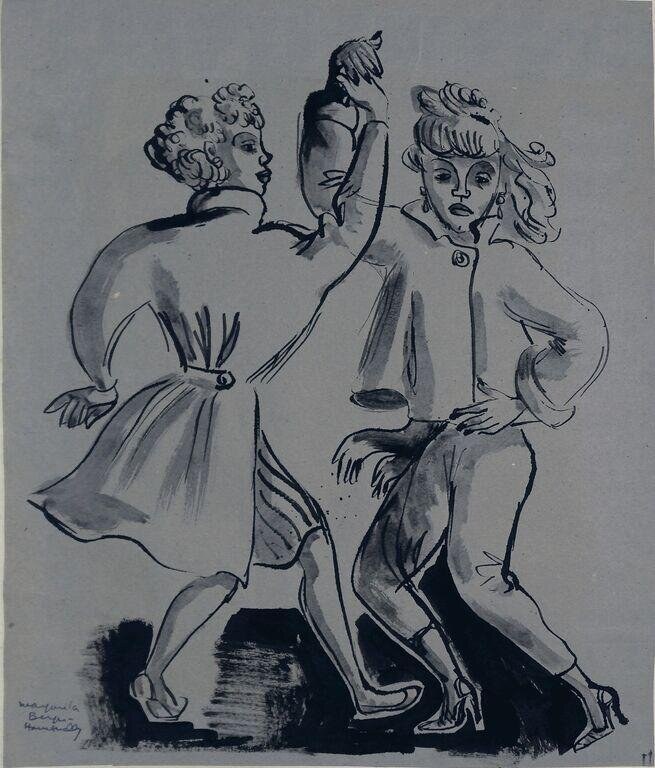
This drawing is significant evidence of how social dancing functioned in postwar American youth culture—not as formal instruction or theatrical spectacle, but as everyday courtship and recreation. The series title and the artist's choice to document the scene with caricatural immediacy tells us that youth club dancing was considered newsworthy and culturally interesting enough to illustrate for popular consumption. For dancers and historians studying swing, ballroom, and youth culture of the 1950s, such images provide crucial context for understanding where and how these dances actually happened.
What you are looking at
A pen and ink drawing showing three young women in 1950s dress engaged in social dancing. The composition is a compact, overlapping group arranged diagonally across the page. The woman on the left, seen from behind, wears a fitted dress with puffed sleeves and has styled curled hair; she faces a man in a suit and fedora hat positioned centrally. The woman on the right, frontally posed, wears a similar period dress and displays an animated expression. The figures are rendered with expressive, sketchy linework that suggests movement and spontaneity. The setting is minimal—a dark brushed ground at the bottom anchors the figures—allowing focus to remain entirely on the dancers and their interaction. The style is caricature or social illustration rather than formal portraiture, capturing a moment of youthful leisure and flirtation.
The dancing
The three figures adopt varied positions within close physical proximity, suggesting active partnering. The man's raised arm and angled posture suggest he is leading or initiating movement. The woman on the left leans away slightly, her body responsive to the man's gesture; the woman on the right stands more frontally, her gaze and body language suggesting engagement or amusement. All three are upright and mobile rather than in a fixed ballroom hold. The linework emphasizes the movement of fabric—particularly skirts—and the tilt of heads, conveying momentum rather than stillness.
The dance depicted
This appears to be social partner dancing of the 1950s leisure variety, most likely swing, jitterbug, or general ballroom social dancing of the postwar American youth culture. The title 'Youth Club Series' suggests these are scenes of adolescent or young adult social activity in a recreational setting. The informality of pose and the sketch aesthetic suggest this is documentary or journalistic illustration of actual youth behavior rather than theatrical dance. The composition—particularly the woman on the left angling away while the man's arm reaches—echoes the push-pull dynamics of swing dancing, though the specific style cannot be definitively identified from gesture alone.
How it was made
The work is executed in pen and ink with tonal wash, likely on paper. The artist employed loose, gestural linework combined with areas of dark wash or shadow to create volume and depth. The technique is economical and expressive rather than detailed or refined, consistent with social illustration or caricature drawing intended for rapid production and popular consumption. This method allowed for quick capture of movement and character, suitable for editorial illustration, advertisement, or documentary recording of contemporary youth culture. The sketchy approach gives the work an immediacy that suggests observation from life rather than studio composition.
About this work
This is a pen-and-ink social illustration documenting 1950s youth culture dancing, part of Margarethe Hammerschlag's 'Youth Club Series.' The drawing captures three young dancers in an informal partnership, rendered with expressive linework that conveys movement and social interaction. The work sits at the intersection of social documentation and caricature, typical of mid-twentieth-century illustration practice. For dance historians, it provides evidence of how swing and ballroom social dancing was practiced and understood in the postwar American youth club setting—not as formal technique but as casual, flirtatious leisure activity. The work belongs in this gallery as a record of vernacular, social dance rather than theatrical performance, and as a document of how artists represented dance in popular culture.
How to look at it
Attend to the overlapping arrangement of the three figures and the way the artist has captured mid-movement poses rather than a static moment. The woman on the left's angled torso and the man's reaching arm suggest the push-pull dynamic of partnered social dancing. Notice the emphasis on dress—particularly the treatment of skirts and the styling of hair—which locates this specifically in 1950s youth culture. The expressive linework and the lack of a formal ballroom setting tell you this is casual, social dancing rather than theatrical or competitive dancing; the sketch technique itself conveys immediacy and observation rather than idealization.
The artist
Margarethe Hammerschlag was a mid-twentieth-century illustrator and graphic artist. Little biographical detail is readily available, but the 'Youth Club Series' indicates she was engaged in social illustration and documentary drawing of contemporary life, likely working for editorial or advertising purposes. Her loose, expressive style and focus on youth culture situates her within the tradition of American social realism and illustration that flourished in the 1930s-1950s.
The period
In the 1950s, social dancing was a primary form of youth recreation and courtship in America. Swing and ballroom dancing had been central to youth culture since the 1930s-40s, and the postwar era saw their continued popularity in youth clubs, dance halls, and community centers. Simultaneously, illustration and graphic design were vital means of documenting and celebrating contemporary life; American illustrators frequently depicted social scenes as markers of modern, democratic leisure. Hammerschlag's series reflects this cultural moment when youth culture itself—including the ways young people danced—was a subject worthy of artistic attention and public interest.
Where it lives
The work is held in the VA (Victoria and Albert Museum) collection and is catalogued as a drawing. It is part of the 'Youth Club Series,' suggesting it was one of a set of illustrations documenting youth culture, likely created for publication or exhibition.
Dance in this work
Questions about this work
What dance are they doing?
The specific style is not absolutely clear from the image alone, but the era, setting, and body positions suggest swing, jitterbug, or general 1950s ballroom social dancing. The woman leaning away while the man reaches suggests the characteristic push-pull action of swing. Without more documentary evidence, the safest identification is 'social ballroom or swing dancing of the 1950s youth culture.'
Why is there a man in a dance drawing?
This is social partner dancing, which by definition involves both men and women (or multiple partners) dancing together. The artist chose to show the courtship and leisure aspect of youth culture, which meant depicting mixed-gender partnerships. The man's presence is essential to the scene's meaning.
Is this a finished artwork or a sketch?
It reads as a finished illustration rather than a preliminary sketch. The composition is resolved, the line is confident, and the tonal values are deliberately deployed. However, the technique is expressionistic and economical rather than highly detailed—typical of social illustration and caricature, which valued immediate communicativeness over refinement.
More dance artwork





