49 works in this view — arrow keys or swipe to move between them.
Dance in Art
The Dancing Academy
Cruikshank, George
- Collection:
- Source:
- Victoria and Albert Museum
- Rights:
- Rights vary by item — check the source record before reusing this image. Source record ↗
- Recorded as:
- V&A — check rights per item
Cruikshank's satires of dancing academies and social manners are primary visual documents of how dance was taught, valued, and experienced in Regency London. The print reveals the gap between prescribed social behavior and authentic human response—a tension that historians of dance, manners, and childhood can use to understand the period's anxieties about propriety and instruction.
What you are looking at
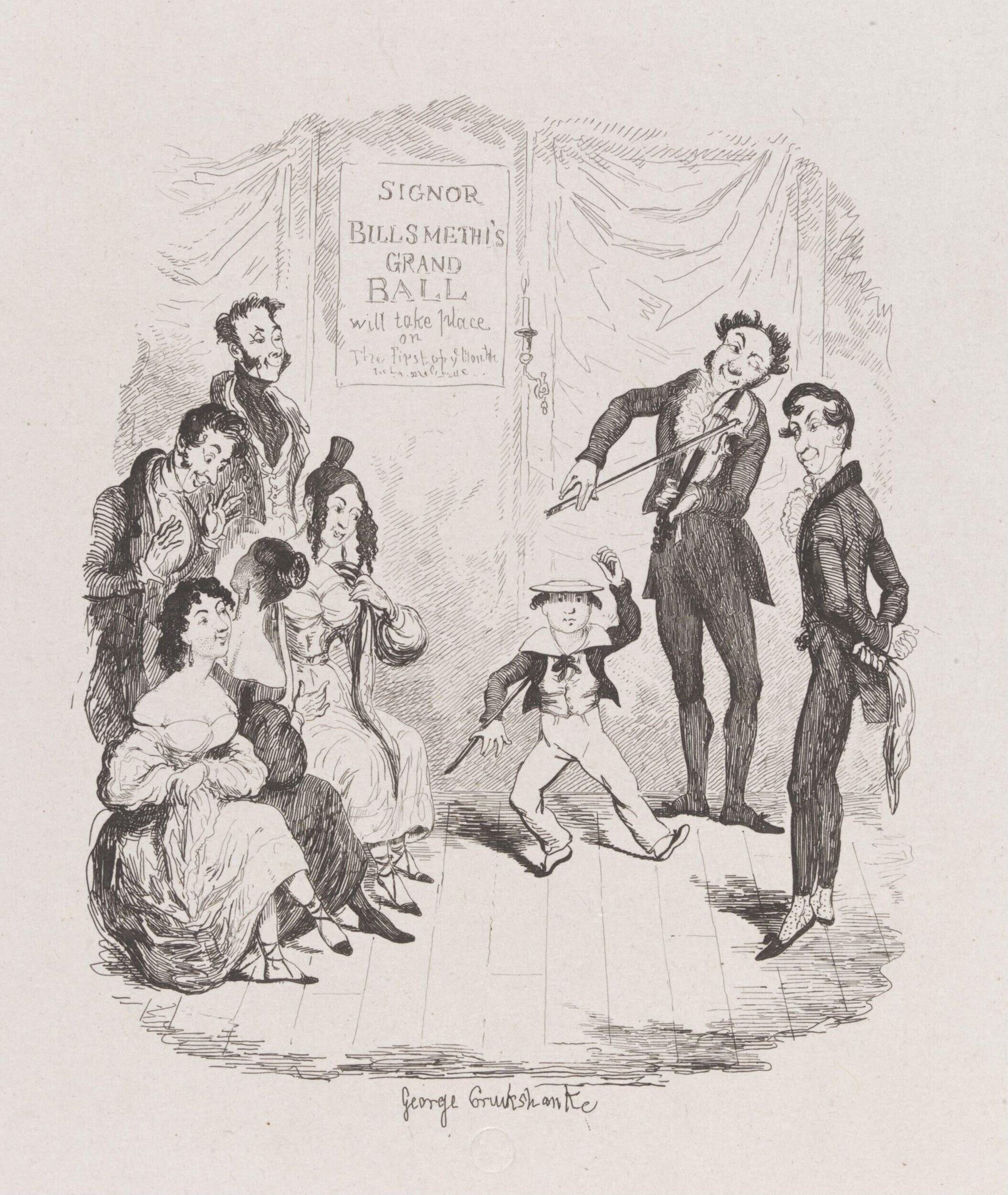
A crowded interior scene depicts the moment a dancing academy advertisement is being read aloud to an assembled group. At center, a placard announces 'SIGNOR BILLSMETHIS GRAND BALL' on a specified evening. The composition is packed with figures in Regency-era dress: women in empire-waist gowns with puffed sleeves sit and stand at left; men in fitted coats and breeches occupy the right side. A small child in the foreground, dressed in adult formal wear including a top hat, has begun to dance—feet kicked up in an exuberant leap or skip. The other figures watch with expressions ranging from amusement to bewilderment. The setting appears to be an indoor reception room with draped fabrics visible in the background. The sketch is executed in Cruikshank's characteristic style: rapid pen lines with cross-hatching for shadow and volume, capturing movement and emotion through economical mark-making.
The dancing
The central dancing figure is a child in miniature formal dress executing a spontaneous, uncontrolled hop or skip—weight lifted, legs bent, arms held at the sides in a posture of abandon rather than instruction. The surrounding adults are stationary, adopting the formal, upright carriage of Regency social posture: women seated or standing with hands folded or gesturing, men standing with hands in pockets or at their sides. No formal dance hold is present; this is not a demonstration of technique but a comic outburst of enthusiasm.
The dance depicted
This is not a depiction of a specific dance style but a satirical scene of social dancing culture in Regency London. The humor lies in the child's uninstructed, enthusiastic response to news of a grand ball—a moment of genuine joy contrasted with the restrained decorum expected of adults. The image mocks both the formality of dancing academies and the stilted manners of polite society, suggesting that the child's natural impulse to dance is more honest than the choreographed performances of adults.
How it was made
This is a pen-and-ink engraving or etching, executed with the rapid linear style characteristic of Cruikshank's satirical work. The technique employs fine parallel lines (hatching) for shading and volume, allowing fine detail in dress and facial expression while maintaining a sketch-like immediacy. The medium was well-suited to serial publication in periodicals and satirical prints, making such work widely accessible and reproducible. Cruikshank's hand is evident in the economy of line and the expressive distortion of features for comic effect.
About this work
This is a satirical engraving by George Cruikshank depicting the social absurdity of Regency dancing culture. It captures the moment when a child, on hearing of a forthcoming grand ball, spontaneously begins to dance with unschooled enthusiasm—a gesture that contrasts sharply with the formal restraint of the assembled adults. The work belongs in a gallery of dance imagery not because it depicts a dance style or technique, but because it uses dance as a lens for social and behavioral satire. It reveals how dance functioned in Regency society: as a formal accomplishment to be mastered under instruction, yet also as an impulse that could break through propriety, especially in the young.
How to look at it
Attend to the contrast between the child's body in motion—genuinely off the ground, limbs loose, expression unconstrained—and the vertical, static postures of the adults surrounding him. Notice Cruikshank's use of the child's small scale within the composition: he is dwarfed by the room and the assembly, yet his moment of movement is the visual and emotional center. The placard announcing the ball is secondary; it is the child's response that makes the image satirical. Look also at the faces: the adults' expressions register varying degrees of surprise, amusement, and disapproval, telling a story about how spontaneous dance was received in polite society.
The artist
George Cruikshank (1792–1878) was England's pre-eminent satirical engraver and illustrator, known for his mordant social commentary delivered through accessible print media. His work appeared in periodicals and as individual prints sold cheaply to a broad audience. Cruikshank specialized in scenes of everyday life, social folly, and instruction gone awry, using exaggerated physiognomy and gestural comedy to expose vanity and pretension. His technical skill in engraving was matched by his keen eye for the absurd in contemporary manners and institutions.
The period
The Regency era (1811–1820, though the cultural period extended into the 1830s) saw a codification of ballroom dancing through the rise of professional dancing masters and academies. Authors like Thomas Wilson published detailed instruction in cotillion, quadrille, and country dances, aiming to standardize movement and ensure social correctness. Simultaneously, satirical prints mocking such earnest efforts at refinement were immensely popular, reflecting both admiration for and skepticism about the commodification of etiquette. Cruikshank's work sits at this intersection: he documents the academy system while lampooning its pretensions.
Where it lives
The work is held as a print in a collection indexed as 'va' (likely a British archive or museum). Cruikshank's satirical prints circulated widely in his lifetime as individual sheets and in bound collections; this work is characteristic of his output for the 1830s.
Dance in this work
Questions about this work
What is Signor Billsmethis's grand ball?
The placard announces a forthcoming ball or dance event. 'Signor' suggests an Italian or Italian-styled dancing master—a common figure in Regency London who taught fashionable dances. The point of Cruikshank's satire is that the formality and hype surrounding such events are undermined by the simple, honest joy the child experiences on hearing about them.
Is the child actually dancing, or just jumping?
The child is executing an exuberant, uncontrolled hop or skip—a spontaneous physical response rather than a learned dance step. Cruikshank's satire turns on this distinction: the child dances without instruction, while the adults wait to be taught. The 'dance' here is natural impulse, not choreography.
What does this tell us about Regency dancing?
The image suggests that dancing in this era was a formal, taught accomplishment rather than a social pleasure—something one learned from masters in academies rather than experienced naturally. The satire implies skepticism about this professionalization and a nostalgia for unschooled physical joy. It also documents the real existence of commercial dancing academies and the social anxiety around mastering them.
Why is the child dressed as an adult?
Children in Regency society were often dressed in miniature versions of adult formal wear, especially for social occasions. Cruikshank exaggerates this in the image for comic effect: the child's top hat and formal coat make his spontaneous dance all the more ridiculous and poignant—he is costumed for solemn propriety but moved by genuine feeling.
More dance artwork





