49 works in this view — arrow keys or swipe to move between them.
Dance in Art
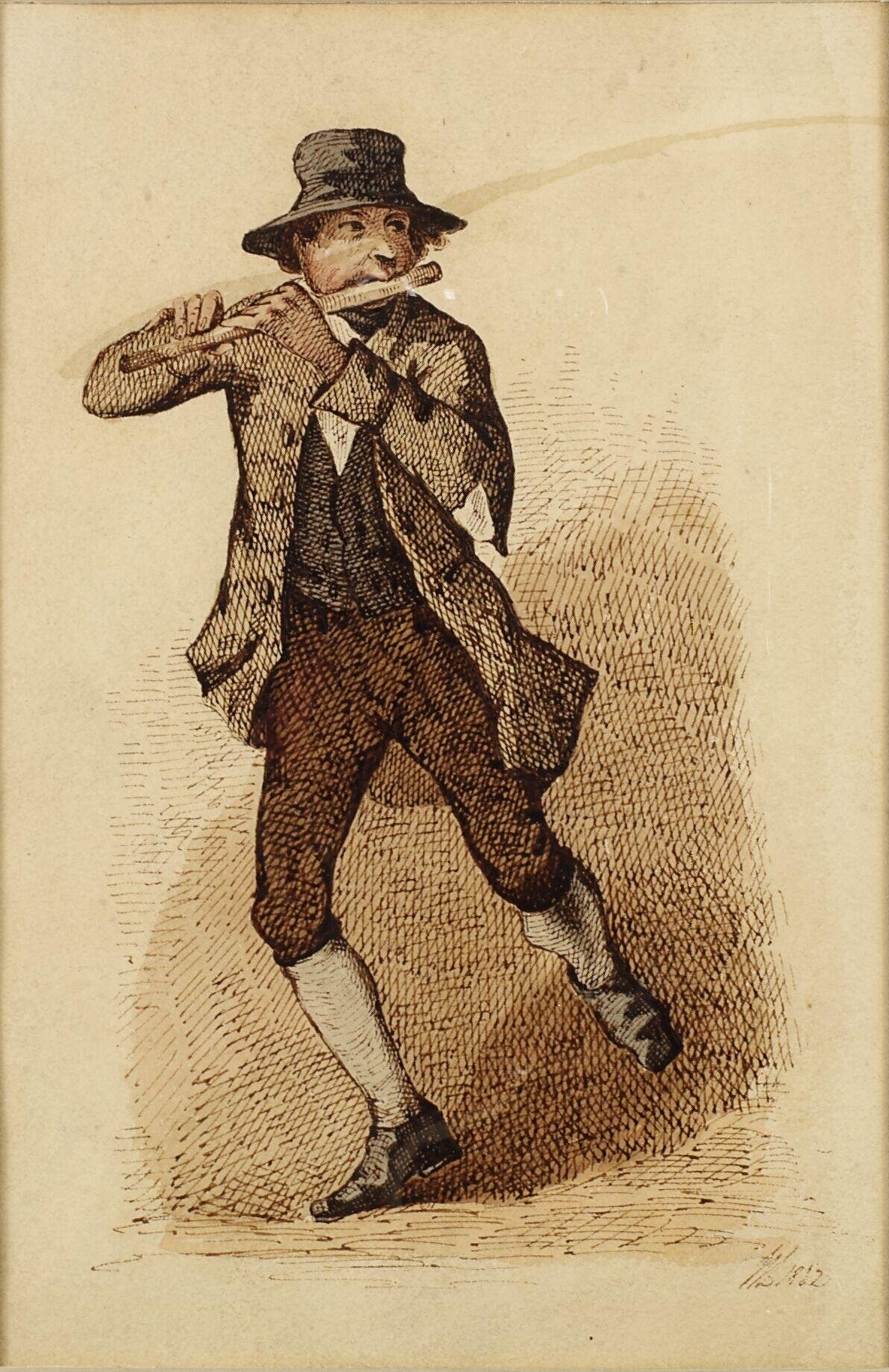
An Irish flute player dancing a jig
Low, William
- Collection:
- Watercolour drawing
- Source:
- Victoria and Albert Museum
- Rights:
- Rights vary by item — check the source record before reusing this image. Source record ↗
- Recorded as:
- V&A — check rights per item
This is rare visual evidence of how an Irish jig was actually performed in the early 19th century, before stage Irishness and theatrical conventions reshaped the dance. It shows the jig as a street and home tradition, danced by musicians who played while they moved, with upper-body restraint and lower-body dynamism. For dancers and historians, it is proof that the form documented here is the direct ancestor of modern Irish step dance.
What you are looking at
A single male figure dominates the composition, captured mid-dance in a dynamic diagonal stride across the frame. He wears early 19th-century dress: a dark coat with wide lapels and patterned cross-hatching, brown breeches, white stockings, and dark shoes. His tall cylindrical hat sits squarely on his head. The figure's body leans forward with energy, his left leg extended in a pronounced stride while his right supports his weight, and his left arm is raised to shoulder height holding a wooden flute horizontally to his mouth. His right arm hangs at his side. The background is rendered in light parallel hatching that suggests depth without defining a specific locale; the figure appears to move across an undefined ground. The entire work is executed in brown ink with careful cross-hatching for shadow and volume, characteristic of early 19th-century reproductive print techniques.
The dancing
A single dancer shown in a forceful forward stride, leaning from the hip with substantial forward propulsion. The extended left leg and supporting right leg create the characteristic spring of a jig, a fast Irish step dance. The flute remains at the mouth throughout the movement, suggesting the dancer is both musician and dancer—a common practice in traditional Irish music. The upper body remains relatively stable despite the dynamic leg action, with the arm positions open and unrestrained, consistent with traditional Irish step dancing's upper-body control.
The dance depicted
This is a jig, the Irish step dance most commonly danced to flute accompaniment. The image captures the essential character of the form: rapid footwork in a springing rhythm, the dancer providing his own musical accompaniment on the wooden flute. The costume—respectable middle-class dress of the 1820s–30s—and the informal setting suggest this was a social or street performance rather than a formal theatrical event. The jig was a ubiquitous dance across Ireland and the Irish diaspora in this period, performed in homes, at fairs, and in the streets, often by working musicians who danced and played simultaneously.
How it was made
This is a hand-colored engraving or aquatint, identifiable from the fine parallel hatching lines (cross-hatching and directional shading) that model form and create tonal depth. The brown ink outline and the restrained palette—browns, tans, and touches of red for the face—suggest hand-coloring applied to a printed base. The technique allowed for wide circulation and reproducibility; such prints were affordable and common in the 1820s–30s, reaching working-class audiences and travelers. The careful rendering of fabric texture through hatching shows the engraver's skill in capturing the weight and drape of the coat and the pattern of the breeches.
About this work
This is a portrait of an Irish street musician and dancer, frozen in the act of performing a jig while playing the flute—a common sight in early 19th-century Ireland and in Irish communities in Britain and America. William Low's print documents a vernacular dance form and a mode of performance that was already becoming a subject of antiquarian and romantic interest as industrialization and emigration reshaped Irish life. The image preserves not only the steps and posture of the dance but also the social context in which it was performed: by working musicians in everyday dress, in public spaces, as entertainment and livelihood. It is a record of dance as it was lived, not as it was staged.
How to look at it
Pay attention to the suspended moment: the dancer's body is in mid-stride, with one leg extended and the other bearing weight, creating the impression of forward momentum frozen on the page. The flute at the mouth is the key detail—it tells you this is not just a dance but a performance of music and movement together. Notice the restraint in the upper body despite the vigorous leg action: the shoulders are square, the torso upright, the head level. This is the Irish jig, not a wild caper, and the engraver has caught its essential character—rhythmic footwork, musical accompaniment, and controlled carriage.
The artist
William Low was a British engraver and print maker active in the early 19th century, known for social and character studies rendered in fine hatching. His work often captured street life, working-class figures, and regional types with a combination of documentary precision and romantic sentiment. Prints of this kind were issued individually or in series and sold to a broad audience; they were affordable, portable, and served as both entertainment and a form of ethnographic record.
The period
The 1830s saw a growing romantic and antiquarian interest in Irish culture, music, and dance, even as economic hardship and emigration were accelerating. The jig had been a staple of Irish social life for centuries, but it was increasingly being collected, documented, and presented as a symbol of Irish national identity. Simultaneously, Irish dance was beginning its long process of formalization and theatricalization—a movement that would accelerate through the 19th century and culminate in the competitive step-dance forms of the 20th. This print captures a moment of transition, when the jig was still primarily a living vernacular practice but was beginning to be seen as a subject worthy of artistic attention and preservation.
Where it lives
Held as a watercolor drawing in the collection recorded as 'va' (likely Victoria and Albert Museum, London), this work is catalogued as a watercolor but is more likely a hand-colored engraving or aquatint based on its technique. It dates to 1832 and bears Low's signature or mark.
Dance in this work
Questions about this work
How do we know this is a jig and not some other dance?
The title names it explicitly, and the visual evidence supports this: the rapid, springing stride and the forward propulsion are characteristic of jig footwork. The flute accompaniment is also typical—jigs were danced to flute, fiddle, or pipes, often played by the dancer themselves. The costume and setting (street or informal venue) match the social context of jig dancing.
Did Irish dancers really play flutes while they danced?
Yes, frequently. Street musicians and dancers often combined both skills, providing their own accompaniment and making performance more marketable. This was especially common in the 18th and 19th centuries, before dance professionalization separated the roles of musician and dancer.
Is this the same as modern Irish step dance?
This is a direct ancestor, but not identical. Modern competitive Irish step dance developed its current form through the 20th century, with more rigid upper-body control and more formalized footwork sequences. What you see here is the jig in its looser, more individual, pre-formalized state—still energetic but less codified.
Who was William Low?
Low was an early 19th-century British engraver specializing in social and character studies, particularly of working-class and regional figures. Prints like this one were sold individually or in sets to a general audience and served both as entertainment and as a form of visual documentation of daily life.
More dance artwork





