49 works in this view — arrow keys or swipe to move between them.
Dance in Art
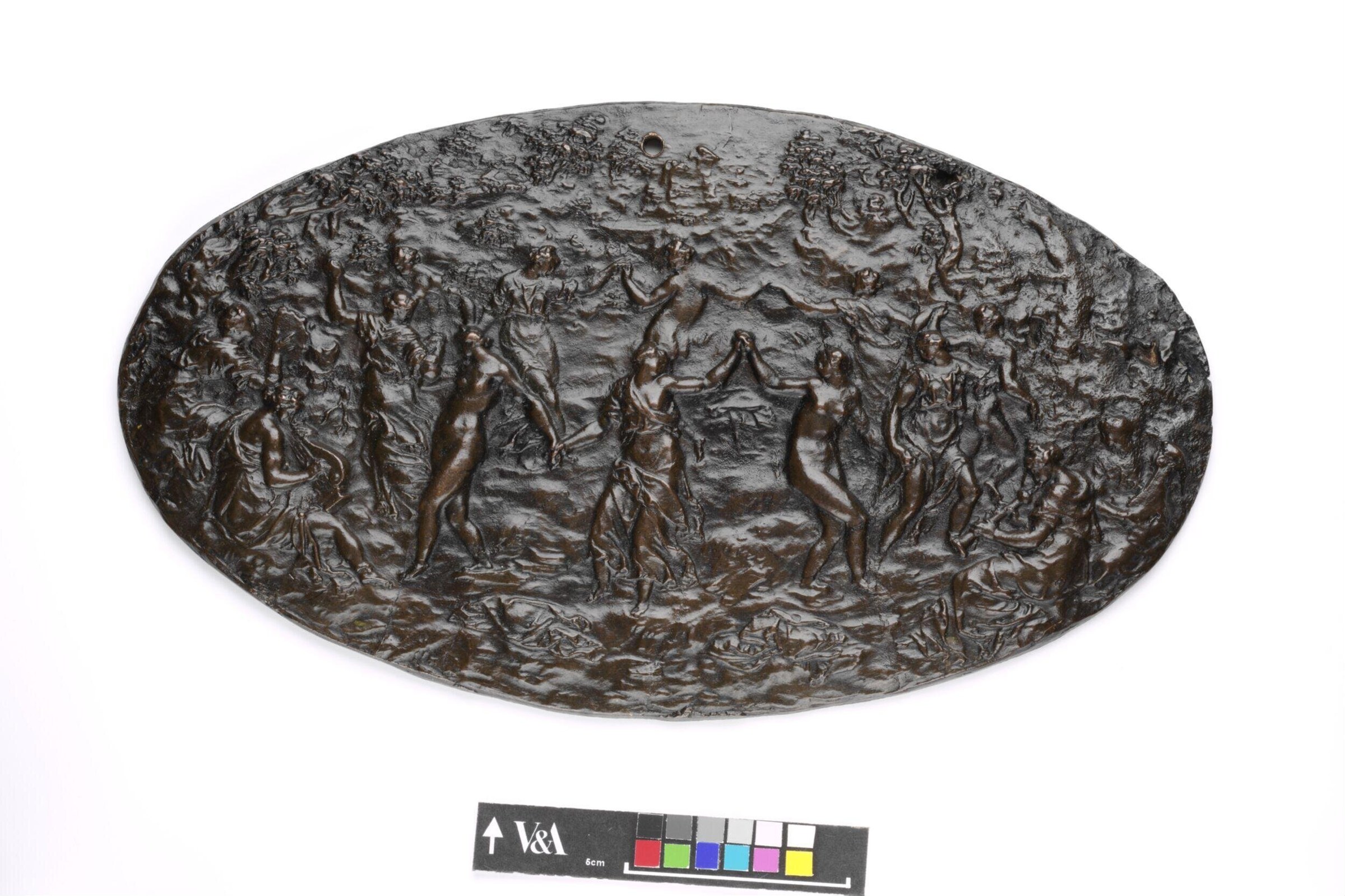
Nymphs Dancing
Cobaert, Jacob Cornelisz
- Collection:
- Plaquette
- Source:
- Victoria and Albert Museum
- Rights:
- Rights vary by item — check the source record before reusing this image. Source record ↗
- Recorded as:
- V&A — check rights per item
This is a primary source for understanding how Renaissance and early modern artists portrayed ideal movement and the body in motion. The work shows that dance imagery existed in multiple registers—some highly formal and prescriptive, some frankly fantastical and erotic—and that collectors valued scenes of mythological abandon alongside the rigid choreographies of the ballroom.
What you are looking at
This oval bronze plaquette depicts a densely populated scene of mythological nymphs in motion across a shallow, rocky landscape. The composition is crowded with nude or lightly draped female figures distributed across the entire surface, creating a sense of continuous movement and revelry. Some figures dance in pairs or small groups; others leap, gesture, or recline. The modelling is high relief with considerable depth variation, allowing light to catch the musculature and drapery. Trees or vegetation appear at the edges, and the ground is suggested by rocky outcrops. The overall effect is one of uninhibited celebration—a bacchanal or woodland revel—executed with the technical precision characteristic of Renaissance and early modern metalwork.
The dancing
The nymphs display highly varied postures: some stand with arms raised or extended in open gestures; others appear mid-leap with legs splayed; several are in pairs suggesting physical contact or partnering. The bodies show classical training in their proportions and articulation. Few wear substantial garments; those that do wear light drapery that clings or floats around the form. The poses are exuberant and uncontained—very different from the geometric precision of court dance. There is no sense of formal partnering, closed positions, or aligned lines; instead, the movement reads as spontaneous, ecstatic, and communal.
The dance depicted
The scene represents a mythological or allegorical bacchanal rather than a documented historical dance. Nymphs in Renaissance and early modern art embody ideals of natural grace, sensuality, and freedom from courtly constraint. The poses suggest a generic antique 'revelry' rather than a specific named dance, though the tradition of representing such scenes was well established in painting and sculpture. The work captures not technique but a spirit of uninhibited movement—a fantasy of what dance might be outside the formality of court performance. The fluidity and varied directions of the figures suggest the artist's aim to convey motion and abandon rather than precision.
How it was made
This is a bronze plaquette—a small-scale relief intended for collection, display on a piece of furniture, or mounting as a decorative element. The oval format and high finish are typical of the genre. Bronze plaquettes could be cast from models, allowing some circulation of popular designs, though each cast could vary. The relief technique permits considerable surface modelling and light-play across the forms, crucial here for suggesting the musculature of active, undraped bodies. The work would have circulated among educated collectors and patrons with access to classical knowledge; it is not a mass medium but a luxury object.
About this work
This oval bronze plaquette depicts a mythological assembly of nymphs engaged in ecstatic movement and celebration. It belongs to a long tradition of Renaissance and early modern representations of antique revelry—visual fantasies of uninhibited, sensual movement standing apart from the codified dances of the court and salon. The work is attributed to Jacob Cornelisz Cobaert, a Flemish artist active around 1590, a period when such Italianate mythological scenes were fashionable among Northern European collectors.
The plaquette documents not a specific dance form but an aesthetic ideal: the representation of movement as natural, exuberant, and free from formal constraint. In this respect it complements and contrasts with contemporary court dances of the period—minuets, pavanes, and galliards—which were governed by strict geometry and deportment. The work is evidence of how dance imagery circulated in the minor arts and what fantasies about movement were cultivated among collectors.
How to look at it
Note the variety of poses and directions: no two figures repeat the same gesture or stance. This is the artist's strategy for conveying continuous, spontaneous movement rather than choreographed order. Observe also the contrast between the nymphs' energetic or languid bodies and the inert rocky landscape. The relief technique allows the artist to use light and shadow across the forms to enhance the sense of muscularity and motion. This is movement imagined as natural and organic, not learned or performed.
The artist
Jacob Cornelisz Cobaert (c. 1550–c. 1615) was a Flemish artist and medalist who worked in an Italianate style. He specialized in small bronzes and plaquettes for elite collectors, blending Northern European technical mastery with Italian Renaissance subject matter and composition. His works often draw on classical and mythological themes, reflecting the humanist interests of his patrons.
The period
The late 16th century saw intense interest in classical antiquity among educated European collectors and artists. In dance, the same period witnessed the codification of court dances—pavanes, galliards, almains—which emphasized geometry, dignity, and precise positioning. Mythological scenes like this one, however, offered an imagined alternative: a vision of antique freedom and sensuality, of bodies moving not to measure but to impulse. The plaquette format was popular for circulating such scenes among collectors who could not own paintings or sculptures.
Where it lives
The work is held as part of the V&A collections (Victoria and Albert Museum, London) and is identified in their records as a bronze plaquette from the late 16th century. Plaquettes of this type were luxury items produced for the Renaissance and early modern collector market.
Dance in this work
Questions about this work
Is this a real dance that nymphs performed?
No. Nymphs are mythological beings, and this scene represents an imagined antique revel rather than a documented historical dance. The artist has created a fantasy of uninhibited, sensual movement as an ideal—a contrast to the carefully codified court dances of the Renaissance period.
What does the style of the bronze tell us about who saw this?
Plaquettes were luxury objects made for wealthy collectors and patrons. They were not mass-produced but cast in small numbers, often from a single model. The person who commissioned or owned this would have been educated in classical knowledge and interested in Italian art and humanist ideas.
Why are the figures mostly nude?
Nudity in Renaissance representations of mythological figures signaled their connection to the antique world and their freedom from the constraints of contemporary society—including courtly dress codes. It also allowed the artist to display skill in depicting the human body and to emphasize the sensuality and physicality of the scene.
More dance artwork





