49 works in this view — arrow keys or swipe to move between them.
Dance in Art
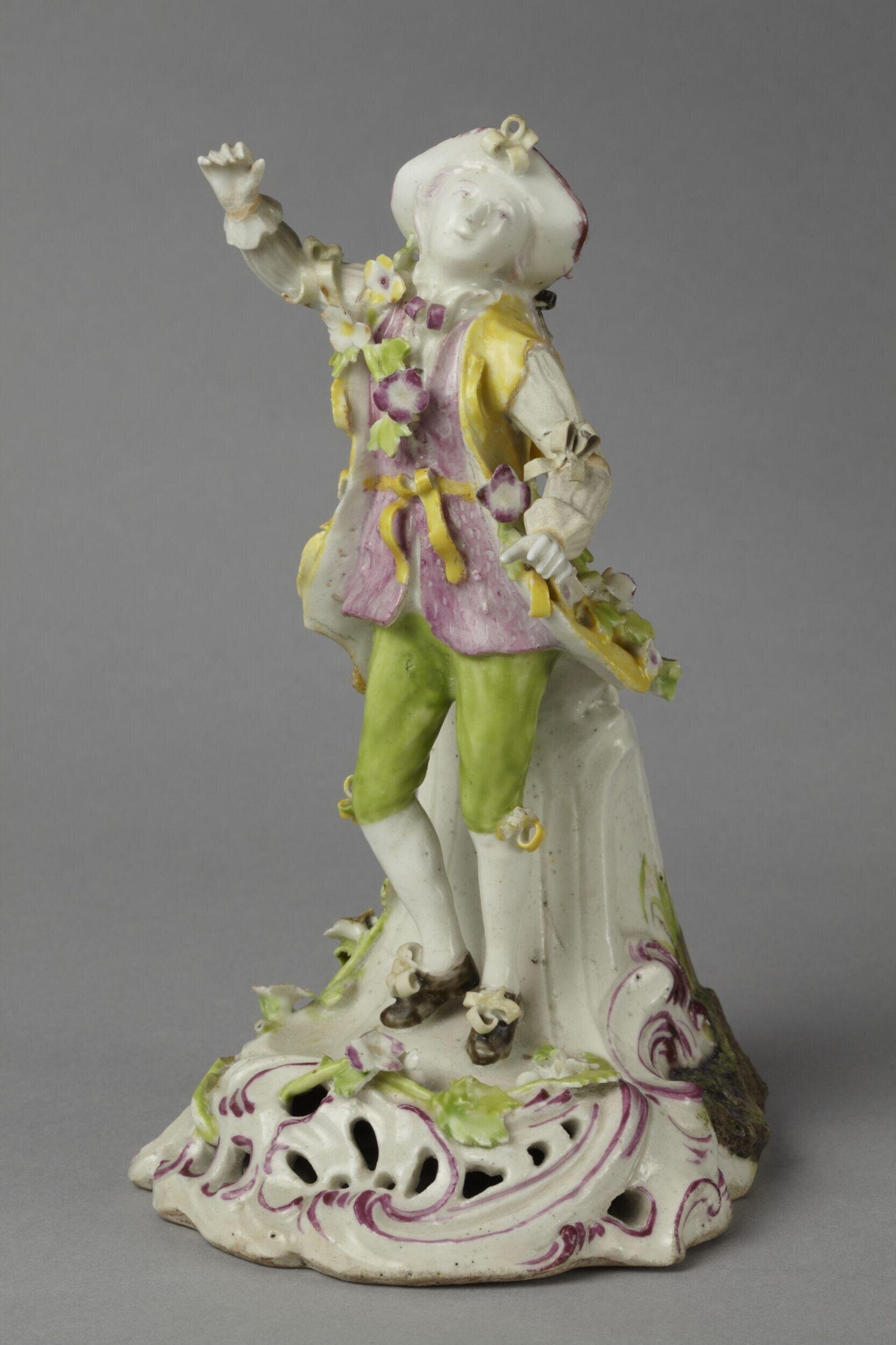
Dancing man
Derby porcelain factory
- Collection:
- Figure
- Source:
- Victoria and Albert Museum
- Rights:
- Rights vary by item — check the source record before reusing this image. Source record ↗
- Recorded as:
- V&A — check rights per item
This figurine is evidence of how mid-eighteenth-century European society understood and displayed dance: not as an abstract ideal, but as a living, joyful human practice, desirable enough to reproduce in porcelain and beautiful enough to keep in view. It shows us the actual costuming and bearing of stage dancers of the period in a way that prints and paintings alone cannot convey.
What you are looking at
A porcelain figurine depicts a young dancer in mid-performance, captured in a moment of exuberant movement. The figure wears a lavishly decorated costume in yellow, mauve, and white: a short jacket or doublet in yellow with mauve panels and floral ornament, paired with fitted breeches in chartreuse yellow, white stockings, and dark shoes. The dancer's left arm is raised in an expressive gesture, the hand open and reaching upward; the body twists with energy and lightness. The face, modeled with youth and animation, gazes upward in the direction of the gesture. The figure stands on an ornamental base decorated in white porcelain with mauve scrollwork and rococo relief carving, including openwork apertures typical of Derby production. The entire object is hand-painted in underglaze cobalt and overglaze enamel colors that remain bright despite age.
The dancing
A single male dancer, shown in a pose of upward reach and torso rotation. The left arm extends overhead with an open palm; the right arm hangs lower, implied to be extended sideways or held in a dancing position. The weight appears centered on both feet, planted firmly on the decorated base, suggesting a moment of balance within a turning or jumping movement. The posture conveys buoyancy and joy rather than formality—the body curves from the extended arm through the torso, creating a line of energy upward.
The dance depicted
This appears to represent a male dancer of the mid-eighteenth-century European stage, most likely in a theatrical dance of the Baroque or early Rococo era—possibly a role in a court ballet or a comic intermezzio character. The costume, with its bold coloring and ornamental richness, and the performer's youth and exuberant pose suggest a lighter, more playful theatrical role rather than a serious heroic one. The reaching gesture and upward gaze are characteristic of joy, triumph, or courtship in the gestural language of Baroque stage dance. Without more documentation, the specific dance cannot be named with certainty.
How it was made
This is a glazed porcelain figurine, hand-modeled and assembled from separate cast parts (body, arms, base). The surface is decorated in underglaze blue and overglaze enamel colors—yellows, mauves, greens, and browns—applied after firing. Derby porcelain of the 1750s used soft-paste porcelain, prone to slight color variation and surface irregularities, yet capable of fine sculptural detail and bright, stable enamels. The figurine was likely part of a table service or decorative collection, created for wealthy households; such dancing figures were popular exports and status objects in the rococo period.
About this work
This Derby porcelain figurine of c. 1755 records not a specific named dance but a type of performer—a theatrical dancer of the mid-eighteenth-century stage, preserved in porcelain at the moment of joyful, upward-reaching movement. It is a document of how dance was understood and valued in affluent European households: as a subject beautiful enough to grace a dining table or parlor shelf, and as a symbol of youthful grace, gaiety, and theatrical skill. The bright colors, fine modeling, and buoyant pose encapsulate the rococo fascination with movement, lightness, and the pleasures of performance. For historians of eighteenth-century dance, it is one of many such figurines that testify to the popularity of theatrical dance as entertainment and the integration of dancers into the symbolic world of luxury goods and interior display.
How to look at it
Notice the specificity of the costume: the color blocking, the floral ornament on the jacket, the fit of the breeches and stockings. These details were based on actual stage dress of the period. Observe the pose carefully—the extension and reach of the left arm, the slight twist of the torso, the upward gaze—and imagine the motion this arrested moment implies: a turn, a jump, or a gesture of expression. The artist (the Derby modeler) chose to show the dancer at the peak of a joyful movement, not in a neutral standing pose, which tells us something about how the figure was meant to be read: as an image of the vitality and pleasure of dance itself.
The artist
The Derby porcelain factory, founded in 1751 in Derbyshire, England, quickly became one of Europe's leading manufacturers of soft-paste porcelain. Derby was known for finely modeled figurines in the rococo style, competing directly with Meissen and Sèvres. Factory modelers drew on a repertoire of stock subjects—shepherdesses, soldiers, musicians, and dancers—that appealed to the affluent collectors who could afford porcelain. This figurine bears the stylistic hallmarks of Derby's first decade: bold modeling, bright enamel colors, and a taste for theatrical subjects that reflected contemporary tastes in entertainment and interior design.
The period
In the 1750s, theatrical dance in Europe was undergoing rapid change. Ballet was developing from court entertainment toward a more professional stage form; dancers trained in Italian and French technique were celebrated performers in operas and ballets throughout Europe. At the same time, rococo taste dominated European decorative arts, favoring lightness, color, movement, and pleasure over baroque grandeur. Porcelain figurines of dancers, musicians, and lovers were fashionable luxury goods, and Derby's production responded to market demand for such objects. The theatrical costumes and playful poses visible in porcelain figurines of this era preserve images of actual stage dress and movement conventions that survive in no other form.
Where it lives
This figurine is held in the collection of the Victoria and Albert Museum, which identifies it as a product of the Derby porcelain factory based on stylistic and technical grounds. The catalogue record describes it only as 'Dancing man,' suggesting it was either the contemporary title or a descriptive tag applied later by the museum.
Dance in this work
Questions about this work
Who actually danced like this in the 1750s?
Professional male dancers trained in French and Italian techniques, performing in theaters and at court. The costume and youth of this figure suggest a comic or light-character role rather than a serious heroic male role. Such dancers would have been celebrated performers, trained in turnout, elevation, and the precise gesture language of baroque and early rococo ballet.
Why make a dancing figurine out of porcelain?
Porcelain was the most prestigious and expensive material available for luxury goods in the eighteenth century. A dancing figurine in porcelain was a status object, a conversation piece, and a way for wealthy owners to display their taste in both the arts (by collecting dance imagery) and in collecting (by owning fine porcelain). Such figurines were often part of larger sets or kept on shelves and mantelpieces as decoration.
How do we know this is Derby and not another factory?
Derby porcelain of the 1750s has distinctive technical and stylistic features: the pale, slightly warm tone of the soft-paste body; the bright, stable enamel colors; the specific style of the rococo base with scrollwork and openwork; and the modeling technique. Scholars of porcelain history can attribute such figurines to specific factories and often to specific years or decades based on these characteristics.
Is this one of a series?
Very likely. Derby and other porcelain factories produced dancing figurines in multiple characters and poses, often in sets of matching pieces. However, this specific figurine's original companions, if any, are not documented in the museum record.
More dance artwork





