49 works in this view — arrow keys or swipe to move between them.
Dance in Art
Dancing In My Dreams With You!
Mackey, Haydn
- Collection:
- Source:
- Victoria and Albert Museum
- Rights:
- Rights vary by item — check the source record before reusing this image. Source record ↗
- Recorded as:
- V&A — check rights per item
The print captures ballroom dancing as lived social practice rather than theatrical spectacle, showing how ordinary people danced together for courtship and pleasure. As a commercial print sold for sixpence in 1930s London, it documents both the aesthetic language modernist artists used to represent dance and the central role ballroom dancing played in working-class courtship and leisure. The expressionist style conveys the emotional intensity of the dance—longing, romance, physical connection—in a way that straightforward representational art could not.
What you are looking at
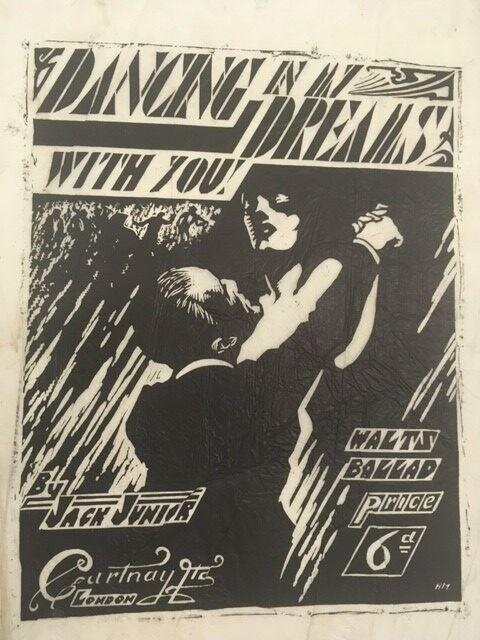
A woodcut or linocut print in stark black and white showing two figures in an intimate dance or embrace. The composition is tightly framed, with diagonal hatching lines filling the background and creating dynamic visual movement. The two dancers are rendered in silhouette and highlight, their bodies intertwined in what appears to be a close partnered position. The figure on the left, with shorter dark hair, leans back slightly while the figure on the right, with longer lighter hair, supports and draws them close. The print uses bold, expressive line work characteristic of early 20th-century modernist printmaking. Text at the top reads "DANCING IN MY DREAMS / WITH YOU!" in angular lettering, while the artist's signature "Mackey" and "LONDON" appear at the bottom left, along with what may be a price mark "6d".
The dancing
Two figures in a tight closed hold, bodies pressed together at close range. The left figure's weight appears to shift backward into the right figure's frame, suggesting a moment of dip or lean. Both heads are turned toward each other in profile, faces close. The right figure's arms support and guide, while the left figure's arms wrap around the right figure's shoulders and back. The positioning suggests ballroom or social dance technique—a partnered frame designed to balance and control the follower's weight. The body language is tender and romantic rather than energetic or athletic.
The dance depicted
This appears to depict social ballroom dancing, most likely a waltz or foxtrot given the close partnered hold and the romantic mood of the composition and title. The intimate positioning and the emphasis on emotional connection over technical display suggests this is social dancing rather than theatrical performance—a couple dancing together for pleasure rather than an audience. The dreamlike quality invoked by the title aligns with the romantic ballroom tradition of the 1920s and 1930s, when such dances were central to courtship and social life. The style of dress and the modernist aesthetic point to the interwar period.
How it was made
This is a relief print—most likely a woodcut or linocut—executed with bold, confident line work and strong areas of black and white contrast. The diagonal hatching in the background is characteristic of expressionist printmaking of the period. The technique allowed rapid production and affordability, evident from the price mark (6d, or sixpence) visible on the print, suggesting this was a popular commercial art object intended for modest circulation. The stark formal language and emotional intensity are hallmarks of early 20th-century modernist printmaking, where the medium's inherent boldness was embraced as expressive rather than apologized for.
About this work
This is a small commercial print from 1935 London depicting a couple in a close ballroom dance hold, captured in an expressionist style that emphasizes emotional intimacy over technical display. The work sits at the intersection of social dance practice and modernist printmaking, documenting both the ballroom culture of the interwar period and the aesthetic innovations of printmakers working in expressionist traditions. The title frames the dance as fantasy or reverie—'dancing in my dreams'—a mood the image reinforces through its compressed composition and dreamlike intensity. The work matters because it records not just the physical technique of ballroom dance but the emotional and romantic significance it carried in working-class leisure culture.
How to look at it
Attend to the moment of suspension in the dance—the instant of lean or dip where the follower's weight is entirely supported by the leader's frame. This is the technical heart of ballroom dance, the moment where trust and control are most visible. Notice how Mackey uses the diagonal hatching lines to create a sense of dynamic movement and emotional turbulence in what is formally a static, intimate pose. The close framing and the overlap of the figures' bodies, rendered in near-silhouette, create a sense of merger or unity that expresses the emotional content of the dance more effectively than anatomical clarity could.
The artist
Haydn Mackey was a London-based printmaker and illustrator working in the 1930s. Little is widely documented about his biographical details or full body of work, but the style and subject matter of this print place him within the tradition of British expressionist and modernist printmakers of the interwar period. The use of commercial printing techniques to represent intimate human moments was characteristic of socially engaged artists of the era who saw printmaking as a vehicle for reaching working-class audiences. The romantic and accessible subject matter of this print suggests Mackey worked in popular commercial illustration as well as fine art printmaking.
The period
In the 1930s, ballroom dancing was undergoing rapid transformation. The rise of jazz-age dance music, radio broadcasts, and dance halls had democratized ballroom dancing, making it a central feature of working-class leisure and courtship culture across Britain. At the same time, modernist and expressionist printmaking was establishing itself as a powerful artistic language in Britain and Europe. Artists were increasingly using bold, distorted forms and emotional intensity to convey psychological and emotional states. The convergence of these two currents—mass social dancing and modernist visual culture—created space for works like Mackey's, which treated a popular social practice with the formal intensity and emotional seriousness previously reserved for 'high art' subjects.
Where it lives
The print is held in an unspecified collection marked 'va' (likely indicating an institutional holding). It is catalogued as a print, consistent with its commercial production and distribution. The price mark visible on the print (6d) indicates it was sold as a commercial art object, likely through print shops, stationers, or other retail venues serving working-class London.
Dance in this work
Questions about this work
What dance are they doing?
The hold and positioning are consistent with ballroom dances of the 1930s—likely a waltz or foxtrot. The close partnered frame, the apparent dip or lean of the left figure into the right figure's support, and the emotional tenor all suggest romantic social ballroom dancing rather than theatrical performance or Latin dance. The title's reference to dreaming and the romantic mood reinforce this reading.
Why is the print so dark and dramatic?
Mackey is working in the expressionist tradition of 1930s printmaking, where bold contrasts and distorted forms were used to convey emotional and psychological intensity. The heavy black lines, the stark silhouetting, and the diagonal hatching background all create a sense of turbulence and passion. For a dance about dreaming and romantic longing, this visual intensity is more expressive than literal realism could be.
Who bought prints like this?
At sixpence, this was affordable for working-class buyers. Such prints were sold through print shops, stationers, and other retail venues, and likely appealed to young people interested in popular dance culture, romance, and modern art. The accessible subject matter—a couple dancing—combined with modernist style created a bridge between fine art and popular culture.
What does the 'dreaming' in the title mean?
The title frames the dance as fantasy or reverie rather than literal social practice, emphasizing the emotional and imaginative dimensions of dancing together. For working-class young people in the 1930s, ballroom dancing was often tied to courtship and romantic hope, so the dreamlike quality may reference both the escapism of leisure dancing and the emotional significance it carried.
More dance artwork





