49 works in this view — arrow keys or swipe to move between them.
Dance in Art
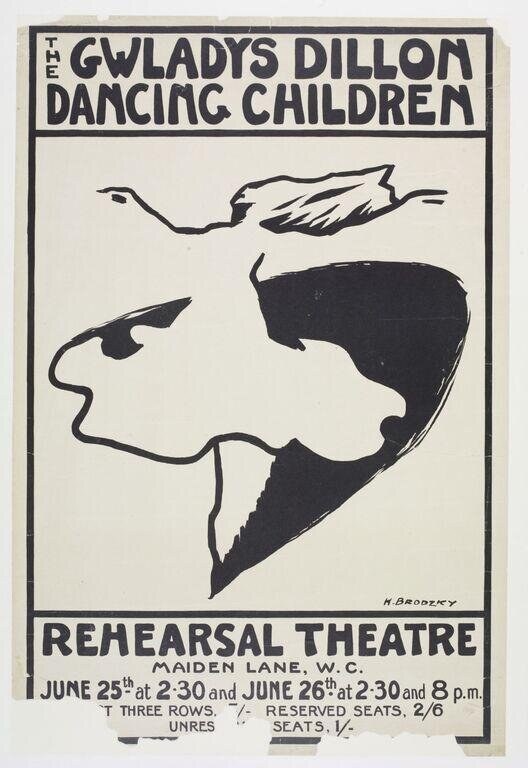
Gwladys Dillon dancing children
Brodzky, Horace
- Collection:
- Poster
- Source:
- Victoria and Albert Museum
- Rights:
- Rights vary by item — check the source record before reusing this image. Source record ↗
- Recorded as:
- V&A — check rights per item
For historians of dance pedagogy, this poster documents the existence and ambitions of a children's dance class in Edwardian London and the values its instructor wished to project—grace, control, and expressive refinement. For design historians and students of dance aesthetics, it is an elegant example of how the avant-garde visual language of the 1910s (silhouette, reduction, modernist typography) was deployed to market theatrical dance to a metropolitan audience.
What you are looking at
A bold woodcut or linocut poster announces a rehearsal for "The Gwladys Dillon Dancing Children" at the Rehearsal Theatre on June 25th and 26th, 1914. The design is strikingly minimalist: a single profile silhouette dominates the composition, rendered in solid black against cream paper. The head is tilted back, the body arched in a graceful curve, with an arm extended upward and outward in an expressive gesture. A second, lighter linear sketch of an arm or upper body appears above, suggesting movement or an alternative pose. The figure's posture conveys lightness, abandon, and the physical confidence of trained movement. The poster's typography is bold and sans-serif, the layout functional but elegant, with pricing and performance details placed below the image. The style is characteristic of early twentieth-century theatrical publicity: stripped of ornament, emphasizing the essential form of the dancing body.
The dancing
A single figure is depicted, though the poster advertises children dancers. The silhouette shows an arched, extended posture with the body in a back bend or release, one arm lifted expressively overhead. A secondary sketch above suggests an alternative arm position or a second body, rendered in outline rather than solid fill. The posture is balletic in its extension and control—the body is neither rigid nor collapsed, but holds an articulate line from the extended arm through the arched torso. The artist demonstrates understanding of weight distribution in a lifted, suspended moment, not a flat or diagram-like rendering.
The dance depicted
The poster advertises a rehearsal performance by children trained under Gwladys Dillon. The specific dance style cannot be determined with certainty from the image alone, but the silhouette's arched line, extended port de bras, and lifted quality suggest ballet training or a related theatrical dance form taught in early twentieth-century Britain. Dillon may have been a ballet teacher or a teacher in the Dalcroze eurhythmics or physical culture tradition popular in that era. The archival nature of a rehearsal poster suggests a semi-public dress rehearsal or student recital, likely for an educated metropolitan audience.
How it was made
This is a letterpress poster, likely created from a linocut or woodcut designed by Horace Brodzky, whose signature appears in the lower right. The medium allowed for bold, high-contrast imagery suitable for public display, and the stark black-and-white silhouette approach is characteristic of modernist graphic design of the 1910s. The technique demanded simplification and clarity—the figure reduces to its essential line and mass, which gives the work its striking visual power. As a printed theatrical advertisement, it would have circulated widely in London's theatre district and among the educated class likely to attend such a performance.
About this work
This is a typographic and design artifact of early twentieth-century British theatrical culture, specifically the experimental and educational dance scene. It documents a rehearsal event for a children's dance class or company, but more importantly it is a specimen of modernist graphic design applied to dance publicity. Brodzky's silhouette method transforms the dancing body into pure visual form, eliminating costume, narrative, and setting to focus on the architecture of the pose itself. The poster belongs in a dance archive both as evidence of pedagogical practice and as testimony to how the dancing body was visualized and promoted in the 1910s. It shows an artist who understood the expressive potential of a single, well-chosen gesture.
How to look at it
Attend to the moment of suspension Brodzky chose to depict: the figure is caught at the apex of a back arch, not in motion downward or upward, but held in a state of weightless extension. The secondary arm sketch above suggests the artist was exploring multiple possibilities or showing the figure in successive frames of movement. Notice how the silhouette erases all detail—costume, individual features, stage setting—and forces the viewer to read the dance from body geometry alone. This was both an aesthetic choice (modernist reduction) and a practical one (the medium's constraints), but it makes the poster paradoxically more universal and more powerful than a detailed narrative scene would be.
The artist
Horace Brodzky (1884–1969) was a British artist and graphic designer known for his bold, reductive approach to portraiture and figure representation. He worked extensively in woodcut and linocut, and designed posters and theatrical announcements in the 1910s–1920s. His work is characterized by stark contrast, psychological intensity, and an interest in capturing essential character through simplified form. He later became better known for his fine-art prints and book illustration, but this poster shows his skill in distilling a complex subject—the dancing body in motion—into a single, memorable image.
The period
In 1914, British dance was entering a period of reform and modernization. The classical ballet establishment coexisted with newer educational movements influenced by Dalcroze eurhythmics, Swedish gymnastics, and Duncan-inspired free dance. Children's dance education was becoming fashionable among educated middle-class families, and small schools and independent teachers like Dillon advertised through the visual culture of the poster. This same period saw the rise of modernist graphic design in Europe, and Brodzky's work sits at the intersection of theatrical enterprise and avant-garde visual experiment. The rehearsal format—a semi-public dress rehearsal for invited audiences—was a common way for dance teachers to showcase their students and generate patronage or enrollment.
Where it lives
This poster is held in the Victoria & Albert Museum's collection of theatrical and graphic ephemera. It is a printed advertisement, a mass-produced object, and is registered as a two-dimensional work on paper.
Dance in this work
Questions about this work
Who was Gwladys Dillon?
The poster does not provide biographical information beyond her name and her role as an instructor of dancing children. She may have been a ballet teacher, a eurythmics instructor, or a physical culture educator working in London in the 1910s. No other records of her have been located in this database; further research would require consultation of London theatre archives, local newspapers, or the papers of Horace Brodzky.
What style of dance did the children perform?
The visual evidence—an arched line, extended arm position, lifted quality—suggests training in classical ballet or an allied theatrical form. The rehearsal format and the educated market implied by the poster suggest this was not commercial entertainment but a pedagogical or semi-professional event, possibly with influences from the physical culture or eurhythmics movements that were popular in British progressive schools of the era.
Why is the figure silhouetted rather than detailed?
Silhouette is a modernist graphic technique that emphasizes form over decoration or narrative detail. For Brodzky, it allowed him to capture the essential geometry of the dancing body in a single, memorable image suitable for printing and public display. The starkness also reflects the constraints and aesthetic priorities of early twentieth-century woodcut design, where bold contrast was both technically necessary and aesthetically desirable.
More dance artwork





