49 works in this view — arrow keys or swipe to move between them.
Dance in Art
Dancing Lady
Roy, Jamini
- Collection:
- Painting
- Source:
- Victoria and Albert Museum
- Rights:
- Rights vary by item — check the source record before reusing this image. Source record ↗
- Recorded as:
- V&A — check rights per item
This work documents a moment when a major Indian modernist artist chose to center the female dancer as a subject of spiritual and cultural significance, positioning dance not as entertainment but as a repository of classical knowledge and devotional practice. Roy's visual language—the rejection of Western perspective, the embrace of flat pattern and bold outline, the use of Indian materials and pigments—was itself a form of cultural reclamation during the independence era, and his treatment of the dancing figure exemplifies how modernist form could be mobilized in service of decolonizing Indian art.
What you are looking at
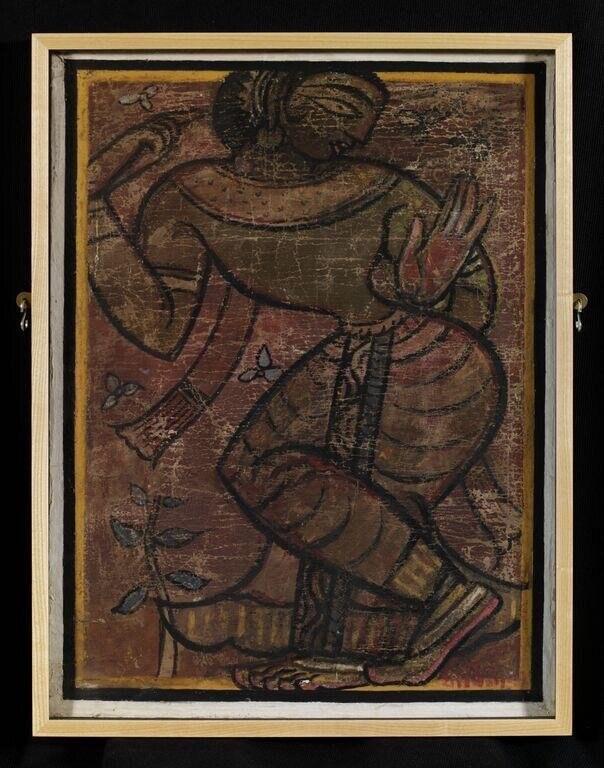
A single female figure occupies the centre of this worn, earthen-toned composition. She is rendered in dark outlines against a background of muted browns, ochres, and magentas, her body caught in a dynamic, forward-leaning pose. Her face is shown in profile, tilted upward, with her head adorned with what appears to be a decorative headdress or crown. Her arms are raised and extended, one bent at the elbow, the other reaching outward in a gesture of exuberance or abandon. Her torso is wrapped in a voluminous garment—possibly a sari or draped cloth—gathered at the waist with visible folds and pleats. Her legs are bent in a deep lunge or squat position, with her feet planted firmly, one leg clearly supporting more weight than the other. The lower half of her body is wrapped in striped or segmented textiles, suggesting bangles or leg ornaments. The figure occupies most of the canvas, rendered with bold, gestural marks that suggest movement and energy rather than anatomical precision. The background is heavily worked and weathered, with scratches and marks that suggest age or intentional distressing.
The dancing
A single dancer, depicted from roughly mid-thigh upward in three-quarter view. Her weight is shifted onto her back leg in a deep bent-knee position, while her front leg extends forward into a lunge. Her torso twists, with her spine curved backward and her arms raised asymmetrically—one arm bent and held near her body, the other extended outward at shoulder height. Her head is thrown back, face lifted skyward. The pose conveys dynamic movement and upward momentum, with the body in a state of propulsive energy rather than stillness.
The dance depicted
The figure's pose and adornment suggest South Asian classical or devotional dance, most likely Bharatanatyam or a related Indian classical dance tradition. The ardhanarishvara (half-man, half-woman) or feminine divine iconography suggested by the headdress, the jewelry visible on the legs, the gathered drapery of what appears to be a sari, and the mudra-like arm positions all point toward classical Indian dance vocabulary. The backward arch of the spine, the lifted face, and the emphatic leg work are consistent with the contrapposto and fluid torso articulation characteristic of Bharatanatyam. The pose captures what might be called a moment of spiritual or ecstatic expression—the dancer appears to be in communion with something transcendent rather than performing for an audience.
How it was made
The work appears to be created using a printing or drawing technique on paper or board, possibly woodcut, linocut, or relief printing, combined with hand-coloring or painting. The bold, simplified outlines and the flat application of color are consistent with printmaking traditions. The heavy wear, discoloration, and visible scratches suggest the object is old or has been deliberately aged. The technique allowed for bold graphic impact and would have made the work reproducible, suggesting it was created for distribution or study rather than as a unique artwork.
About this work
Jamini Roy's 'Dancing Lady' from 1945 depicts a single Indian dancer in a moment of spiritual or devotional movement, rendered in Roy's distinctive style that merges Indian classical iconography with modernist simplification. The figure's pose, adornment, and gesture are grounded in South Asian dance tradition, yet the flattened form, bold outline, and earthy palette reflect Roy's deliberate engagement with Indian folk and classical art forms as a means of moving away from European academic painting. The work sits at a crucial moment in Indian modernism, when artists were actively reclaiming indigenous aesthetic vocabularies in the context of India's independence movement. Roy's practice centered on elevating vernacular and classical Indian art—including dance—as subjects worthy of serious artistic attention, rejecting the hierarchies of colonial art education.
How to look at it
Attend to the moment Roy has chosen to freeze: not a moment of geometric precision or formal correctness, but one of apparent abandonment and spiritual transport. The dancer's lifted face and backward-arching spine suggest ecstasy or communion rather than technical display. Notice how Roy has simplified anatomy—the legs are almost cylindrical, the arms geometric—yet the pose conveys genuine physical understanding of how weight shifts in a deep lunge and how the torso must twist to allow the spine to arch. The bold outlines and flat colors direct your eye to the essential gesture rather than surface detail, much like the simplified forms of Indian sculpture that Roy admired.
The artist
Jamini Roy (1887–1972) was a pioneering Indian modernist painter who deliberately turned away from Western academic training to develop a practice rooted in Indian folk, classical, and tribal art traditions. Based in Kolkata, Roy was instrumental in the Bengal School's later phase and became known for his distinctive flattened forms, bold outlines, and use of traditional materials. His engagement with Indian classical dance, village art, and vernacular imagery was part of a broader project of cultural affirmation during the independence movement. He worked across multiple media and scales, from small studies to large public commissions, always maintaining his commitment to an 'Indianist' aesthetic.
The period
The 1940s were a moment of intense cultural nationalism in India as independence approached. Artists, intellectuals, and performers were actively engaged in recovering and revaluing indigenous traditions that had been marginalized under colonial rule. Indian classical dance, suppressed during the British period, was being revived and reframed as high art. The natyashastra, the ancient Sanskrit text on performance, was being recovered and studied. Simultaneously, modernist movements worldwide were embracing primitivism and simplification, but in India this formal vocabulary was being deployed specifically to reclaim and honor local traditions. Roy's work participates in this context, using modernist formal strategies to elevate the figure of the classical dancer.
Where it lives
The work is recorded as a painting held in a public collection (source marked as 'va', likely indicating a major museum or archive). The catalogue record provides minimal provenance detail beyond artist, date, and title.
Dance in this work
Questions about this work
What is the dancer wearing?
The figure wears what appears to be a sari or draped classical Indian garment, gathered at the waist with visible pleating. Her legs are wrapped in striped or segmented textiles suggesting jewelry or leg ornaments (bangles or ghungroo) typical of classical Indian dance costume. She wears a headdress or crown, likely referencing the adornments worn in Bharatanatyam performance.
Why did Roy paint this subject?
Roy was committed to elevating Indian classical and folk traditions as subjects worthy of serious modern art. In the 1940s, as India moved toward independence, reclaiming classical dance as high art—rather than the colonial stereotype of mere entertainment—was part of a broader cultural reclamation. Roy's visual language, drawn from Indian aesthetics, was itself a political and cultural statement.
Is this a real dancer or an imagined figure?
Roy was interested in the classical dance tradition itself rather than portraiture of a specific dancer. The figure embodies the ideal posture and gesture vocabulary of Bharatanatyam, rendered in a way that celebrates the dance form's spiritual and devotional dimensions rather than documenting a particular performance.
More dance artwork





