49 works in this view — arrow keys or swipe to move between them.
Dance in Art
Adzido Pan African Dance Company
Unknown artist
- Collection:
- Dance costume
- Source:
- Victoria and Albert Museum
- Rights:
- Rights vary by item — check the source record before reusing this image. Source record ↗
- Recorded as:
- V&A — check rights per item
Adzido was (and remains) one of Britain's most important institutional platforms for African and African-diasporic dance, and its costume archive documents a crucial moment in the professionalization and theatrical staging of African dance forms in Britain. The costume itself—especially its composite textile strategy—reveals how late-twentieth-century Pan-African performance negotiates between archive and innovation, specificity and synthesis. For dancers and choreographers, this object is a case study in how costume can carry cultural information and create stage presence without relying on European balletic convention.
What you are looking at
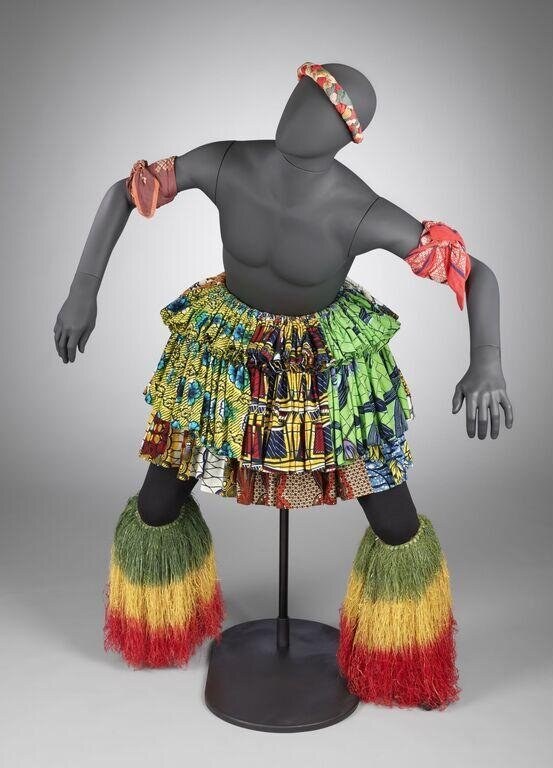
A mannequin wearing vibrant Pan-African performance costume stands against a neutral gray background. The figure is dressed in a patchwork skirt assembled from multiple African textile patterns—bold geometric prints in yellow, green, red, and blue dominate, with sections of contrasting fabric creating visual rhythm across the hip. The upper body wears a fitted gray sleeveless top. At wrists and above the elbows, the mannequin displays coral-pink fabric wraps or bindings. Most striking are the leg pieces: voluminous cylindrical sheaths of dyed raffia or natural fiber, dyed in graduated horizontal stripes—green at top transitioning through yellow to deep red at the bottom—extend from ankles upward. The figure's posture is dynamic: arms are spread wide in an open position suggesting movement or greeting, weight shifts through the stance, and the head tilts back slightly, conveying energy and celebratory mood.
The dancing
The single figure adopts an expansive open stance with arms extended laterally at shoulder height, palms visible and slightly turned outward—a posture of release, joy, or invitation. The slight backward tilt of the head and the openness of the torso convey upward momentum and exuberance. The spread legs and planted feet suggest grounded stability, anchoring the upper-body lift. The costume's volume and the leg wrappings would restrict footwork to a kind of stepping or stamping motion rather than intricate heel-and-toe work, implying a dance rooted in weight-shift and hip articulation.
The dance depicted
This is a costume from Adzido Pan African Dance Company, a British-based ensemble founded in 1984 that specializes in the reconstruction and performance of traditional and contemporary African dances. The garment synthesizes elements across multiple African dance traditions: the wrapped leg sheaths recall war dances and ceremonial movement (perhaps Zulu indlamu or similar southern African forms), while the patchwork textile mixing and the open, celebratory upper-body gesture suggest contemporary Pan-African performance practice that blends traditions. The costume itself is the primary text—designed for visibility, rhythmic spectacle, and the expression of joy and community identity characteristic of diaspora African performance in the late twentieth century.
How it was made
This is a three-dimensional costume object photographed in museum studio conditions: a dress form or mannequin wearing assembled textile components photographed against a controlled background with soft, even lighting that eliminates shadows and emphasizes form and color. The photograph is documentary in intent—a record of an artifact for collection and reference. The costume itself is constructed from sewn and wrapped fabrics; the leg wrappings appear to be natural raffia or jute fiber, dyed in sections using traditional resist or immersion techniques, while the skirt panels are stitched patchwork of printed cotton or cotton-blend African textiles. This method of documentation—the isolated, front-facing pose against neutral background—is standard museum practice for costume and textile collections, allowing clear viewing of construction and detail.
About this work
This is a costume from the Adzido Pan African Dance Company's performance archive, dated to 1999. It is a composite garment that synthesizes textile traditions and movement vocabularies from multiple African cultures, designed for stage performance in a British/diaspora context. The costume itself enacts ideology: the visible, deliberate mixing of African fabric traditions, the celebratory color palette, and the expansive gesture of the posed mannequin communicate the company's mission to honor African dance heritage while situating it in contemporary, transnational performance. As a museum object, it shifts from a tool of ephemeral performance to a still-life text that speaks to questions of authenticity, curation, and cultural memory in diaspora practice.
How to look at it
Look first at the patchwork skirt: each panel is a distinct printed African textile, chosen and placed deliberately. This is not 'an African skirt' but a composition that asserts: many African traditions, mixed and co-present. The leg wrappings—the most labor-intensive part of the costume—are what catch light and create kinetic visual effect on stage; they are designed to amplify leg and foot movement into a visual spectacle even if the footwork itself is simple. The open arm position and tilted-back head are the choreographer's choice of how to present the body in stillness: generous, upward-reaching, joyful. Notice that this costume supports and requires a particular kind of movement—grounded, hip-driven, weight-shifting—quite different from the turned-out, linearly extended body of European dance training.
The artist
Adzido Pan African Dance Company was founded in 1984 by Canadian choreographer and producer Claude Conyers and has been led since 1987 by artistic director Omofolabo Ajayi. The company is based in London and specializes in learning, preserving, and performing African dances from multiple regions and eras—from Yoruba, Zulu, and Ethiopian forms to contemporary African popular dances. The company model combines performance, teaching, and documentation, and has been instrumental in establishing African dance as a legitimate (and economically viable) performance category in British theatres and arts institutions. Adzido's work has always centered on the question of how to honor specificity and regional authenticity while also creating Pan-African solidarity and modern stage presence.
The period
By 1999, Adzido was nearly two decades into its institutional presence. This was a moment when African dance had begun to shift from the margins of British arts funding and critical attention toward greater mainstream visibility—driven partly by the growing Black British arts sector, partly by increasing interest in 'world dance,' and partly by the maturation of institutions like Adzido that had proven both artistic rigor and public draw. The late 1990s saw increasing professionalization of African dance performance in Europe, with companies developing more sophisticated costume and stagecraft (moving away from 'village authenticity' tropes toward conceptual and theatrical approaches). The costume's date of 1999 places it at a moment of consolidation for this shift. Theatrically, this period also saw the rise of diaspora aesthetics in British culture—a move away from looking to Africa as an external source to be accessed and toward recognizing African-British and African-diasporic culture as a living, hybrid, creative force.
Where it lives
This costume is held in the Victoria and Albert Museum collection as a dance costume. It is documented as associated with Adzido Pan African Dance Company and dated to 1999, suggesting it may be from a specific production or production series from that year, though the catalogue record does not specify which work or performance context. It entered the V&A collection, which has systematized acquisition of dance costumes and performance materials since the 1980s.
Dance in this work
Questions about this work
What is Adzido and why does it matter?
Adzido Pan African Dance Company, founded in 1984, is one of Britain's most important institutions for African and African-diasporic dance. It has spent four decades learning, preserving, and performing dances from across Africa and the diaspora, and has been crucial in establishing African dance as a theatrical and culturally significant practice in British arts institutions. The company combines performance, teaching, and documentation, and works intentionally with questions of authenticity, cultural specificity, and contemporary creativity.
What dance is this costume for?
The catalogue does not specify which work or choreography this costume was worn for. The costume itself synthesizes multiple African dance traditions through its textile choices and movement support—the wrapped leg pieces suggest connection to southern African ceremonial and warrior dances, while the patchwork skirt and celebratory gesture of the display suggest a contemporary Pan-African work. The costume is designed to support grounded, hip-centered movement rather than upward extension.
Why are the leg wrappings so prominent?
The dyed raffia or fiber leg wrappings are visually striking and kinetically functional: they amplify movement of the legs and lower body into a spectacle of color and texture even when footwork is simple or restrained. This is characteristic of African dance costume design—using volume, fiber, and color to create visual interest and to honor the legs as a primary expressive center. On stage, as the dancer moves, these wrappings would create continuous visual rhythm and draw focus to the lower body.
What does the patchwork skirt represent?
The deliberate mixing of distinct African printed textiles—each panel a different pattern and color—is a curatorial choice that asserts Pan-African identity and solidarity. Rather than claiming to represent a single African tradition, the skirt visibly combines multiple textiles, suggesting that African-diasporic performance can honor specificity while also creating new, hybrid identities. This is a theatrical and conceptual statement, not a claim of historical accuracy.
More dance artwork





