49 works in this view — arrow keys or swipe to move between them.
Dance in Art
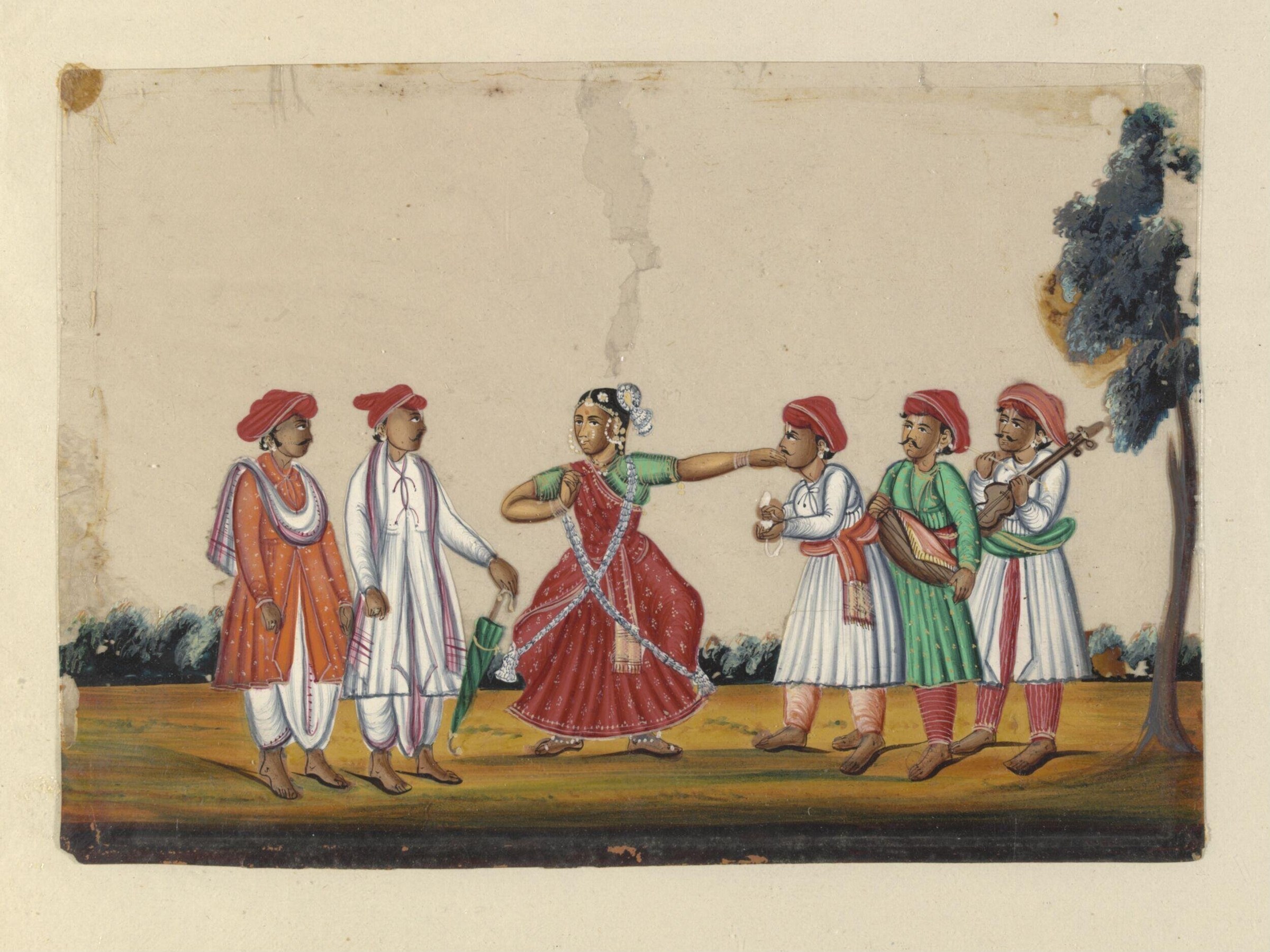
A dancing-girl with musicians
Unknown
- Collection:
- Painting
- Source:
- Victoria and Albert Museum
- Rights:
- Rights vary by item — check the source record before reusing this image. Source record ↗
- Recorded as:
- V&A — check rights per item
This work documents a crucial but often overlooked moment in Indian dance history: the persistence of courtly performance traditions, and the particular role of women dancers, during the colonial period when many classical forms were actively suppressed or reframed. The precise watercolor technique and ethnographic detail make it valuable evidence for how 19th-century elites understood and valued dance practice, and for understanding the continuity between precolonial and modern Indian classical forms.
What you are looking at
A South Asian court scene, likely from 19th-century India, depicting a dancing woman in the center wearing a fitted red silk garment with gold embroidery, attended by five men in traditional dress. The dancer wears an ornate jeweled headdress and holds her right arm extended in a graceful gesture toward the gathered company. She stands on a hard-packed earth ground with sparse vegetation, beneath a tall tree with blue-gray foliage on the right. The composition places the central figure in clear focus, with the men distributed on either side—two to the left in purple-bordered white garments, three to the right in varied dress including green, cream, and patterned fabrics. All wear red or rust-colored turbans except the dancer, whose headdress is more elaborate. The watercolor technique is precise in rendering fabric and jewelry; the palette is warm except for the cool tree foliage, which draws the eye upward and suggests an outdoor performance or social gathering.
The dancing
The dancer's posture is upright and controlled, with her weight centered and her extended right arm positioned at roughly shoulder height in a welcoming or graceful gesture. Her left arm hangs at her side. The five men stand in relaxed, attentive postures, facing or partly facing the dancer; some gesture toward her or each other with their hands. There is no closed-hold coupling—this is a solo performance with an audience rather than a partner dance. The relative scale and positioning make clear this is a hierarchical court arrangement with the dancer as the focus of attention.
The dance depicted
This appears to depict a courtesan or nautch girl performing for a court audience in 19th-century India. The gathering, dress, setting, and the woman's central role as the sole dancer suggest a formal performance or entertainment context common to Mughal and post-Mughal courts. The precise arm position and upright carriage are consistent with classical Indian dance training, though the watercolor does not give enough detail of footwork or mudra specificity to identify a particular classical form such as Kathak or Bharatanatyam. The image documents a social practice—the patronage of trained dancers in court and elite domestic settings—rather than a codified classical style, though the dancer's evident training and the formality of the gathering suggest a refined technique.
How it was made
This is a watercolor on paper, executed with careful attention to figural detail, fabric texture, and jewelry. The painting style—precise line work, close observation of costume and ornament, and flattened perspective typical of colonial-era European artists working in India—suggests this is a hand-painted ethnographic or documentary work, likely created for a British or Anglo-Indian patron. The medium and technique allowed for portable, easily reproduced documentation of Indian court life and practices; watercolors of this kind circulated widely among colonial officials and collectors in the 19th century as records of indigenous customs.
About this work
This is a documentary watercolor of a South Asian court dance performance, created around 1860 in the style of Anglo-Indian ethnographic practice. It captures a moment in the history of Indian dance patronage and the role of trained performers in elite male social gatherings. The work is valuable not as a portrait of a named performer or a record of a particular historical event, but as visual testimony to the continuation and formal practice of courtly dance traditions under British rule. It shows a woman dancer in full command of her body and the attention of her audience, working within conventions of dress, gesture, and social hierarchy that shaped 19th-century South Asian performance.
How to look at it
Attend to the dancer's face and posture: she is neither demure nor flamboyant, but composed and professional, meeting the gaze of the men around her without submission. Her extended arm is neither summoningly theatrical nor bashful—it is a formal gesture, part of a trained repertoire. Notice the ornaments: the jeweled headdress, the gold embroidery on her garment, the multiple rings—these are marks of status and training, not decoration. Look at how the artist has positioned her in the center and elevated her relative to the standing men; she commands the space she occupies. The outdoor setting and the tree suggest this is a formal occasion, not a domestic or commercial scene.
The artist
Unknown artist. The style is consistent with Anglo-Indian watercolor practice of the 1850s–1880s, when many European and European-trained painters in India created documentary works recording court life, social customs, and ethnographic subjects for circulation among British patrons and the East India Company. Such works were often unsigned and treated as records rather than as individually authored artworks, which explains the attribution gap.
The period
In 1860, Indian classical dance was in a precarious position. The Brahmin-dominated court traditions were being actively discouraged by British authorities and Christian missionaries, and the term 'nautch' was becoming increasingly stigmatized. However, in princely states and in private court settings, patronage of dancers continued, particularly in Lucknow and other cities with strong Mughal heritage. This watercolor captures that continuation—a world that official discourse was working to erase. Simultaneously in Europe, Orientalism as an artistic and literary movement was at its height, and India was a primary subject for ethnographic documentation and exotic representation. This painting sits at the intersection: it records a real social practice while also serving the colonial appetite for images of Indian life.
Where it lives
The work is held in a collection catalogued as 'va' (likely Victoria and Albert Museum or a similar institution). It is a watercolor, likely acquired as part of a broader colonial-era collection documenting Indian life and customs for British institutional collections.
Dance in this work
Questions about this work
Is this a Kathak or Bharatanatyam performance?
The watercolor does not show enough detail of mudra, footwork, or the specific technical vocabulary of either form to definitively distinguish them. The upright posture and arm position are consistent with Kathak, which was historically the form favored in North Indian courts. However, the image documents the social fact of courtly dance performance more than it documents a specific classical technique.
Who was this dancer?
The painting does not identify her by name. She is presented as a representative figure—a trained performer in a court setting—rather than as an individual portrait. Many such dancers went unrecorded in formal documentation.
Was she a courtesan?
The formal gathering, her elaborate dress and jewelry, and her role as the sole performer suggest she was a professional dancer in a court or elite domestic setting. The term 'courtesan' and 'nautch girl' were both used in colonial sources for such performers, but with significant negative bias. This painting is more reliable evidence of her professional status and training than such labels are.
Why is this important for dance history?
This image provides rare visual evidence of the continuation of Indian court dance traditions during the 19th century, when such practices were under intense pressure from colonial authorities and Christian mission activity. It shows that women dancers were still valued, trained, and patronized in elite settings, and that formal performance traditions persisted even as the official colonial narrative tried to erase or condemn them.
More dance artwork





