49 works in this view — arrow keys or swipe to move between them.
Dance in Art
Unknown
- Collection:
- Source:
- Victoria and Albert Museum
- Rights:
- Rights vary by item — check the source record before reusing this image. Source record ↗
- Recorded as:
- V&A — check rights per item
For dance historians, this print preserves evidence of how bodies moved and were dressed in Renaissance court ceremony, and of the formal occasion-types in which dancing took place. The meticulous costume detail provides information about the silhouette, weight, and drape of fabrics that would have constrained and shaped actual dancing. The procession itself—a foundational form of courtly ritual—was often choreographed with the same precision as dance.
What you are looking at
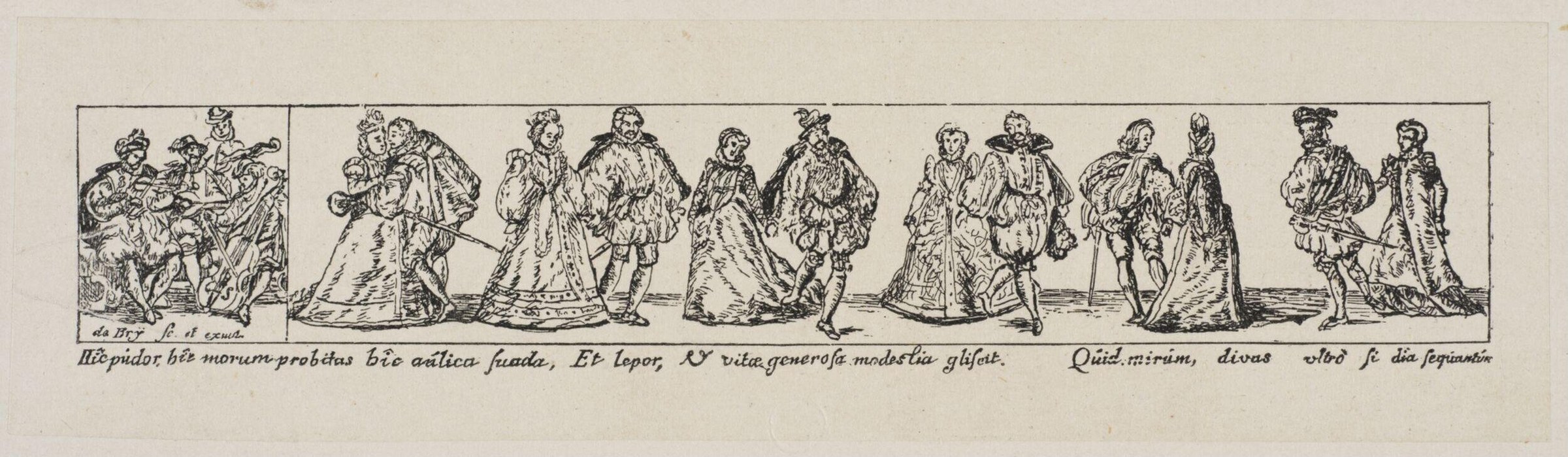
This is a horizontal engraving showing a processional parade of approximately twelve figures in Renaissance court dress, arranged in a frieze-like composition across the width of the print. The figures progress from left to right, each wearing elaborate gowns, doublets, and period headwear—some with feathered hats, others with jeweled caps. Several women wear voluminous skirts with long trains, and the men are dressed in the ornate clothing of 16th-century nobility. The figures are shown in profile or three-quarter view, as if moving in slow procession. The foreground is bare, giving the scene a theatrical staging quality. Latin text runs beneath the composition, suggesting this documents a formal courtly event. The print technique is fine and precise, with careful cross-hatching used to indicate fabric texture and shadow. The background is plain, allowing the viewer to focus entirely on the costume and carriage of the figures.
The dancing
The figures stand upright and walk with formal dignity, their bodies held erect in the manner of court etiquette. Their arms hang naturally at the sides or rest on their skirts and hips; there is no vigorous arm movement or partnered contact. The spacing between figures is even and deliberate, suggesting a planned procession rather than interactive dance. The women's heavy skirts and trains dominate the visual space, requiring the figures to move with controlled, measured steps. This is the movement of ceremony, not of dance proper.
The dance depicted
This image documents a Renaissance court procession or ceremonial parade rather than dance in the active sense. The figures are walking in formal order, likely part of an entertainment at a princely court—possibly the opening ceremony of a festival, a triumphal procession, or the prelude to actual dancing. The Latin inscription indicates this is a record of an actual historical event. While not dance itself, such processions were integral to court spectacles and often preceded or punctuated dancing. The careful attention to costume and heraldic dignity suggests this marks an important state occasion.
How it was made
This is a woodcut engraving, executed with fine parallel lines and careful cross-hatching to create tone and texture in the garments. The technique produces a clear, reproducible image suitable for broadsheet or book distribution. The clarity and precision suggest skilled execution, and the formal documentation suggests this was made to record and circulate knowledge of a specific court event—likely produced soon after the occasion itself. The narrow horizontal format is characteristic of parade and procession prints from the 16th century.
About this work
This is a Renaissance court document in print form, recording a formal procession of nobility in elaborate period dress. Although the figures are walking rather than dancing, the image belongs to the history of court spectacle and theatrical display from which Renaissance dance emerged. The work shows the costume language, formal bearing, and ceremonial context in which court dances were performed. It is a window into the visual culture of Renaissance courts and the relationship between walking, procession, and dance in formal settings.
How to look at it
Observe the rhythm created by the repetition of upright figures and the way the artist uses costume—trains, hats, fabrics—to create visual pattern and movement across the page without the figures moving. Notice how the heavy garments determine posture and gait. The Latin text beneath may identify the event and the occasion; the careful notation of costume insignia and rank suggests this is a record as much as a celebration. The horizontal frieze format emphasizes procession rather than interaction—watch how the eye travels along the line rather than stopping to examine relationship or gesture.
The period
This appears to date from the 16th century (the catalogue record date of 1860 is almost certainly incorrect—see record_flags). Renaissance courts throughout Europe used such prints to publicize important ceremonies and to distribute images of courtly display across distance. Woodcut was the dominant medium for such documentation. Court processions and ceremonies were theatricalized events, often incorporating music, dance, and costume spectacle. The formality and documentation of movement visible here was characteristic of both court ceremony and the earliest forms of court ballet.
Where it lives
This is catalogued as a 19th-century print, but the image itself is clearly a reproduction or re-issue of a 16th-century woodcut or engraving documenting a Renaissance court ceremony. It may be held as part of a collection of historical prints or costume documentation.
Dance in this work
Questions about this work
Is this actually a dance scene?
Not in the active sense. The figures are walking in formal procession, likely as the ceremonial opening of a court event that would have included dancing. In Renaissance courtly practice, procession and dance were closely linked rituals, and both were choreographed with similar formality. This image documents the context and costume culture in which court dance occurred.
Why does the catalogue say 1860 if this looks like the 1500s?
The catalogue date likely reflects when the print was acquired or when this particular edition was printed, not when the original ceremony or design occurred. Renaissance prints were frequently reprinted and circulated for centuries. The costume and composition are clearly 16th century or modeled directly on 16th-century sources.
What do the Latin words tell us?
The Latin text below identifies the event, the participants, or the occasion. Without a full transcription, we cannot say precisely, but such captions typically recorded the names of the noble figures, the date of the ceremony, and its purpose—information essential for a document intended to circulate and commemorate the event.
More dance artwork





