49 works in this view — arrow keys or swipe to move between them.
Dance in Art
Painting
Devi, Shastrikala
- Collection:
- Painting
- Source:
- Victoria and Albert Museum
- Rights:
- Rights vary by item — check the source record before reusing this image. Source record ↗
- Recorded as:
- V&A — check rights per item
This work documents the visual codification of classical Indian dance in the mid-twentieth century, at a moment when bharatanatyam was being revived and formalized. It shows how a trained artist understood the dancer's body—not as a naturalistic figure but as a repository of geometric and rhythmic information. For historians of South Asian dance, it provides evidence of how the tradition was visually conceptualized and transmitted in the postcolonial period.
What you are looking at
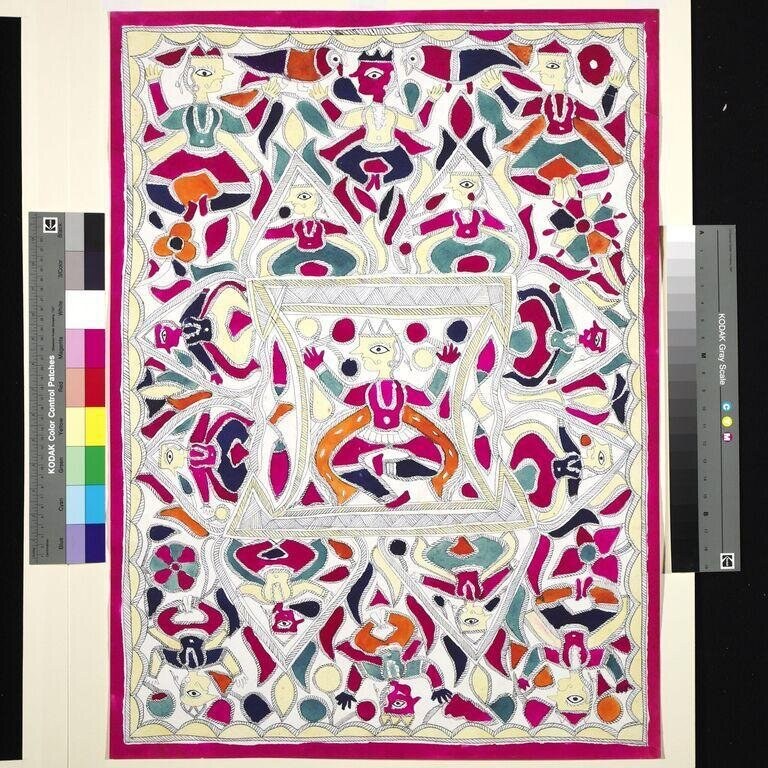
A densely patterned composition showing repeated figures of dancers rendered in bold, flat color against a cream ground, organized in a grid-like arrangement across the page. The dancers appear in vibrant magenta, navy, teal, orange, and ochre, their bodies depicted in profile or three-quarter view with limbs extended in dynamic poses. Each figure wears a defined costume—possibly a fitted bodice or jacket with contrasting lower garments—and many have a circular motif suggesting a bindi or face marking. The composition is framed by a magenta border, and the entire surface is filled with densely interlocking abstract shapes between and around the figures: geometric fragments, curved segments, and decorative elements that fill every void. The effect is rhythmic and ceremonial, suggesting repeated movement or a sequence of identical dancers captured at different moments.
The dancing
The dancers are rendered as individual figures in varied stances, typically with legs in a wide stance or lunge position, arms raised, bent, or extended outward with evident angularity. The torsos are upright or slightly tilted, and the overall frame suggests a vocabulary of codified gesture rather than naturalistic movement. The repetition of similar forms across the composition—each dancer recognizable as the same figure repeated—suggests either a single dancer in sequential motion, or a corps of identically trained dancers. No partners or paired configurations are evident; each figure is spatially independent.
The dance depicted
This appears to document South Asian classical dance, most likely Bharatanatyam or a related Odissi tradition, based on the costume silhouette, the upright posture, the geometric arm and leg positions, and the presence of what appears to be kumkum or tilaka marking on the face. The composition resembles a movement sequence (a tani avartanam or repeating phrase), showing a single choreographed posture or mudra configuration repeated across the field. The dense decorative patterning between the figures may reference the elaborate jewelry, ankle bells (ghungroos), or the visually complex textile environment of a temple or formal concert setting. The work appears to be an artist's study of classical dance vocabulary rendered as a decorative system.
How it was made
This is a gouache or tempera painting on paper, with colors applied as flat, opaque fields characteristic of Indian miniature or poster painting traditions. The precision of the repeated figures and the density of the patterning suggest a methodical approach using resist or masking techniques, or careful hand-drawing. The bold graphic quality and the filling of every compositional space are consistent with early-to-mid twentieth-century Indian modernist practice, where traditional dance and textile motifs were integrated into formal painting vocabularies. The medium allowed the artist to create a rhythmic, densely packed surface that reads simultaneously as representation and ornament.
About this work
This 1973 painting by Shastrikala Devi presents a classical South Asian dance vocabulary as a formal geometric and chromatic system. The work sits at the intersection of traditional bharatanatyam practice and mid-century modernist abstraction, treating the trained body and its codified gestures as the basis for a repeating decorative structure. By fragmenting the surrounding space and filling it with abstract patterning, the artist elevates the dancer's form from illustration to architectonic principle—the dance becomes the organizing logic of the entire picture plane.
The work is significant within Indian modernism as an example of artists drawing on classical performance traditions to create new visual vocabularies. Rather than depicting a narrative scene or a moment of performance, the painting treats dance as a system of knowledge, one that can organize color, form, and space across the entire surface. It belongs in a dance archive as evidence of how classical training informs visual composition, and how dancers and their traditions have been represented in twentieth-century art.
How to look at it
Attend first to the consistency and precision of the repeated dancer figure: the eye learns to recognize the posture instantly, and the repetition creates a rhythm across the page. Then look at the negative space—the intricate patterning that surrounds and interlocks with the figures. Note how the magenta border echoes the magenta in the dancers' costumes, creating a visual loop between figure and frame. Finally, observe how the color choices—the specific pairing of magenta with navy, teal, and orange—create visual chords that move across the composition, making the eye track paths through the repeated forms.
The artist
Shastrikala Devi was an Indian artist working in the twentieth century, engaged with the revival and modernization of Indian classical arts. The name and date suggest practice during India's independence period, when artists were actively reexamining indigenous artistic traditions. The work's formal sophistication—the control of color, the precision of composition—indicates formal training, and the choice to make dance and costume the central subject reflects a broader mid-century interest in performance traditions as sources for visual innovation.
The period
The 1973 date places this work in the post-Rukmini Devi era of bharatanatyam revival, when the dance had been repositioned from temple ritual to concert hall performance and scholarly attention. This was also a period of Indian modernist painting in which artists were synthesizing European modernist formal strategies with Indian subject matter and decorative traditions. The painting reflects both the consolidation of bharatanatyam as a codified classical form and the influence of mid-century abstraction on figurative practice in Indian art.
Where it lives
The work is recorded as held in a painting collection from a source marked 'va' (likely a museum or institutional archive). No further provenance information is available in the catalogue record.
Dance in this work
Questions about this work
Is this a representation of a real dance performance?
No; this is a compositional study based on classical dance vocabulary. The repeated figure shows a single pose or gesture sequence rather than documenting an actual event. The painting treats dance as a formal language—a set of codified positions and movements—that can be used to organize the entire picture plane.
What is the significance of the dense patterning around the dancers?
The patterning likely references the visual complexity of the performance environment—jewelry, textiles, ankle bells, and the ornamental richness of classical dance costume and staging. By making this patterning as prominent as the figures themselves, the artist insists that the dancer cannot be separated from her ornamental and material context.
Why repeat the same figure so many times?
Repetition was central to classical Indian dance training and practice. A single movement or gesture sequence (a phrase or combination) would be practiced and repeated hundreds of times, refined until it became second nature. The painting visualizes this pedagogical process—showing how a single, perfected form can generate rhythm and complexity through iteration.
What does the magenta border signify?
In Indian painting traditions, the frame is often part of the composition rather than a separation from it. The magenta echoes the magenta in the dancers' costumes, linking the border to the figures and suggesting that the dance extends to the edge of the visible field. It is both a formal decision and a reference to the decorated margins of traditional Indian manuscripts.
More dance artwork





