49 works in this view — arrow keys or swipe to move between them.
Dance in Art
Drawing
Jamini, Roy
- Collection:
- Drawing
- Source:
- Victoria and Albert Museum
- Rights:
- Rights vary by item — check the source record before reusing this image. Source record ↗
- Recorded as:
- V&A — check rights per item
The work documents a visual conversation between European modernism and Indian classical dance practice during a period when Indian artists were negotiating their relationship to both traditions. Jamini's treatment of the dancer-figure — simultaneously dignified and comic, ornate and vulnerable — reflects the complex cultural position of dance and performance in early-20th-century India.
What you are looking at
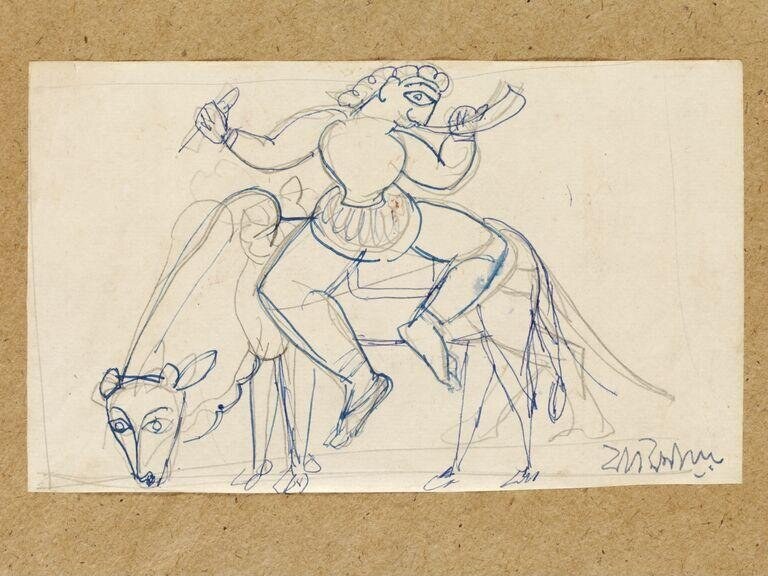
A pen-and-ink sketch shows a portly figure mounted on the back of a lean, anxious-looking quadruped — apparently a deer or antelope with prominent ears and a worried expression. The mounted figure is rotund and bare-chested, wearing what appears to be a pleated or gathered skirt and a decorative band at the waist; the head is adorned with an elaborate headdress of curled or looped forms. The figure holds objects in both raised hands — possibly weapons or ceremonial objects — in an attitude of triumph or exuberance. The animal beneath carries the weight with visible strain, its thin legs splayed. A second figure, similarly lean and anxious, stands or moves to the left, also with an attentive or wary posture. The composition is playful and theatrical, drawn with quick, confident linework against cream paper, signed by the artist in the lower right.
The dancing
The primary dancer or performer is in an elevated, weight-bearing pose on the animal's back, with both arms raised and splayed to the sides, holding implements. The torso is upright, the posture expansive and commanding. The second figure (possibly human or another animal) occupies a supporting or subordinate spatial position to the left, creating a clear hierarchy of attention. The raised-arm gesture and the frontal orientation of the torso suggest a pose of exultation or display rather than balletic control or courtly reserve.
The dance depicted
This appears to be a theatrical or ceremonial performance, possibly influenced by Indian or South Asian dance traditions — the headdress, the skirt form, and the elaborate ornamentation are consistent with classical Indian dance costume (Kathakali, Bharatanatyam, or a related form), though the playful, almost carnivalesque tone and the animal mount suggest a fusion or theatrical interpretation rather than strict adherence to a single classical form. The raising of both arms and the expansive gesture are characteristic of Indian classical dance mudras and body positions, but the overall composition is more theatrical-fantastical than documentary. Without clearer iconographic markers or a known subject, the specific genre cannot be confirmed, but the visual vocabulary points toward global-south-asian traditions.
How it was made
This is a pen sketch, likely ink on paper, executed with fluid, assured linework and minimal shading. The technique allows rapid notation of form and gesture, with anatomical distortion used deliberately for expressive effect — the exaggerated proportions of the mounted figure and the anxious strain of the animals create visual comedy and pathos. The signature in the lower right indicates a completed work presented for exhibition or collection rather than a preliminary study. The sketch format was common for artists working in or documenting non-Western performance traditions during the early 20th century, allowing for rapid capture of movement and costume without the labour of full rendering.
About this work
This 1942 sketch by Roy Jamini depicts a performer in elaborate costume mounted on a strained animal, rendered in a theatrical and slightly absurdist manner. The work sits at the intersection of documentary observation and modernist interpretation — Jamini's interest in Indian vernacular and classical forms expressed through the language of European sketch technique. The figure's ornate headdress and costume vocabulary suggest roots in South Asian classical dance, but the playful composition and animal mount lift it into a realm of fantasy and commentary on spectacle itself. For a gallery of dance in art, the work represents a moment when Indian artists were claiming both their classical traditions and a modernist formal language to represent them.
How to look at it
Attend first to the gesture and carriage of the mounted figure: the raised arms, the frontal orientation, the proud bearing despite (or because of) the precarious seat. The artist has chosen a moment of display or proclamation rather than fluid movement. The comedy of the composition — the strain of the supporting animals, the slight panic in their expressions — operates in dialogue with the performer's apparent confidence and ornament, creating a visual argument about the nature of spectacle, power, and vulnerability. The sketch style itself, with its economy of line, captures the energy of performance without documentary precision.
The artist
Roy Jamini (1887–1972) was a Bengali painter who initially trained in European academic style before turning decisively toward Indian vernacular art forms — particularly the Kalighat pat (scroll paintings) and classical Indian themes. From the 1920s onward, he developed a highly distinctive style that flattened perspective, embraced bold outline and simplified form, and drew heavily on the visual language of Indian folk and classical traditions. His work was simultaneously modernist in its formal innovations and deeply rooted in Indian cultural practice. Jamini was celebrated during his lifetime as a central figure in the Indian modern art movement and for his role in elevating vernacular traditions to the status of high art.
The period
In 1942, India was on the cusp of independence (achieved in 1947), and Indian artists were engaged in urgent cultural work: claiming, documenting, and reinterpreting their own classical and folk traditions in the face of colonial dismissal and erasure. Classical Indian dance — Bharatanatyam, Kathakali, Odissi, and others — was being revived and reformulated during this period after decades of suppression under colonial rule. Simultaneously, European modernism's interest in non-Western form was creating new circuits of influence and appropriation. Jamini's practice sits within this ferment: using modernist technique to assert the dignity and complexity of Indian performance traditions.
Where it lives
The work is held in the VA (Victoria and Albert Museum) collection. No further provenance details are recorded in the available catalogue.
Dance in this work
Questions about this work
Is this Indian dance?
The costume elements — the elaborate headdress, the ornamental skirt, and the bare-chested male figure — are consistent with classical Indian dance traditions, particularly Kathakali or other Kerala forms. However, the animal mount and the playful, almost surreal composition suggest this is not a straightforward document of classical practice, but rather Jamini's imaginative interpretation or fusion piece.
Who was Roy Jamini and why does his style look so modern?
Jamini was a Bengali modernist painter who deliberately rejected European academic training to develop a flattened, outline-based style drawing on Indian folk and classical art. His approach was both deeply rooted in Indian tradition and formally innovative — he used modernist simplification to recover and assert the visual power of Indian vernacular forms.
What is the animal carrying the dancer?
The sketch suggests a deer or antelope, though the exact species is not specified. The choice of a graceful but fragile animal heightens the tension between the performer's weight and ornament and the delicate creature bearing them, creating a visual commentary on the demands of spectacle.
More dance artwork





