49 works in this view — arrow keys or swipe to move between them.
Dance in Art
Theatre costume
Unknown
- Collection:
- Theatre costume
- Source:
- Victoria and Albert Museum
- Rights:
- Rights vary by item — check the source record before reusing this image. Source record ↗
- Recorded as:
- V&A — check rights per item
These ornaments survive as evidence of how dancers' bodies were visually extended and decorated in historical theatrical practice, and how the weightless, ethereal ideal of Romantic ballet was achieved through substantial, carefully constructed costume elements. They show the practical craft skills embedded in performance and remind us that historical dance images must be read alongside the actual objects that shaped what dancers could do.
What you are looking at
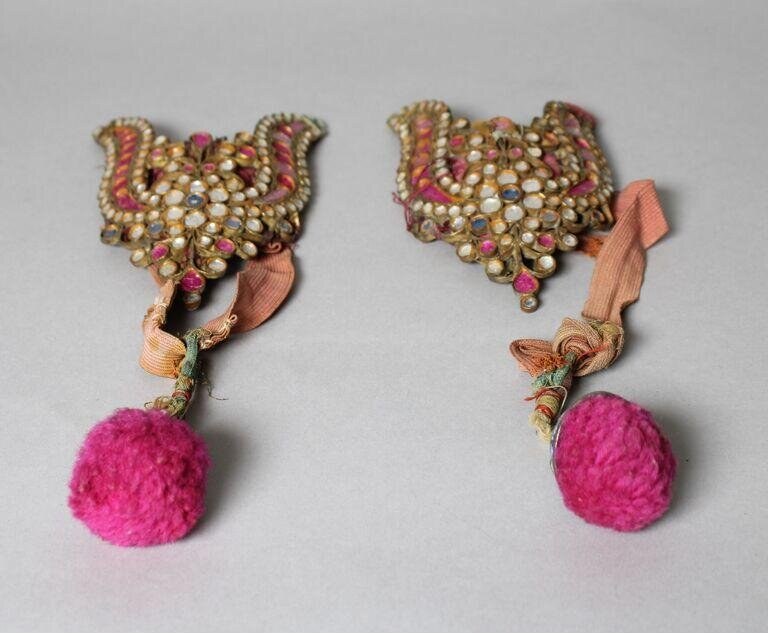
A pair of ornamental costume ornaments, each consisting of a jeweled decorative element suspended from a ribbon. The upper section of each ornament features a scalloped or fan-shaped arrangement of faceted stones—predominantly clear or pale stones with accents of deep pink or ruby-colored gems—all set in gilt metal that catches the light with a warm glow. The stones are densely packed in concentric patterns that radiate outward, creating a rich, three-dimensional effect. Below each jeweled crown hangs a length of coral or salmon-pink silk ribbon, slightly worn and creased from use, gathered and tied with a small gilt metal clasp. At the end of each ribbon dangles a vibrant magenta or fuchsia pom-pom or tassel, densely constructed and fluffy in texture. These appear to be costume jewelry or decorative elements intended to be worn or attached to a dancer's costume, typical of theatrical or ceremonial dress from the 18th or 19th centuries.
The dancing
No figures are present; these are constructed objects rather than representations of dancers. The ornaments are symmetrical and appear identical or near-identical pairs, suggesting they were designed to be worn as a matched set—perhaps pinned to the sides of a corset, attached to the shoulders, or suspended from the arms of a costume. The hanging ribbons would move and sway with a dancer's motion, creating visual interest and extension of the body line.
The dance depicted
These ornaments most likely adorned a theatrical dancer's costume, probably in a European court ballet or pantomime of the 18th or early 19th century. The jeweled construction and substantial scale suggest they were for a principal or noble character rather than ensemble. The pom-poms would swing and draw attention to the wearer's movements; the ribbons would create additional lines and emphasize the body's geometry. Without the costume itself, the precise dance style cannot be definitively identified, but the materials and construction are consistent with Romantic-era ballet or its precursors.
How it was made
These are three-dimensional constructed ornaments made from gilt metal findings, faceted gemstones (likely paste or colored glass rather than precious gems, given the context of theatrical costume), silk ribbon, and wool or silk pom-poms. The faceted stones are individually set or wire-wrapped into place, a labor-intensive process that required skilled craftsmanship. The construction method—dense stone-setting on a metal base—indicates these were made by hand by a theatrical costumier or jewelry maker, a specialized craft in theatre production. The materials suggest theatrical rather than aristocratic use, as precious gems would be rare in disposable costume pieces.
About this work
These are paired costume ornaments from an unknown theatrical production, most likely European, dating to the 18th or 19th century. They represent the intensive craft labor that went into creating visible spectacle for dancing bodies, particularly in court ballet and early Romantic ballet. The ornaments would have been pinned or sewn to a dancer's garment, where they would catch light and move with the body, extending the visual effect of the dancer's lines and adding weight and grandeur to the costume. They are examples of the material culture of historical dance—objects designed specifically to enhance movement and create a unified theatrical image.
How to look at it
Imagine these ornaments in motion: the rigid geometric sparkle of the jeweled upper section contrasts with the soft swing and flutter of the ribbon and pom-pom below, creating a visual syncopation that would draw the eye during rapid footwork or spins. The deep pink and magenta of the pom-poms would stand out against pale ballet costumes of the era, and the ribbons would trace the lines of the dancer's movement through space. The ornaments are designed to be seen from a distance—across the depth of a stage or ballroom—so the jeweled section reads as a unified glittering mass rather than individual stones.
The period
By the late 18th century, European court ballet had evolved into a professional theatrical form with increasingly elaborate costume requirements. The Romantic era (roughly 1830s onwards) introduced tutus, pointe work, and an emphasis on the ethereal and otherworldly; costume ornaments like these would have been essential to creating the illusion of weightlessness and supernatural beauty. Ornamental details of this quality were produced in theatrical centers like Paris, London, and Vienna, where there was a thriving industry of costumiers, wigmakers, and jewelers supplying both opera houses and aristocratic amateur performers.
Where it lives
Held in the V&A (Victoria and Albert Museum) collection as theatre costume. The museum's holdings in historical theatrical dress are among the most comprehensive in the world, drawn from acquisitions spanning the 19th and 20th centuries.
Dance in this work
Questions about this work
What dance would a performer wear these?
Most likely a Romantic-era ballet, a court dance, or a pantomime where a principal character needed to be visually distinguished. The scale and cost suggest a leading role. The wearer would probably be a professional dancer or an aristocratic amateur performing at court or at a private ball in the 18th–19th centuries.
Are these precious jewelry?
No. The stones are almost certainly paste (colored glass) or non-precious stones set into gilt metal—standard materials for theatrical costume, which needed to catch stage light without excessive cost. Precious gems would be reserved for the wearer's personal jewels, not costume pieces that might be damaged or lost in performance.
How would these be attached to a costume?
Most likely pinned or sewn to the upper arms, shoulders, or sides of the corset or bodice. Some ribbon ornaments of this type were also clipped to the hair or attached to a headdress. The pom-poms would hang down when at rest and swing outward with movement, creating dynamic visual interest.
Why are there two?
These are a matched pair, almost certainly designed to be worn as a set—one on each arm or shoulder. Symmetrical ornamentation was standard in ballet and formal dance costume, reinforcing the geometric, balanced aesthetic of the period.
More dance artwork





