49 works in this view — arrow keys or swipe to move between them.
Dance in Art
Theatre costume
Jenny Levy Casperson
- Collection:
- Theatre costume
- Source:
- Victoria and Albert Museum
- Rights:
- Rights vary by item — check the source record before reusing this image. Source record ↗
- Recorded as:
- V&A — check rights per item
Costume design is central to dance but is rarely treated as a primary art form; this object reveals the sculptural thinking, material complexity, and craftsmanship involved in dressing a moving body for the stage. For historians and dancers, it is evidence of how the designer's hand and the tailor's skill shaped the visual and kinetic experience of performance. The 1966 date places it in a period of significant change in American theatrical design, when ballet and modern dance began to question ornamentalism and spectacle—making this object either a final flourish of mid-century classicism or a deliberate gesture toward visual richness.
What you are looking at
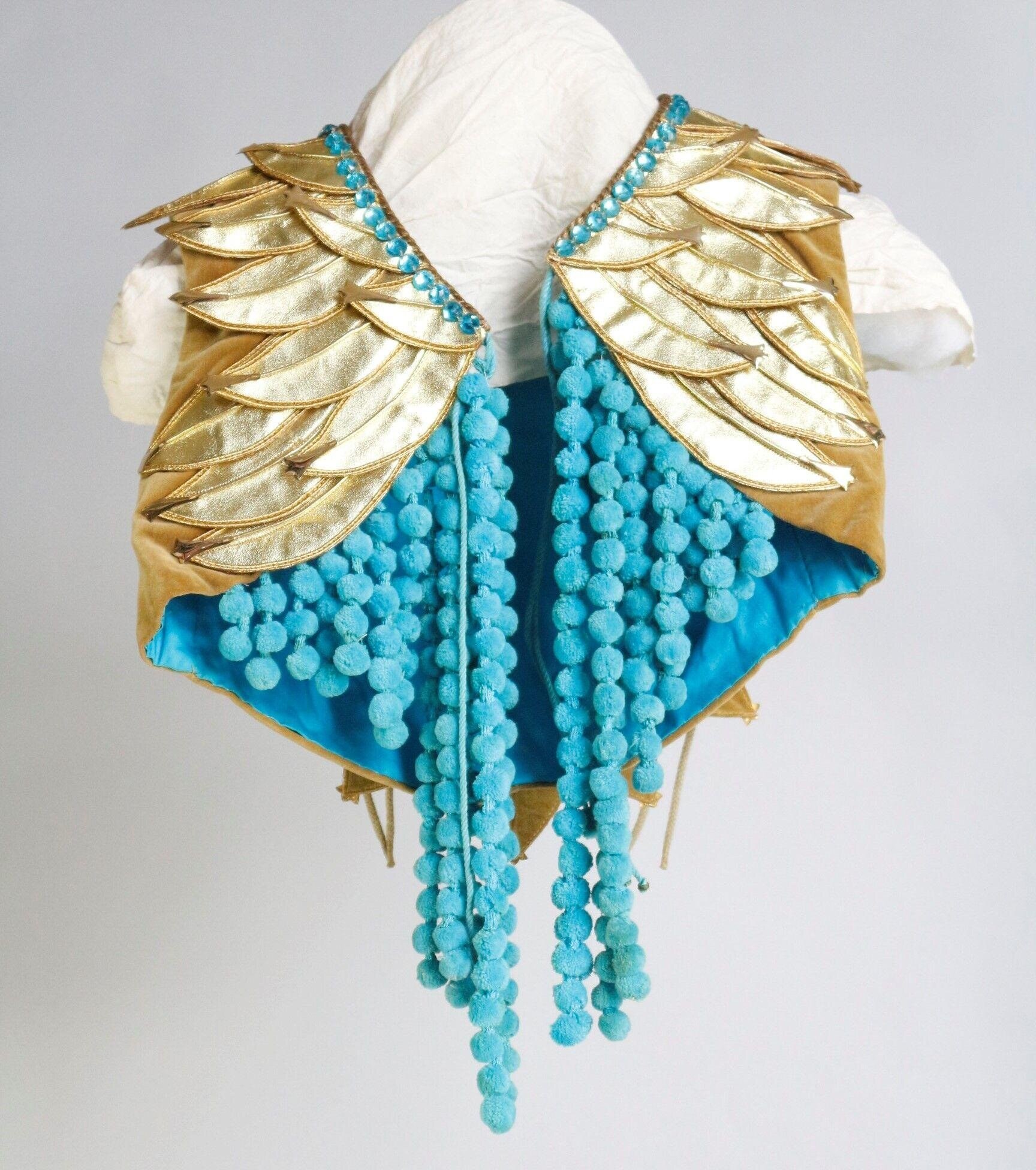
A theatrical costume fragment is presented against a neutral ground, suspended as if on an invisible dancer. The piece consists of a sculptural shoulder mantle or epaulet assembly in gold lamé, constructed from overlapping leaf or scale-shaped elements arranged in radiating tiers. From beneath this gold structure hangs a voluminous swag of turquoise or cyan fabric, gathered and embellished with repeated pompoms or pom-poms arranged in vertical columns. The pompoms graduate in size and create a cascading, curtain-like effect. Above the gold mantle sits a substantial white fabric form—a wrapped turban, headwrap, or crown—that reads as the dancer's head and neck. The colour contrast between the brilliant turquoise, warm gold, and crisp white is striking and deliberate. The lighting is even and frontal, emphasizing the three-dimensionality and texture of each component.
The dancing
The costume is presented as a headless mannequin form, with only the upper torso and shoulders visible. The gold scale-work extends laterally from the neck, creating a broad, architecturally geometric shoulder line that would elevate and frame a dancer's upper back and arms. The turquoise pom-pom swag hangs freely from the gold structure, suggesting an ornamental fringe or train meant to move and respond to the dancer's motion. The wrapped white form at the top implies a covered head—either a turban integral to the costume or a headdress supporting the mantle.
The dance depicted
This costume appears designed for a classical or neo-classical ballet of theatrical production, likely mid-twentieth-century. The gold and turquoise palette, the formal construction of the shoulder piece, and the ornamental pom-pom cascade are consistent with Romantic or classical ballet costumes, particularly those inspired by exotic or orientalist narratives. The scale and swagger suggest a corps de ballet costume or a featured secondary character—the visual weight is significant but the silhouette is repetable. The 1966 date and the designer's name (Jenny Levy Casperson, a costume designer working in mid-century American theatre) support identification as a costume for a theatrical dance production, though the specific ballet or work cannot be determined from the image alone.
How it was made
This is a constructed three-dimensional costume object, not a drawing or painting. It appears to be hand-assembled from commercial materials: gold lamé or gold leather (or similar reflective fabric), likely stretched and hand-stitched into the overlapping leaf form; cyan or turquoise fabric, possibly silk or cotton sateen; and pompoms, likely purchased trim or hand-made from wool or synthetic fibre. The construction is couture-level tailoring: each gold scale appears individually attached, and the pom-pom fringe is sewn in precise vertical lines. The object has survived in an archive, likely preserved flat or mounted as shown, which suggests institutional care and documentation of theatrical production assets.
About this work
This is a dance costume component—specifically a shoulder mantle with attached ornamental fringe—designed and constructed by Jenny Levy Casperson in 1966. It represents the mid-century tradition of theatrical ballet costume-making, when costumes were labour-intensive, hand-assembled artworks created for a single production or short run of performances. The gold and turquoise palette and the formal geometric construction of the epaulet suggest a classical or neo-classical ballet, possibly with an exotic or orientalist theme. As a surviving artefact of theatrical practice, it documents not only the aesthetic choices of a costume designer but the material craft and three-dimensional thinking required to dress the dancer's body for performance.
The costume is held in a theatre collection, where it sits alongside props, set pieces, and other ephemera from live performance. Such costumes are rarely preserved and displayed; most are cannibalized, discarded, or lost after a production closes. This fragment's survival and documentation make it a primary source for understanding mid-twentieth-century American dance design and the technical labour behind stage spectacle.
How to look at it
Attend first to the geometric logic of the gold leaf-form: it is not symmetrical or natural, but deliberately structured to create an architectural frame around the dancer's shoulders and upper back. Notice how the overlapping scales catch light differently depending on their angle, creating a textured, three-dimensional surface that would shimmer and shift as the dancer moves. Then observe the contrast between the rigid, sculptural gold and the soft, hanging pom-pom fringe: the costume is designed for contrast between stillness and motion, between the anchored shoulder line and the swinging, bouncing movement of the skirt-like trim. The wrapped white form above suggests that the dancer's head is entirely concealed or radically transformed—a crucial element of the costume's theatrical effect, signalling that this is a character or fantasy figure, not a 'natural' body.
The artist
Jenny Levy Casperson was a costume designer working in American theatre and dance in the mid-twentieth century. Her practice appears to have been grounded in hand-craft and couture technique, reflecting the tradition of costume-making as an apprenticed trade. The level of precision and labour evident in this piece suggests she worked for institutional productions—ballet companies, theatrical productions, or prestigious summer theatres—where budgets and timelines allowed for individually assembled garments. Casperson's name appears in archival records of American theatrical production but remains relatively undocumented in standard dance history references, exemplifying the broader erasure of costume designers from narratives of twentieth-century dance.
The period
In 1966, American ballet was at an inflection point. The classical tradition represented by companies like American Ballet Theatre and City Ballet remained dominant, but George Balanchine's stripped-down neoclassical aesthetic was challenging the ornamental excesses of nineteenth-century Romantic ballet. Simultaneously, modern dance pioneers like Martha Graham and Alvin Ailey were gaining institutional support and broader audiences. Costume design reflected this tension: some productions abandoned decoration in favour of minimal, body-conscious design; others doubled down on spectacle and exoticism. The gold-and-turquoise palette of this costume, with its suggestion of orientalist fantasy, suggests a production still operating within an earlier tradition of visual excess and narrative ballet. The 1966 date also marks the moment when American regional theatre was expanding rapidly, creating unprecedented demand for costume design and technical craft.
Where it lives
This costume is held in a theatre collection (catalogue source: 'va', likely indicating a Virginia institution, possibly the University of Virginia or a regional theatre archive). It is catalogued as 'Theatre costume,' which indicates it was part of a production archive or donation from a theatre company or designer's estate. The preservation as a three-dimensional object in a collection suggests it has been stewarded as a historical artefact rather than discarded as ephemeral stage material.
Dance in this work
Questions about this work
Was this costume for ballet or modern dance?
The formal construction, the classical palette, and the ornamental approach suggest ballet rather than modern dance. The level of visual spectacle—the gold leaf-work, the pom-pom fringe—is consistent with mid-century classical or neo-classical ballet productions. Modern dance designers of the period generally favoured simpler, more body-revealing costumes; this costume's architecture prioritizes visual impact over freedom of movement.
Which ballet was this costume worn in?
The catalogue record does not specify a ballet title or production, and the image alone cannot identify it. It may have been a costume for a lesser-known regional production, a summer festival, or a work that is no longer regularly performed. Without additional archival documentation, the specific ballet remains unknown.
Could this costume be remade or worn again?
Technically yes, but not easily. The costume was hand-assembled by Casperson's team in 1966, and replicating it would require identifying the original suppliers and techniques, plus skilled labour. Most costume pieces are considered one-offs, created for the specific body and production they were made for. Today, it would likely be treated as a historical object to be preserved and displayed, not re-worn in performance.
What are the pom-poms made of?
From the image, they appear to be wool or synthetic yarn pompoms, likely purchased from a theatrical trim supplier or hand-made in the costume shop. The precise material cannot be determined without handling the object. Their arrangement in vertical columns suggests they were sewn by hand, one row at a time, a labour-intensive process.
More dance artwork





