49 works in this view — arrow keys or swipe to move between them.
Dance in Art
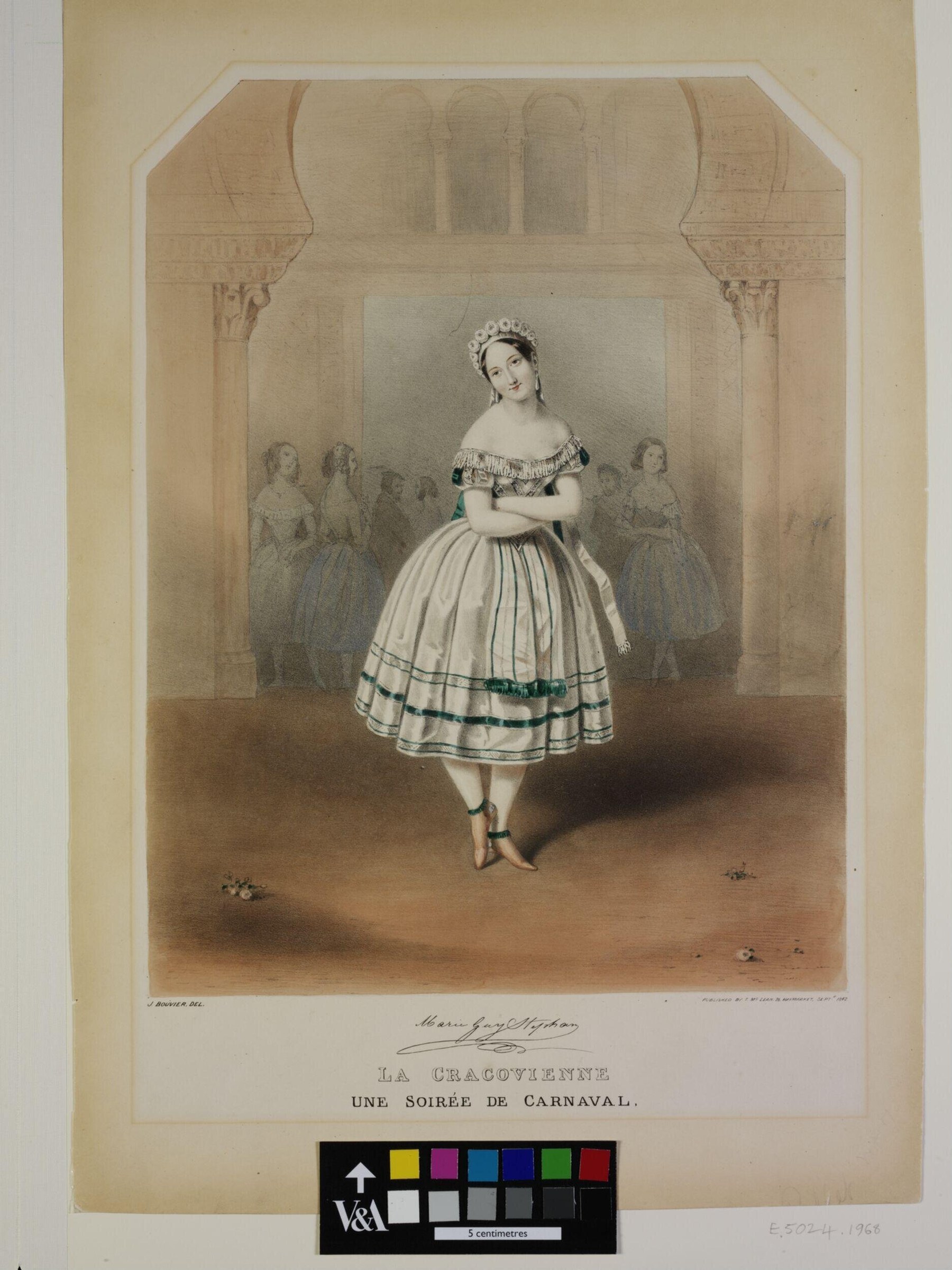
Marie Guy Stephan (facsimile signature) / La Cracovienne / Une Soirée de Carnaval.
Bouvier, Jules
- Collection:
- Source:
- Victoria and Albert Museum
- Rights:
- Rights vary by item — check the source record before reusing this image. Source record ↗
- Recorded as:
- V&A — check rights per item
For dance historians, this print is crucial documentation of the Cracovienne's status as a fashionable social and theatrical dance in 1840s Europe, and of how new dances were disseminated through celebrity performers and commercial image production. The work also reveals the conventions of dance representation in the pre-photographic era: the emphasis on costume, formal presentation, and the moment of display rather than the movement itself. For visual culture scholars, it exemplifies the lithographic portrait trade and the commercialization of ballroom entertainment in the early industrial period.
What you are looking at
A young woman in pale ballroom dress stands alone at center stage in a grand neoclassical interior, spotlit against shadowed architectural elements and attendant figures. The setting is an ornate hall with fluted columns and classical capitals; tall Gothic-arched windows rise behind her. She wears a white ball gown with a fitted bodice trimmed in dark ribbon or lace at the shoulders, and a voluminous skirt decorated with horizontal bands of dark green or teal trim at the hem. A tiara crowns her hair, which is parted and smoothly styled. Her posture is upright and composed, weight centered, with her arms held gracefully at her sides; she appears to be pausing mid-movement or presenting herself for observation. Several other female figures in similar period dress stand in shadow on either side of the space, creating the sense of an audience or witnesses to her solitary moment. The foreground floor is bare and neutral in tone; the overall effect is of staged theatrical performance rather than social dancing.
The dancing
The central dancer stands in an upright, nearly frontal pose with her weight evenly distributed and her arms relaxed at her sides or lightly gathered. Her posture is formal and presentational rather than actively dancing—there is no visible weight shift, turnout, or active extension. Her gaze is direct and composed. The attendant figures in the background are rendered as indistinct silhouettes, establishing her isolation as the focal point. The absence of a partner and the stillness of her frame suggest a moment of display or entrance rather than the dynamic movement of partnered dance.
The dance depicted
The work is titled *La Cracovienne: Une Soirée de Carnaval* (The Cracovienne: A Carnival Evening), identifying the dance as the Cracovienne, a Polish mazurka-derived social dance that became fashionable in European ballrooms during the 1840s. The print depicts not active dancing but rather the formal presentation of a dancer—possibly a celebrated performer of the period—at a carnival or ball. The Cracovienne was typically a solo or partnered display dance with characteristic Polish rhythmic patterns and posture, but this image captures the theatrical moment of entrance or salutation rather than the dance's characteristic traveling steps or arm movement. The title's reference to carnival suggests this was a performance piece as much as a social dance, typical of how novelty dances entered European high society in the early 19th century.
How it was made
This is a hand-colored lithographic print, a medium that allowed rapid mass production and circulation of popular entertainment imagery in the 1840s. The artist Jules Bouvier worked in this technique to capture fashionable theatrical and ballroom subjects. Lithography enabled the subtle modeling of the figure through tonal gradation visible in the dancer's skin and drapery, while the careful outlining suggests the use of color separately applied after printing. The V&A museum's acquisition mark and the facsimile signature of the dancer (Marie Guy Stephan) indicate this was marketed as a portrait of a specific performer or society figure, a common commercial practice for dance prints of this era. The print was designed for a middle-class audience interested in fashion, entertainment, and ballroom culture.
About this work
This hand-colored lithographic print documents the 1840s craze for the Cracovienne, a Polish dance that swept European ballrooms and theaters in the early 19th century. It depicts a celebrated dancer, Marie Guy Stephan, not in mid-movement but in the formal theatrical moment of entrance or salutation—a convention of performance prints from the period that emphasizes elegance and costume over kinetic description. The work sits at the intersection of ballroom culture and commercial theatrical portraiture, capturing the point at which novel folk-derived dances entered elite European society and were repackaged as fashionable entertainment. It is valuable evidence of how dances circulated, were celebrated, and were marketed through visual media before photography.
How to look at it
The artist has chosen not the moment of active dancing but the formal moment of entry or salutation, a theatrical convention of the period. Attend to the dancer's stillness and upright posture, which convey elegance and composure rather than the rhythmic or propulsive qualities the Cracovienne itself would have possessed. The costume—the tiara, the pale gown, the colored trim—is the primary subject; the figure's body is presented as a display object. The attendant figures in shadow reinforce the sense of performance and spectatorship. This freeze-frame approach was typical of how dance was translated into printmaking before instantaneous photography; the artist prioritized costume, lineage, and formal beauty over the ephemeral kinetics of the dance itself.
The artist
Jules Bouvier was a French lithographic artist active in the second quarter of the 19th century, specializing in theatrical and ballroom subjects. He was part of the commercial print industry that supplied middle-class audiences with images of fashionable entertainment, performers, and dances. His work documents the visual culture of the July Monarchy and Second Empire, when lithography was the dominant medium for circulating images of contemporary social life and celebrity. Little is known of Bouvier's biography, but his consistent output of dance and theater subjects suggests he was a specialist in this market.
The period
The 1840s were a period of intense enthusiasm for novel dances in European ballrooms. The Cracovienne entered high society as part of a broader Romantic-era fascination with Polish and Eastern European culture and music, following the Polish Uprising of 1830–31 and the émigration of Polish artists to Western Europe. Meanwhile, the commercial lithographic print trade was at its height, producing thousands of images of dancers, singers, and theatrical celebrities for a rapidly expanding bourgeois market. Dance was a central subject of popular prints alongside fashion, and celebrity performers—especially women—were marketed through their images in ways that prefigured modern celebrity culture. This print is a direct product of that convergence: a lithograph documenting a fashionable dance through the image of a named performer.
Where it lives
This lithographic print is held by the Victoria and Albert Museum (accession E.5024, catalogued as 1968). The facsimile signature of Marie Guy Stephan, a dancer or performer of the period, appears below the title, indicating the work was marketed as a portrait of a specific celebrity. The print was acquired through the V&A's standing collection of theatrical and ballroom imagery.
Dance in this work
Questions about this work
What is a Cracovienne?
The Cracovienne is a Polish dance derived from the mazurka, characterized by rhythmic complexity, proud posture, and often performed solo or in pairs. It became a fashionable novelty in European ballrooms during the 1840s, particularly among the French and English aristocracy and upper middle classes. The dance was part of a Romantic-era enthusiasm for Polish culture that intensified after the Polish Uprisings of the 1830s.
Why doesn't the dancer look like she's actually dancing?
The artist has captured the formal moment of theatrical entrance or salutation rather than active movement. This was a convention of dance portraiture in the lithographic era—artists prioritized showing the dancer's face, costume, and elegance in a composed pose over attempting to depict the kinetic qualities of the dance itself. The print served as a celebrity portrait as much as a document of the dance.
Who was Marie Guy Stephan?
Marie Guy Stephan was a dancer or performer known enough to merit a commercial portrait print in the 1840s, but little biographical information survives. The facsimile signature on the print indicates she was celebrated enough to lend her name and image to a marketable commodity, typical of how celebrity performers in this era were disseminated through the print trade.
Why is this a lithograph rather than a painting or engraving?
Lithography allowed rapid, affordable mass production of colored prints for a middle-class market, making it the ideal medium for commercial dance and theater portraiture in the 1840s. Unlike engravings, which required extensive labor, lithographs could be printed quickly and hand-colored by workshop assistants, keeping costs low and circulation high. This technical advantage made lithography the dominant medium for popular entertainment imagery during this period.
More dance artwork





