49 works in this view — arrow keys or swipe to move between them.
Dance in Art
Painting
Devi, Mahesvari
- Collection:
- Painting
- Source:
- Victoria and Albert Museum
- Rights:
- Rights vary by item — check the source record before reusing this image. Source record ↗
- Recorded as:
- V&A — check rights per item
This work documents how non-European and folk artistic traditions were reclaimed and celebrated by modernist and postcolonial artists in the late twentieth century. It demonstrates that dance and performance in visual art need not follow Western academic conventions—rhythm, repetition, gesture, and symbolic movement can be conveyed through flat color, pattern, and expressive distortion. For dancers and historians, the painting raises questions about how dance is recorded and honored in visual culture when the medium is not photography or classical representation.
What you are looking at
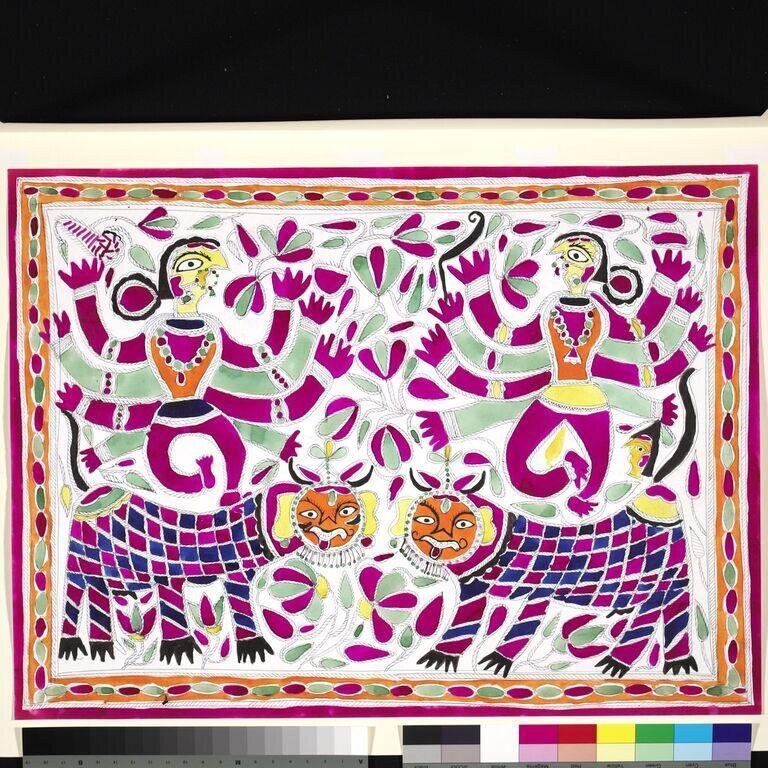
This painting presents two stylized female figures in a vibrant, densely patterned composition dominated by magenta, purple, and green. The figures occupy the upper half of the canvas, wearing ornate jewelry and clothing rendered in bold flat colors. They appear to be in dynamic poses with curved, expressive bodies. The lower half of the composition features two large animal heads—possibly lions or mythological creatures—with geometric patterned bodies rendered in a checkered or scaled texture in purple and navy. Between and around all the figures are scattered organic shapes—stylized leaves, petals, and abstract forms in magenta and green—that create a sense of movement and visual density across the entire surface. A decorative border in magenta, gold, and patterned elements frames the composition. The painting employs a folk-art or tribal aesthetic with flattened perspective, bold outlines in black, and jewel-like color saturation.
The dancing
The two human figures display exaggerated, non-naturalistic poses with curved spines and limbs that suggest fluid, continuous motion rather than a frozen moment. Their bodies twist and undulate across the upper register. Both wear jewelry—necklaces and ornaments—and minimal upper clothing. Their gestures appear rhythmic and expressive rather than balletic; the weight and balance are decorative rather than anatomically grounded. The relationship between the figures is ambiguous; they do not appear to interact directly but exist as parallel elements in the overall composition.
The dance depicted
The painting does not depict a recognizable codified dance form. Instead, it presents stylized human and animal figures in expressive, rhythmic poses that suggest celebration, ritual, or performance rather than a specific dance technique. The dense, repetitive patterning and the integration of animal motifs suggest inspiration from folk, tribal, or ceremonial traditions, but without clearer contextual markers—costume details, instruments, a visible ground or architecture—the specific dance tradition cannot be identified with confidence. The mode of representation prioritizes decorative pattern and symbolic meaning over anatomical accuracy or technical dance vocabulary.
How it was made
This is a watercolor or gouache on paper, as indicated by the luminous color, the precision of the outlined forms, and the visible flatness of application. The technique employs bold black outlines defining discrete areas of flat, saturated color—a method associated with folk art, indigenous painting traditions, and early-twentieth-century modernist engagement with non-European visual languages. The patterning is meticulous and repetitive, suggesting a laborious hand process. The decorative border in multiple colors and patterns frames the composition in a manner common to manuscript illumination, folk textiles, and South Asian painting traditions.
About this work
This 1973 painting by Mahesvari Devi presents a visually exuberant celebration of rhythm, pattern, and expressive movement. The work combines human and animal figures in a densely decorated composition that suggests performance, ritual, or celebration without adhering to a single recognizable dance vocabulary. The style—with its bold outlines, flat color planes, decorative borders, and integration of organic and geometric patterning—indicates engagement with folk, tribal, or South Asian artistic traditions. The painting occupies a space between fine art and decorative arts, between figuration and abstraction, where the rhythm of the composition itself becomes a kind of visual dance.
How to look at it
Attend first to the overall rhythm created by the repetition of shapes, patterns, and colors across the entire surface—the composition is designed as a unified visual field rather than a composition with foreground and background. Notice how the artist uses flat, saturated colors and bold black outlines to create a sense of energy and movement without relying on shading or perspective. Look at how the curves and poses of the human figures echo the organic, looping shapes scattered throughout—the painting treats all its elements as equally important contributors to a rhythmic whole. The decorative border frames the intensity of the interior, suggesting this is a sacred or ceremonial object as well as a painting.
The artist
Mahesvari Devi is documented as a painter working in 1973. Beyond the catalogue record provided, no further biographical or contextual information is available. The style of this work—its engagement with folk, tribal, or South Asian visual languages, its use of bold pattern and flat color, and its celebration of rhythmic, expressive figures—situates it within twentieth-century movements that drew on non-Western artistic traditions as a counter to academic European modernism. The artist's name and practice suggest possible connections to Indian or South Asian artistic contexts, but this cannot be confirmed from the image alone.
The period
The 1970s saw renewed international interest in indigenous, folk, and non-Western artistic traditions as sources of aesthetic and spiritual renewal. In postcolonial contexts, artists were reclaiming and elevating visual and performance traditions that had been marginalized under colonialism. The emphasis on pattern, repetition, and symbolic meaning over realistic representation reflects both modernist abstraction and the reassertion of non-European artistic values. In dance, the same period witnessed growing interest in ethnographic documentation, world dance traditions, and the politics of cultural representation—though this painting operates in the visual arts rather than performance itself.
Where it lives
The catalogue record identifies this as a painting held in a collection designated 'Painting' with source 'va' (likely Virginia or a related institutional designation). No accession number, acquisition date, or further provenance is recorded. The work exists as a loose sheet of watercolor or gouache on paper.
Dance in this work
Questions about this work
What dance is this depicting?
The painting does not represent a specific, codified dance form recognizable from technique, costume, or setting. Instead, it presents expressive, rhythmic human and animal figures in a mode of representation drawn from folk, tribal, or South Asian artistic traditions. The 'dance' is conveyed through the overall composition, pattern, and gesture rather than through anatomical or technical dance vocabulary.
Why are there animals in a dance painting?
The inclusion of animal figures—likely lions or mythological creatures—is characteristic of folk, tribal, and South Asian art traditions in which human and animal presences are integrated symbolically rather than naturalistically. The animals may represent sacred forces, protective spirits, or elements of a cosmological narrative rather than realistic participants in a human dance.
What does the artist's name suggest about the work's origins?
Mahesvari Devi's name and the painting's style—with its dense patterning, integration of ornament, and engagement with non-Western artistic conventions—suggest possible connections to South Asian, particularly Indian, artistic traditions. However, the catalogue record contains no biographical information to confirm this or to situate the artist definitively within a particular cultural or regional context.
Is this a finished work or a study?
The meticulous patterning, the coherence of the composition, the framing border, and the saturation of color throughout suggest this is a complete, finished work rather than a preparatory study. The care lavished on decorative detail indicates this was intended as a final statement.
More dance artwork





