49 works in this view — arrow keys or swipe to move between them.
Dance in Art
Theatre costume
Givens, Craig
- Collection:
- Theatre costume
- Source:
- Victoria and Albert Museum
- Rights:
- Rights vary by item — check the source record before reusing this image. Source record ↗
- Recorded as:
- V&A — check rights per item
This costume reveals how 1980s experimental theatre reshaped the relationship between the dancer's body and textile ornament, moving away from tailored fit toward sculptural transformation. The sheer visual abundance and handcrafted quality represent a philosophy of performance that valued transformation and spectacle as legitimate alternatives to movement virtuosity. It is a primary document of how costume design functioned as a core creative act in that era's theatre-making.
What you are looking at
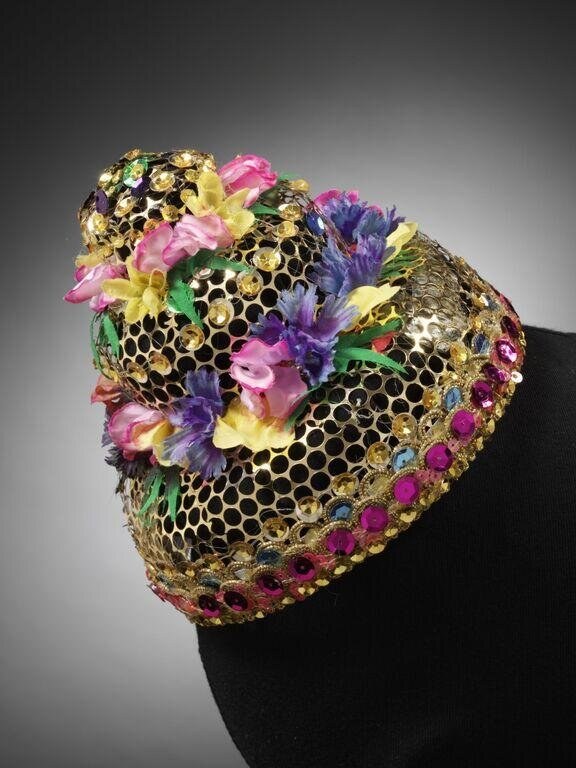
A theatrical costume piece constructed from gold mesh or chainmail, densely covered in colorful three-dimensional flowers and ornamental elements. The base is a helmet or head-covering shape, fully encrusted with the gold metalwork. Across the front and sides, dozens of silk or velvet flowers in hot pink, purple, yellow, and pale green emerge from the mesh in layered clusters, creating a wildly exuberant, almost sculptural effect. The flowers appear to be hand-stitched into the structure. Along the bottom edge and extending down the sides, larger gemstones or beads in deep magenta, turquoise, and other jewel tones are densely sewn, forming a glittering border. The piece is photographed against a dark background, mounted on what appears to be a black fabric form or dress stand, showing how the costume would sit on a performer's head and shoulders. The lighting is studio-quality, emphasizing the reflective properties of the gold mesh and the vivid colors of the applied ornament.
The dancing
This is not a depiction of dancers in motion but rather a costume object itself—a wearable theatrical piece designed to transform the wearer's silhouette and presence. The form suggests it would cover the head and upper body, creating a monumental, frontal presence rather than emphasizing physical movement or partnering. The density and weight of applied ornament suggest the wearer would move within it rather than execute virtuosic footwork; movement would be stately and ceremonial.
The dance depicted
The costume's ornate, sculptural quality and floral abundance suggest theatrical dance rather than social or competitive ballroom forms. The gold mesh construction, the profusion of applied flowers, and the jeweled border are consistent with late 20th-century experimental or avant-garde theatre costume design. Without identifying marks or a clearer context, the specific dance tradition remains uncertain; the piece may belong to contemporary ballet, experimental theatrical dance, or a fusion genre. The 1986 date and the artist Craig Givens position this in the era of postmodern theatrical innovation.
How it was made
This is a constructed costume object, not a painting, drawing, or photograph. It appears to be made from a gold mesh or chainmail base to which layers of silk or velvet flowers have been hand-sewn, interspersed with faceted gemstones or beads. The technique is artisanal textile work—hand-stitching, possibly with some wire-wrapping to shape the flowers. The object was photographed in studio conditions, likely as documentary record of the finished piece. Such costumes are typically one-of-a-kind or limited productions for specific theatrical runs, reflecting the labor-intensive craft practices of avant-garde theatre workshops.
About this work
This is a theatrical costume element created by Craig Givens in 1986—a head and shoulder-covering constructed from gold mesh densely layered with appliquéd silk flowers and jeweled embellishments. It belongs to the visual and material culture of late 20th-century experimental theatre design, at a moment when postmodern choreographers and directors were radically departing from ballet's classical vocabulary and embracing sculptural, environmental, and ornamental approaches to the dancing body. The piece embodies the handmade, labor-intensive ethos of that era's theatre workshops and the belief that costume could be as much a sculptural environment as a garment. For dancers and historians, it documents a specific moment in the material practice of avant-garde dance—the choices made about how the body should be framed, what it should carry, and how ornament and weight shape performance possibility.
How to look at it
Attend first to the sheer density and complexity of the surface—every inch is worked, nothing is plain. Notice how the flowers emerge in three dimensions from the mesh base, creating shadow and depth rather than flat appliqué. Observe the color choices: the hot pink and purple flowers against gold mesh create a jarring, non-naturalistic palette, signaling artificiality and transformation rather than enhancement of natural beauty. Consider the weight and immobility the piece would impose on a wearer: this is costume-as-sculpture, not costume-as-extension. Finally, note the care evident in the handwork—the labor and time visible in every seam and stone suggest a philosophy in which the costume's making is part of its meaning.
The artist
Craig Givens worked as a costume and set designer in American experimental theatre during the 1980s and beyond, collaborating with avant-garde choreographers and theatre companies. His approach combined textile craft, sculptural thinking, and a maximalist visual sensibility. Givens' practice exemplified the interdisciplinary ethos of post-1960s avant-garde performance, where costume design was reconceived as environmental, conceptual, and radically collaborative rather than subordinate to choreography.
The period
In 1986, theatrical dance in the United States was fragmenting into multiple centers of innovation. While ballet companies continued classical traditions, a vibrant avant-garde had emerged in lower Manhattan, San Francisco, and other cities, influenced by Judson Church aesthetics, postmodern dance theory, and the interdisciplinary energy of performance art. Costume design in this context moved away from the tailored leotard and toward sculptural, thematic, and ornamental approaches. The 1980s also saw rising interest in textile arts and craft as serious aesthetic domains, partly in response to conceptual art's dominance. Givens' densely ornamented, labor-intensive costume sits at the intersection of all three: avant-garde theatre, textile craft, and sculptural thinking about the body.
Where it lives
The piece is held in a theatre costume collection (labeled 'Theatre costume' in the holding field), likely part of an institutional or archive collection related to experimental American theatre. The 1986 date and association with Givens suggest it may come from a specific production, though the record does not identify the show, company, or choreographer. It functions as a primary artifact of theatre production practice rather than a finished artwork for exhibition.
Dance in this work
Questions about this work
Is this a garment or a sculpture?
It is both—a wearable costume object that functions as sculpture. The distinction between garment and sculpture dissolves in experimental theatre design of this era. The piece was designed to be worn and to transform the performer's silhouette and presence, but it operates more like an environmental shell or architectural addition than a fitted garment.
What dance or theatrical form would this costume belong to?
Without documentation of the specific production, we cannot identify the dance form with certainty. The ornament, scale, and aesthetic suggest experimental or avant-garde theatre from the 1980s—possibly contemporary ballet, postmodern dance, or a fusion form. The absence of any classical ballet vocabulary and the radical ornamentalism point away from mainstream choreography.
How would a dancer move in this piece?
The weight, bulk, and immobility of the costume would severely restrict movement—likely favoring slow, stately, processional, or statuary qualities over virtuosic footwork. A performer would move within and around the costume's constraints rather than executing complex steps. This constraint is likely intentional, reflecting a design philosophy that valued presence and visual transformation over dance technique.
Why is the ornament so excessive?
In 1980s avant-garde theatre, maximalist ornamentation was a deliberate aesthetic choice—a rejection of minimalist austerity and a reclamation of spectacle, color, and handmade abundance. The excess signals that this is theatre, artifice, transformation. It declares the body as a site for sculptural intervention rather than a vehicle for naturalistic movement.
More dance artwork





