49 works in this view — arrow keys or swipe to move between them.
Dance in Art
Painting
Devi, Jogmaya
- Collection:
- Painting
- Source:
- Victoria and Albert Museum
- Rights:
- Rights vary by item — check the source record before reusing this image. Source record ↗
- Recorded as:
- V&A — check rights per item
This painting documents the visual and symbolic language through which South Asian folk celebration—and specifically the raised-arm gesture of joy and invocation—is represented in contemporary art. For historians of South Asian dance, it is valuable evidence of how Garba and related festivals are understood and celebrated outside the dance arena itself, in the visual culture of their communities. The work testifies to the continuity and vitality of folk celebration in contemporary practice.
What you are looking at
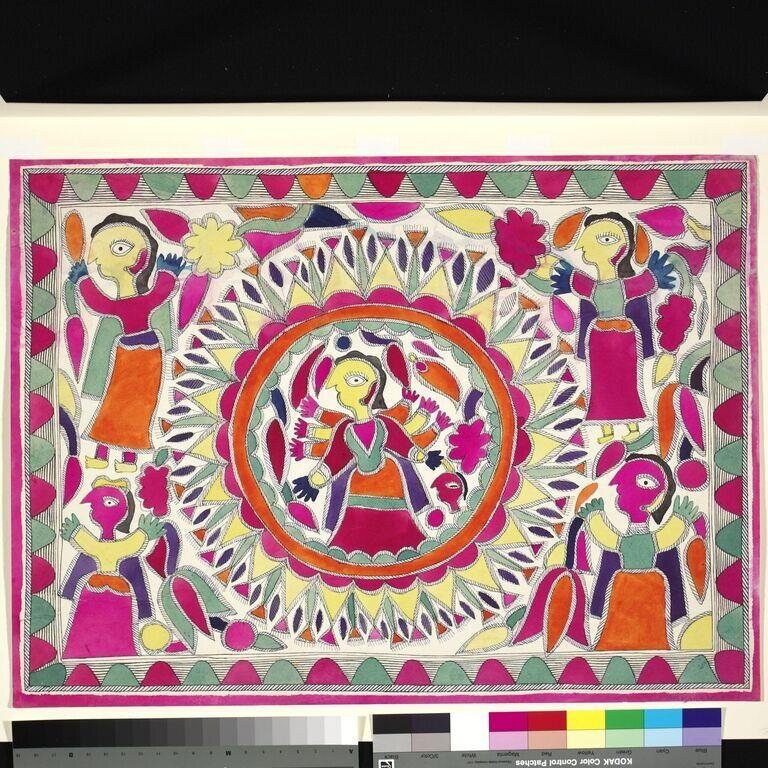
This is a vivid, densely composed painting rendered in bright acrylics or gouache with bold outlines. At the center is a large circular medallion framed in red and orange concentric rings, within which a single female figure dances. She wears a magenta or deep pink garment—possibly a skirt or wrapped dress—with an orange-yellow upper section, and her face is rendered as a schematic yellow oval with dark eyes. Her arms are raised and bent, and her posture suggests active, rhythmic movement. Radiating outward from this central circle is an elaborate mandala-like pattern of repeated leaf or petal shapes in shades of magenta, purple, navy, yellow, and orange, creating a sense of energy and celebration. To the left, right, and lower portions of the composition stand four additional female figures in similar simplified style, each wearing bright clothing in coordinating colors—magenta, orange, and yellow predominate. These outer figures appear static or posed, facing the central dancer, and their scale suggests they are witnessing or participating in a communal celebration. The composition is contained within a rectangular border frame featuring a repeating pattern of alternating magenta and olive-green triangular shapes. The entire image has the character of a devotional or celebratory scene rendered in a folk or contemporary indigenous aesthetic.
The dancing
The central dancer stands with arms raised and bent at the elbows, a gesture of celebration or invocation. Her torso is upright and her legs are not clearly articulated, suggesting either stillness or a moment of suspension in the dance. The four surrounding figures are rendered frontally in a more static pose, their arms at their sides or minimally gestured. All figures are highly simplified and schematic—rendered as geometric shapes with minimal anatomical detail—which emphasizes the symbolic or spiritual dimension of the scene over naturalistic movement observation.
The dance depicted
This appears to depict a South Asian folk or sacred celebration, most likely a festival or ritual gathering. The style of dress, the mandala-like sacred geometry, and the devotional composition suggest this may represent Garba, a Gujarati folk circle dance traditionally performed during Navaratri, or a related regional celebration. The central raised-arm gesture is consistent with celebratory South Asian dance practice. However, the work is not realistic enough in its rendering of movement to be certain of the specific dance style. The composition prioritizes spiritual or communal significance over technical dance detail.
How it was made
The painting is executed in what appears to be gouache or acrylic paint on paper or board, with bold black outlines defining all forms—a technique common in Indian folk art traditions and contemporary South Asian painter-storytellers. The flat color fields, simplified forms, and use of strong primary and secondary colors are characteristic of both traditional Madhubani and Warli painting traditions and contemporary South Asian women's artistic practice. The bold outlining and bright, saturated hues suggest this is a contemporary work using folk aesthetic principles rather than a reproduction of an older tradition.
About this work
This is a contemporary South Asian devotional or celebratory painting depicting a communal dance or festival scene, possibly representing Garba or another regional folk celebration. The work combines the formal vocabulary of South Asian sacred geometry—the mandala frame and radiating petal pattern—with simplified, energetic human figures. It belongs in a dance gallery because it captures not realistic movement but the spiritual and communal dimensions of folk celebration, and because the central figure's raised-arm gesture and active posture mark the moment of festive participation. The work is of interest both to dancers and historians because it demonstrates how folk and contemporary South Asian artists use dance as a symbol of spiritual and communal identity.
How to look at it
Attend first to the central medallion and the raised-arm gesture of the dancing figure—this is the energetic moment the artist has chosen to freeze. Notice how the radiating mandala pattern does not merely frame the figure but seems to emanate from her, suggesting that her movement is generating spiritual or celebratory energy. Then look outward at the four witness figures, whose static poses and frontal orientation emphasize that they are drawn into the scene. The bright color contrasts—magenta against yellow, orange against purple—create visual rhythm that mirrors the rhythm of the dance itself. Finally, observe the border pattern: its geometric repetition suggests the cyclical, communal nature of the celebration.
The artist
Jogmaya Devi (also recorded as Jogmaya Dev) was a Madhubani painter and artist from Bihar, India, working in the late 20th century. Madhubani painting is a centuries-old tradition of folk art practiced primarily by women in the Mithila region of Bihar and Nepal, characterized by geometric patterns, mythological narratives, and scenes of daily and ritual life rendered in bright colors with bold black outlines. Devi's work is part of the mid-20th-century revival and modernization of Madhubani practice, in which artists including Sita Devi, Bharati Dey, and others gained international recognition. Her paintings often depict devotional subjects, festival celebrations, and scenes of communal life.
The period
This work was painted in 1973, a period of significant revival and international recognition for Madhubani painting. In the 1960s and 1970s, Madhubani artists—particularly women—began exhibiting internationally and gained prominence in discussions of folk art modernism. At the same time, there was growing scholarly and artistic interest in South Asian folk dance traditions, including Garba and other regional celebrations, as expressions of cultural identity. The 1970s also marked increased documentation and celebration of women's roles in preserving and practicing these traditions. This painting reflects that moment of cultural affirmation, when folk celebration was being positioned as both a living practice and an aesthetic subject worthy of fine-art representation.
Where it lives
The work is held in a collection designated "Painting" with source code "va", suggesting it may be in a Virginia-based collection, though the catalogue record provides no further information on accession, exhibition history, or prior ownership.
Dance in this work
Questions about this work
Is this Madhubani painting?
The style is consistent with Madhubani painting traditions—the bold black outlines, flat color fields, geometric patterning, and devotional subject matter are all characteristic. However, the catalogue record does not confirm this. The artist's name, Jogmaya Devi, is associated with South Asian folk practice, and the 1973 date places the work during the period of Madhubani revival. It is reasonable to read this as a contemporary work in the Madhubani tradition or inspired by it.
What dance is being depicted?
The most likely candidate is Garba, a Gujarati folk circle dance traditionally performed during Navaratri (the autumn festival honoring the goddess Durga). The raised-arm gesture, the circular composition, and the focus on communal participation are all consistent with Garba celebrations. However, the work is stylized rather than realistic, so the specific dance style cannot be confirmed from the image alone. It may represent a broader category of South Asian women's celebratory dance.
Why is the central figure shown in a circle?
The circular framing serves multiple purposes: it emphasizes the sacred or spiritual dimension of the celebration (mandala circles are sacred in Hindu and Buddhist art), it isolates the dancing figure as the focal point of the composition, and it may evoke the actual circular formation of Garba dancing. The radiating pattern extending outward suggests the energy or blessing of the dance spreading outward to the community.
What do the colors mean?
In South Asian folk art and devotional practice, bright colors—particularly magenta, yellow, and orange—are associated with celebration, fertility, auspiciousness, and divine presence. The saturation and intensity of the colors here create a sense of joy and spiritual vitality rather than naturalism. The color choices reflect the aesthetic values of Madhubani painting and South Asian festival culture.
More dance artwork





