49 works in this view — arrow keys or swipe to move between them.
Dance in Art
M.J. Booth
- Collection:
- Source:
- Victoria and Albert Museum
- Rights:
- Rights vary by item — check the source record before reusing this image. Source record ↗
- Recorded as:
- V&A — check rights per item
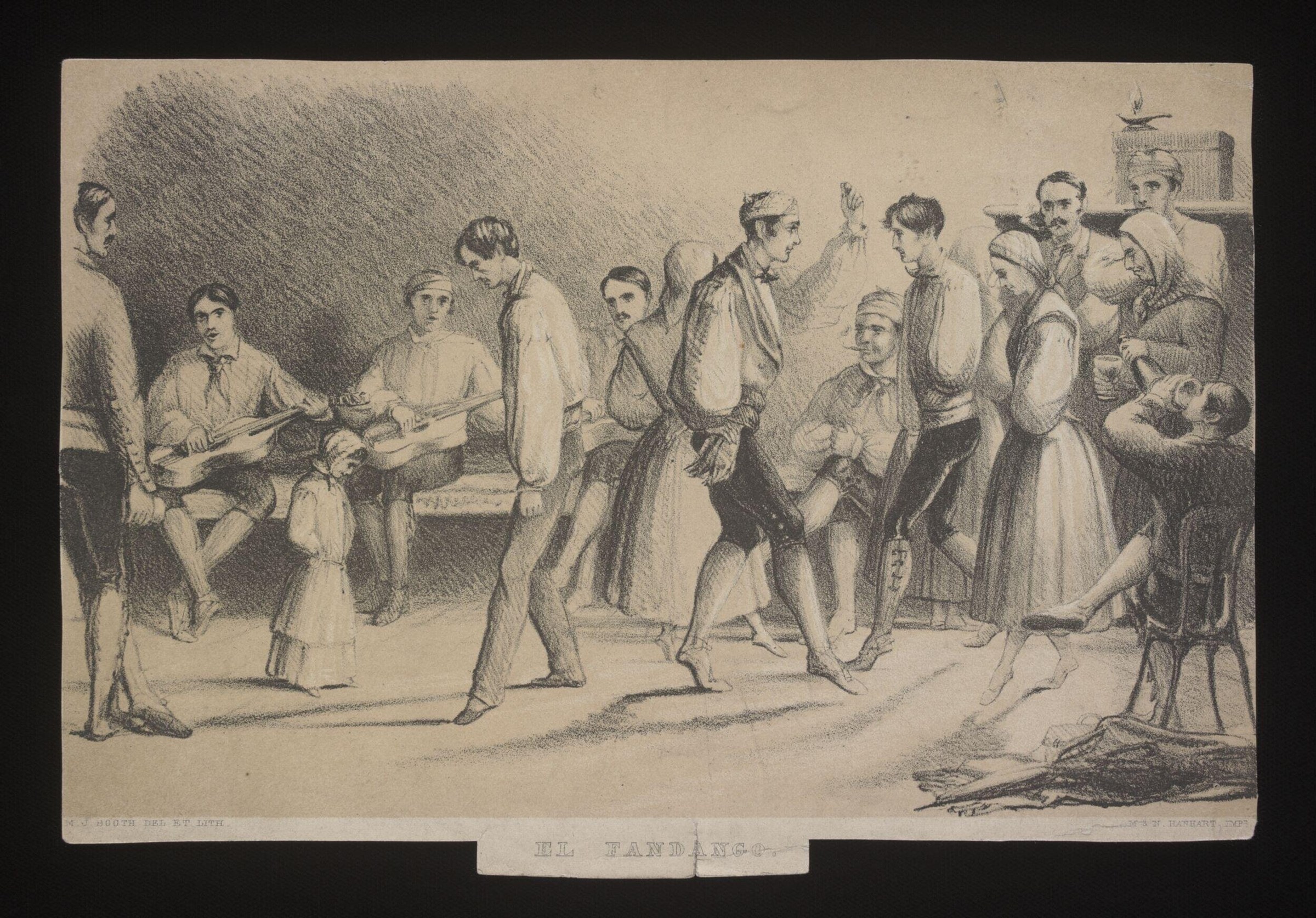
This engraving is one of the few contemporary visual records of how quadrilles and cotillions were actually danced in society, rather than how they were prescribed in instruction books. It captures the social awkwardness and genuine uncertainty of partner selection in the ballroom, the presence of musicians, and the mix of active and waiting dancers that characterized real balls. For historians and dancers alike, it offers evidence of what the *experience* of early 19th-century social dancing looked and felt like.
What you are looking at
A crowded indoor dance scene, rendered in pen or pencil on paper, depicts a lively social gathering of roughly a dozen figures arranged across a shallow stage-like space. The figures are dressed in early 19th-century costume: men wear tailored jackets, vests, and trousers; women wear high-waisted Empire silhouettes with full skirts and bonnets or feathered headdresses. The lighting is handled through cross-hatching that creates shadows on the back wall, emphasizing the depth of the room and the informality of the gathering. In the foreground, a man kneels or sits, one hand raised in animated gesture; to his left, a seated musician plays a stringed instrument (possibly a guitar or mandolin). Pairs of dancers are scattered throughout—some upright and facing each other, others in more relaxed postures—creating the impression of multiple conversations and flirtations in progress rather than a unified choreographic moment. The scene has the quality of documentary observation, capturing the texture of social dance as lived practice rather than formal performance.
The dancing
The dancers are predominantly in upright postures, some with arms raised or extended in conversational gesture rather than codified dance positions. Several couples face each other at a distance suggesting the hold and frame of social partner dance—possibly at the moment of invitation or between figures. The figures in the foreground (particularly the kneeling man and the musician) suggest a moment of pause or transition rather than continuous movement. Weight appears distributed lightly, with the impression of bodies ready to move. The ensemble quality—multiple interactions visible simultaneously—suggests a social gathering where dancing is one activity among others rather than a spectacle to be watched.
The dance depicted
This appears to document a *quadrille* or *cotillion*—the most fashionable social dances of the Regency and early Victorian era. The title 'EL FANDANGO' on the print suggests a Spanish-inflected version or a deliberate exoticization of the form, though the costume and setting are unambiguously Northern European. The composition—multiple couples scattered through space, the mix of active and inactive participants, the emphasis on social choreography and courtship negotiation—is consistent with English quadrille practice, where figures were separated by social distance and the dance involved both movement and stationary positions. The presence of a musician with a plucked-string instrument supports a salon or ball setting. The work may be satirical, capturing the social awkwardness and performative nature of fashionable dancing in the 1820s–1830s.
How it was made
This is an engraving or etching on paper, identifiable by the fine parallel lines (hatching and cross-hatching) used to build tone and shadow, and the precision of the line work. The technique allows for clear delineation of fabrics (the distinction between silk and linen, between fitted and gathered cloth) and fine facial characterization. The slight irregularities in line pressure and the deliberate roughness of some hatching suggests this is a hand-pulled print rather than a mechanically produced reproduction, consistent with early 19th-century print culture. The technique was well-suited to satirical or documentary representation of contemporary social life and circulated widely among middle-class and aristocratic audiences.
About this work
This is a social-dance scene from the Regency or early Victorian period, captured in the form of an engraving by M.J. Booth. The work documents the texture and etiquette of ballroom dancing among the fashionable classes, with particular attention to the moments between steps—the gestures of invitation, the informal clusters of waiting dancers, the negotiations of flirtation and distance that structured social dancing. The title invokes Spain ('El Fandango'), suggesting either that this represents a fashionable variation on Spanish dance, or that it is a satirical commentary on the Anglicization and sentimentalization of foreign dance forms. The print is a valuable record of how social dance was actually enacted and experienced, rather than how it was taught in dance manuals.
As a visual document, it belongs in a gallery of dance imagery because it captures the social function of dance—the courtship, the waiting, the musical accompaniment, the mix of activity and pause—rather than reducing dance to technique or spectacle. It shows us a moment when dance was inseparable from the management of desire, status, and social belonging.
How to look at it
Pay attention to what the artist chose *not* to show: there is no moment of spectacular movement, no leap or turn, no fully articulated step. Instead, the viewer sees waiting, negotiation, and the social distance between partners. Notice the raised hand of the man in the foreground—is this a gesture of emphasis, or an offer to dance? Watch the musician: where is he placed relative to the dancers, and does that placement tell us anything about how music structured the social space? The engraver has used the shallow stage-like space and the scattered placement of figures to emphasize simultaneity and chaos rather than unison—several things happening at once, several possible partners and flirtations visible at the same moment.
The artist
M.J. Booth is recorded as an engraver active in the early 19th century, likely working in Britain. Beyond this attribution and the title 'EL FANDANGO,' little is currently known of the artist's practice, biography, or other works. The style and execution are consistent with commercial printmaking of the 1820s–1840s, a period of high demand for satirical and observational prints of contemporary social life.
The period
This work dates to the height of the quadrille's popularity in Britain and Europe, a period (c. 1815–1850) when social dancing was a central pillar of courtship and respectability among the middle and upper classes. Dance instruction books proliferated; dance floors were packed; and the quadrille became the symbol of refinement and order. Simultaneously, Romantic-era artists and writers were fascinated by Spanish and Italian dance—by *fandango* and *tarantella*—as expressions of passion and exoticism that contrasted with the formality of ballroom dancing. This print likely capitalizes on that fascination, using the exotic title to comment on the stiffness or inauthenticity of fashionable dancing. In the history of visual representation, the 1820s–1840s saw an explosion of satirical prints documenting contemporary manners and social types; this image belongs to that tradition.
Where it lives
The work is held as a print in a Virginia collection (identified as 'va' in the source record). It is catalogued as a print with artist attribution to M.J. Booth and a title 'EL FANDANGO,' but lacks further documentation of date, edition, or publication details.
Dance in this work
Questions about this work
Is this a ballet, or social dancing?
This is social dancing—the kind of dance that would have occurred in a ballroom or assembly room among the fashionable classes. There is no evidence of pointe work, theatrical staging, or professional performance. The print documents how ordinary people (or at least wealthy people) danced with one another for courtship and amusement, not for an audience.
What does the title 'El Fandango' mean if the dancers are dressed in English clothes?
The title likely indicates either that this depicts a fashionable English quadrille performed to Spanish or Spanish-inflected music, or that it is a satirical comment on the Anglicization of Spanish dance forms. In the early 19th century, Spanish and Italian dances were admired as exotic and passionate, and British dancers and composers often borrowed from or imitated them. The print may be making fun of this fashion, or documenting it.
Why are some people sitting or standing still?
In quadrilles and cotillions, not all dancers moved at once. The dance involved a series of figures, and while some couples performed steps, others waited. This created a rhythm of activity and pause, of being 'in' the dance and 'out' of it. The print captures this rhythm realistically: some dancers are active, some are watching or waiting for their turn, some are in conversation.
Who was M.J. Booth?
M.J. Booth was an engraver active in early 19th-century Britain, but little else is currently documented about his life or practice. He appears to have worked in the tradition of satirical and observational prints that were popular during the Regency and early Victorian periods.
More dance artwork





