49 works in this view — arrow keys or swipe to move between them.
Dance in Art
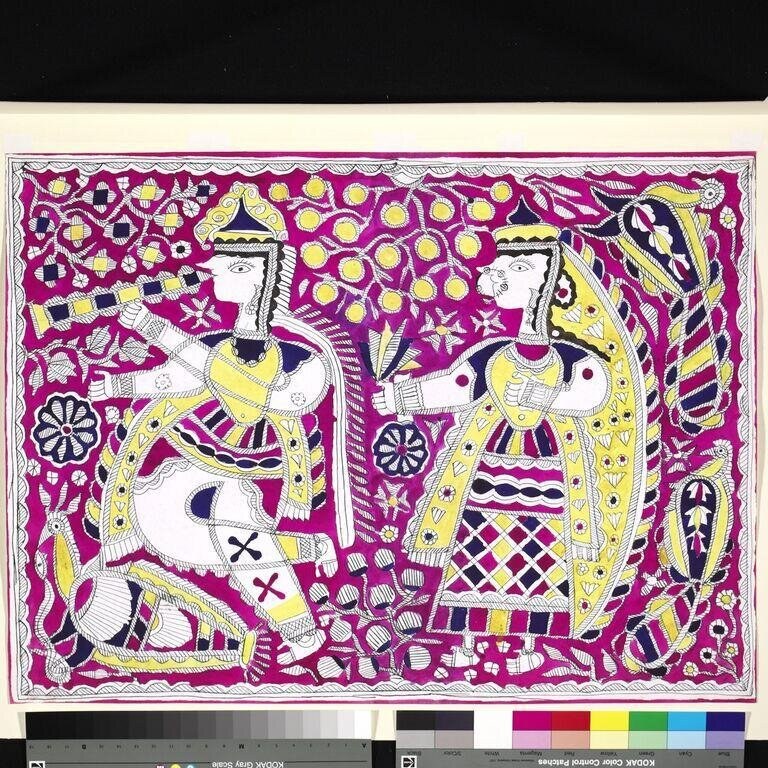
Krishna and Radha
Devi, Jagdami
- Collection:
- Painting
- Source:
- Victoria and Albert Museum
- Rights:
- Rights vary by item — check the source record before reusing this image. Source record ↗
- Recorded as:
- V&A — check rights per item
This work is relevant to the study of how dance subjects—particularly the Krishna and Radha narrative—have been represented in Indian visual culture outside the context of live performance. The tension between the work's cultural location within a dance tradition and its actual stillness raises questions about how dance is pictured in non-Western artistic conventions, and how devotional art and dance history intersect.
What you are looking at
Two elaborately costumed figures occupy a symmetrical composition against a vivid magenta ground densely patterned with floral and geometric motifs in gold, yellow, navy, and purple. Both figures wear tall jeweled crowns and richly decorated garments with hierarchical patterning: the left figure wears a wrapped skirt with geometric diamond patterns in contrasting colors and carries what appears to be a flute or musical instrument; the right figure wears a similar skirt with horizontal striped sections and holds an ornate staff or scepter. Their upper bodies are bare or minimally draped, their postures formal and frontal. The left figure's body leans slightly toward the center; the right figure stands more rigidly upright. Gold thread and embroidered detail suggest precious metalwork throughout the costume, while the densely decorated background creates a sumptuous, palatial atmosphere typical of Indian court or devotional art.
The dancing
The two figures are arranged in bilateral symmetry with their bodies oriented toward the viewer rather than toward each other, despite their proximity. Neither figure displays the fluid, continuous movement typical of South Asian classical dance; instead, both hold static, frontal poses suggesting representation rather than captured motion. The left figure's arm position suggests gesture or mudra, while the right figure's staff-bearing posture conveys authority. The bodies are painted with elongated proportions and stylized anatomy characteristic of Indian miniature and devotional painting traditions rather than Western life study.
The dance depicted
The catalogue identifies this as Krishna and Radha, the archetypal pair from medieval Sanskrit devotional literature and Hindu tradition. In Hindu devotional and classical dance contexts, Krishna and Radha are represented in tableaux vivants and narrative art rather than as dancers in motion, though their story has been central to Kathak and Manipuri dance traditions. The static, frontal presentation here suggests a devotional icon rather than a moment of dance—the figures are in darshan pose, presented for contemplation rather than caught mid-gesture. The title and iconography point to classical South Asian religious subject matter, but the pose and composition do not depict active dance performance.
How it was made
This appears to be a gouache or tempera work on paper, likely created in the Indian miniature painting tradition. The dense, opaque color handling, the meticulous patterning of the background, the gold thread or gilding details, and the style of line work are consistent with 20th-century Indian painting executed in this tradition. The medium allowed for brilliant saturated color and fine detail in the costume and jewelry, typical of devotional and courtly subject matter in Indian art. The technique implies a trained hand in classical Indian miniature conventions rather than Western academic training.
About this work
This 1973 work by Jagdami Devi renders Krishna and Radha as a jeweled devotional icon in the South Asian miniature painting tradition. The artist has created a symmetrical, richly decorated tableau that celebrates the divine pair central to Hindu devotion and classical dance repertoire, using the dense patterning and precise draftsmanship characteristic of Indian courtly art. Though the catalogue record names the subjects of classical Indian dance, the work itself presents them in static, frontal poses suited to devotional viewing rather than as a record of dance movement or gesture.
How to look at it
Attend to the symmetry and frontality of the composition: the artist has chosen not to represent motion or a narrative moment, but rather a formal presentation akin to a temple icon or court portrait. Notice how the costume's geometric patterning creates a visual rhythm that overwhelms any sense of the body's weight or movement beneath. The dense background pattern serves not to create spatial depth but to press the figures forward as objects of devotion. This is a work about presentation and ornament rather than about the dynamics of dance.
The artist
Jagdami Devi (dates not established in the catalogue record) worked in the Indian miniature painting tradition in the late 20th century. The precise technique, the subject matter drawn from Hindu devotional literature, and the adherence to classical Indian painting conventions suggest training in this tradition. Without fuller biographical information, her specific artistic lineage and training remain unclear, but the work is confident in its command of color, pattern, and the iconographic conventions of devotional art.
The period
By 1973, when this work was created, Indian miniature painting traditions were experiencing renewed interest both within India and internationally. The revival of classical Indian art forms in the post-independence period included renewed attention to historical painting techniques and devotional subject matter. Simultaneously, Kathak, Manipuri, and Bharatanatyam dance traditions—all of which draw on Krishna and Radha narratives—were being preserved and revived in institutional settings. This work sits at the intersection of that cultural moment, representing devotional subject matter through a classical visual tradition rather than through dance documentation.
Where it lives
The work is held in the Victoria and Albert Museum's collection (indicated by the source code 'va'). The catalogue record provides minimal documentation beyond title, artist name, and date; the work has not been assigned a medium classification or era label in the institutional record.
Dance in this work
Questions about this work
Is this a depiction of actual dance movement?
No. Though Krishna and Radha are central figures in classical Indian dance traditions like Kathak and Manipuri, this work presents them as a static devotional icon in the miniature painting tradition. The frontality, symmetry, and lack of dynamic gesture suggest the artists intended religious contemplation rather than a record of dance performance.
What is the significance of Krishna and Radha in dance?
In Kathak, Manipuri, and Bharatanatyam traditions, the Krishna-Radha narrative—particularly their romantic and divine relationship—provides central themes and repertoire. Their story has been performed and pictured for centuries across South Asian visual and performance cultures. However, this particular image represents them through the lens of devotional painting rather than as dancers.
Why is the background so densely patterned?
The elaborate patterning is characteristic of Indian miniature painting, where dense, jewel-like decoration creates a sense of luxury, divinity, and spiritual significance. The pattern presses the figures forward as the focus, eliminating spatial recession and creating an otherworldly, sacred atmosphere appropriate to the subject.
More dance artwork





