49 works in this view — arrow keys or swipe to move between them.
Dance in Art
Theatre costume
Unknown
- Collection:
- Theatre costume
- Source:
- Victoria and Albert Museum
- Rights:
- Rights vary by item — check the source record before reusing this image. Source record ↗
- Recorded as:
- V&A — check rights per item
These bracelets are evidence of the material and craft traditions embedded in theatrical costume. For dancers and historians, they reveal how performance depended on metalwork, light, and ornament—and how the smallest details of costume construction contributed to stage presence and visual impact. They raise questions about the labor, cost, and technical skill required to outfit a single dancer.
What you are looking at
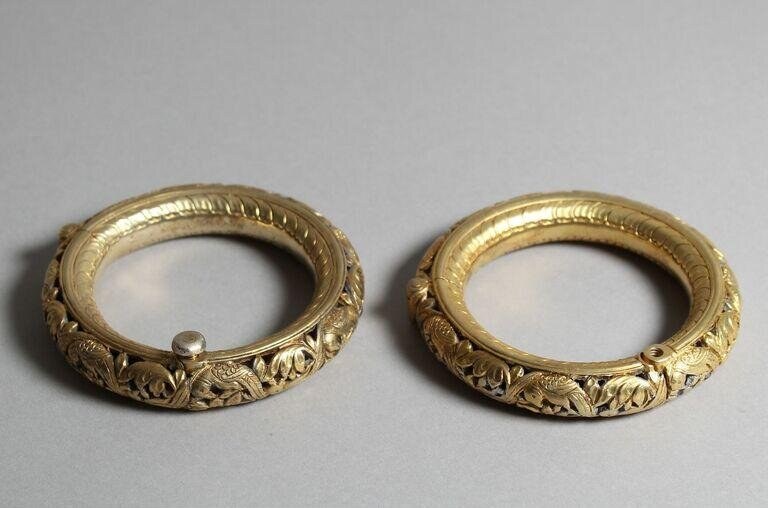
Two ornamental bracelets or bangles lie against a neutral background, photographed in raking light that emphasizes their three-dimensional relief. Each is a closed ring of yellow metal (likely gilt bronze or brass) decorated with dense, finely incised foliate patterns—scrolls, acanthus leaves, and floral motifs arranged in repeating bands around the outer surface. Both bracelets are identical in design and scale, approximately 2–3 inches in diameter. The inner surfaces are plain and smooth, suggesting these were functional objects worn on the wrist or arm. The craftsmanship is precise and refined; the surface detail catches light unevenly, creating shadow and depth that reveals the skill of the metalworker. There is a small spherical protuberance or loop visible on one bracelet, possibly a clasp mechanism or decorative terminal. The photograph is clinical and frontal, presenting these as artifacts for examination rather than as worn adornment.
The dancing
No figures or gesture are present in this image. These are inanimate metal objects.
The dance depicted
These bracelets do not depict dance and are not themselves dance costumes, despite the catalogue title. They are decorative or functional metal bangles, possibly from a theatrical or historical costume collection where metal ornaments and jewelry were stored together. If they belonged to a dancer's costume, they would have been worn on the wrist or forearm to catch light and movement during performance—common in classical ballet, South Asian dance forms, or historical theatrical productions where elaborate metalwork enhanced visual spectacle. However, the image itself shows only the objects, not a dancer or a dance scene.
How it was made
These are three-dimensional metal objects photographed as museum specimens. The image is a photograph—likely a digital or high-resolution archival photograph—taken with controlled raking light to emphasize the relief detail of the surface decoration. The incised or repoussé foliate patterns on the bracelets indicate hand-tooling or die-stamping in precious or semi-precious metal (gilt bronze, brass, or silver-gilt are most likely). The precise, repetitive nature of the ornament suggests either skilled hand-craftsmanship or use of a repeating pattern tool. The photographic technique—frontal, evenly lit, with minimal shadow and strong surface definition—is standard archival practice for cataloguing and preserving documentation of three-dimensional objects.
About this work
These are two identical ornamental metal bracelets, likely components of a historical or theatrical costume. Their fine foliate decoration and closed-ring construction suggest they were either functional dress ornaments or stage jewelry intended to catch and reflect light during performance. If part of a dancer's costume, such bracelets would have been worn on the wrist or forearm during classical ballet, historical court dance, or South Asian theatrical traditions, where metalwork was essential to visual spectacle. The bracelets are presented here as isolated artifacts in a collection labeled "theatre costume," indicating their role in the material culture of theatrical performance rather than as evidence of a specific dance scene or style.
How to look at it
Examine the relief pattern closely: the repetitive acanthus and scroll motifs are typical of late 19th-century ornamental metalwork. Observe how the incised detail creates visual texture and catches light—this was precisely the effect a dancer needed on stage under gas or early electric lighting. The smooth inner surface and closed-ring form show these were practical objects, not purely decorative sculptures; they were worn and handled. The small clasp or terminal on one bracelet hints at a fastening mechanism, suggesting these bracelets were removable and could be paired with other costume pieces.
The artist
The maker is unknown. The bracelets were likely produced by a metalworker or jeweler specializing in theatrical costume ornament, possibly working for a ballet company, opera house, or traveling theatrical troupe. The style suggests work from the 19th or early 20th century European tradition, when such ornamental metalwork was commissioned in quantity for large-scale theatrical productions.
The period
Theatrical costume ornament flourished from the mid-19th century onward, particularly with the rise of Romantic and Classical ballet. Designers and choreographers like Marius Petipa (in St. Petersburg) and Léon Bakst (Ballets Russes) commissioned elaborate metalwork to enhance dancers' costumes—bracelets, tiaras, clasps, and epaulets that caught stage light and emphasized movement. Metal ornaments were especially prominent in classical roles, courtly character dances, and orientalist or exotic themed productions. By the Gilded Age and early 20th century, such ornament was standardized and mass-produced in workshops, yet handcrafted detail remained valued. These bracelets belong to that industrial-yet-artisanal moment in costume production.
Where it lives
The bracelets are held in a theatre costume collection (indicated by the catalogue label "Theatre costume" and source "va," likely the Victoria and Albert Museum or a similar institutional archive). They are catalogued as functional costume components rather than as standalone decorative objects, reflecting their role within the material assemblage of theatrical dress.
Dance in this work
Questions about this work
Were these bracelets actually worn by dancers?
Possibly, though the image alone does not prove it. Metal bracelets of this style were standard costume ornaments in 19th- and early 20th-century ballet and theatrical productions. They would have been worn on the wrist or forearm to catch stage light during performance. However, without provenance information linking them to a specific dancer, production, or theatre company, we cannot confirm their use history.
What is the metal, and how were these made?
The yellow color and fine relief detail suggest gilt bronze, brass, or silver-gilt—metals chosen for their light-reflective properties and workability. The repetitive foliate pattern was likely produced by hand-tooling, repoussé (hammering from the back), or die-stamping. The closed-ring form indicates seamless construction, either cast as a complete ring or seamed and filed smooth. The precise, even ornament suggests workshop production rather than individual artisanal work.
Why are two identical bracelets shown together?
Dancers typically wore matched pairs of bracelets, one on each wrist or arm. Showing both pieces together documents the set as a functional costume unit. Matching ornamental pairs were also more economical for theatre costume departments to produce and maintain.
What period are these from?
The style and metalworking technique suggest late 19th or early 20th century production, likely 1880–1920. This was the period of Romantic and Classical ballet's international expansion, when elaborate costume ornament was standard. However, without hallmarks, maker's marks, or documented provenance, the date cannot be confirmed from the objects alone.
More dance artwork





