49 works in this view — arrow keys or swipe to move between them.
Dance in Art
Theatre costume
Unknown
- Collection:
- Theatre costume
- Source:
- Victoria and Albert Museum
- Rights:
- Rights vary by item — check the source record before reusing this image. Source record ↗
- Recorded as:
- V&A — check rights per item
This is a primary source document of performance practice and costume technology. It shows exactly what a dancer wore, how the jewelry was constructed, and where visual emphasis was placed on the moving body—information that written records alone cannot provide. For practitioners of Bharatanatyam, Kathak, or related forms, studying historic costume pieces like this illuminates the material conditions and aesthetic priorities of the tradition.
What you are looking at
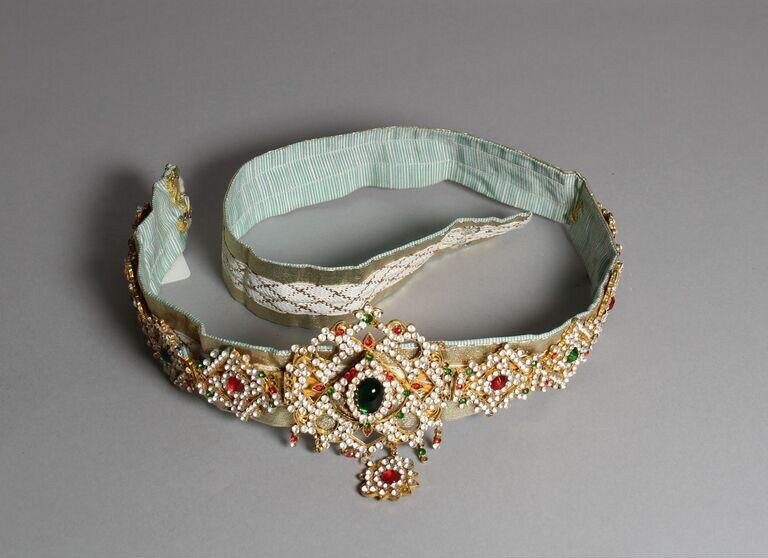
This is a decorative waistband or belt ornament photographed flat against a neutral background. The object is constructed from a pale green or seafoam silk ribbon, approximately 2–3 inches wide, with finished edges. The ribbon is gathered or pleated along its length in fine, regular vertical folds. At the center front hangs a substantial jeweled pendant or brooch consisting of a large dark green stone (likely an emerald or paste emerald) surrounded by an elaborate geometric pattern of seed pearls and smaller gemstones in warm gold tones—rust, amber, and deep red stones alternate with the pale pearls to create a dense, faceted surface. The pendant is teardrop-shaped and hangs from the ribbon by a short attachment. The underside of the ribbon shows a textured brocade or damask weave in metallic thread, visible where the ribbon curves. This appears to be a piece of Indian or South Asian theatrical costume jewelry, possibly from classical dance or court performance dress.
The dancing
No human figures are present. This is a costume object photographed as a document, not a representation of dancers or gesture. The object itself displays the formal symmetry and precious materials characteristic of classical South Asian dance costume ornamentation.
The dance depicted
This waistband is consistent with costume for Bharatanatyam, Kathak, or other classical Indian dance forms, where such jeweled belts (mekhala) are worn at the waist as part of formal performance dress. The quality and style of the stonework, the combination of emerald and seed pearls, and the pleated silk construction point to a piece of theater costume rather than everyday wear. The ornament would have moved with the dancer's hip and torso movements, adding visual emphasis to the dramatic isolation of the pelvis and waist that characterizes these dance traditions. Without inscription or clear dating, the specific dance form and historical period cannot be determined with certainty from the object alone.
How it was made
This is a piece of hand-constructed costume jewelry and textile combined. The ribbon appears to be silk, hand-pleated and finished with precision seaming. The pendant is composed of individually set gemstones (or paste) and seed pearls mounted in gilt or gold-tone metal, a labor-intensive technique requiring a skilled artisan. The workmanship suggests professional theater costume production rather than domestic or amateur work. The object was likely photographed as a museum document to record and preserve evidence of performance practice and costume construction.
About this work
This is a jeweled waistband ornament from Indian classical dance costume, probably late nineteenth or twentieth century. It represents the material culture of professional theater practice: the precious materials, skilled handwork, and formal geometric design all reflect the high status of classical dance in South Asian courts and performance institutions. The piece documents both the aesthetic values of the dance tradition—the emphasis on brilliant, mobile ornamentation at the waist—and the standards of craftsmanship expected in professional costume production.
For a dance historian or costume specialist, the object is valuable as a surviving example of actual performance wear, showing scale, material, and construction technique that photographs and written descriptions cannot convey. The jeweled pendant, in particular, demonstrates the visual strategy of South Asian classical dance: to create points of intense visual interest that direct attention to the precise articulations of the dancer's body.
How to look at it
Examine the scale and weight of the pendant: it is large enough to be seen from a distance and substantial enough to move noticeably with the dancer's torso. Notice the density and precision of the stonework—every surface is covered, with no wasted space. The combination of the deep emerald stone with the pale seed pearls creates high contrast and catches light in multiple directions. Imagine this piece in motion around a dancer's waist, and how the pendant would swing and flash with each movement of the hips and torso, creating a visual rhythm that echoes the percussion and the body's articulation.
The artist
Unknown. This is a costume artifact, not a signed artwork. It was likely created by a professional costume maker or jeweler working for a dance institution, court, or touring company in South Asia, probably in the late nineteenth or early twentieth century.
The period
Classical Indian dance traditions experienced significant institutional codification and revival during the late nineteenth and early twentieth centuries, particularly through the efforts of dancers like Rukmini Devi Arundale and the establishment of schools such as Kalakshetra. During this period, costume standards were formalized and documented as part of the broader project of preserving and elevating these traditions. The high quality and formal design of this waistband reflects the investment in material culture that accompanied this cultural moment. Such ornaments were essential to the visual language of the stage, where distance from the audience meant that the brilliance and movement of jeweled costume became a primary vehicle of aesthetic communication.
Where it lives
Held in the Theatre collection of the Victoria and Albert Museum, London. This is catalogued as a theater costume object and was likely acquired as part of the museum's documentation of world performance traditions.
Dance in this work
Questions about this work
What dance would a dancer wear this with?
This waistband is consistent with classical South Asian dance traditions such as Bharatanatyam or Kathak. It would be worn as part of the formal costume for a solo dancer in a classical recital or court performance. The jeweled pendant (mekhala) is a traditional element of these costumes, worn at the waist to draw attention to the isolations and movements of the hips and lower torso.
Why is the pendant so large and heavy-looking?
In classical dance performance, jewelry and ornamentation are not primarily decorative—they are functional elements of the visual design. The size and weight of the pendant ensure it is visible to an audience seated at a distance, and its substantial construction allows it to move with the dancer's body, creating an additional visual rhythm that reinforces the movement.
How do you know this is actually worn as costume and not just decorative?
The construction of the ribbon as a waistband with a finished edge, and the secure mounting of the pendant, indicate functional costume design. The wear and patina visible on the metal components suggest this piece was actively used rather than created as art or jewelry for personal display.
Why is it in a theater museum?
The V&A's Theatre collection documents the material culture of performance globally. Costume pieces like this waistband are primary sources that show historians and practitioners exactly how performers dressed, what materials and techniques were used, and what aesthetic values the tradition prioritized.
More dance artwork





