49 works in this view — arrow keys or swipe to move between them.
Dance in Art
Theatre costume
Unknown
- Collection:
- Theatre costume
- Source:
- Victoria and Albert Museum
- Rights:
- Rights vary by item — check the source record before reusing this image. Source record ↗
- Recorded as:
- V&A — check rights per item
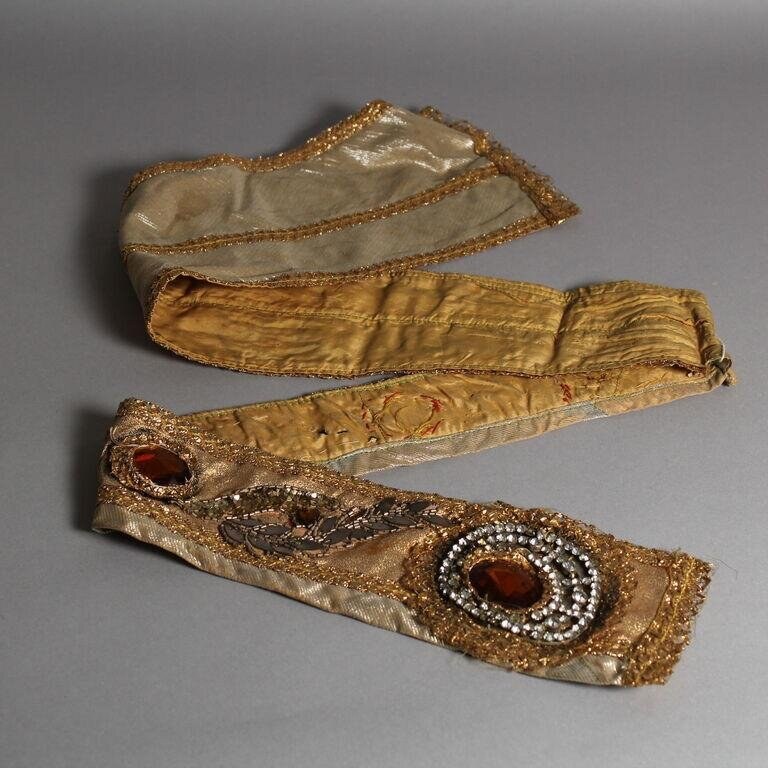
Theatrical costume sleeves are rarely preserved intact, and the presence of large cabochon stones with pearl halos and gold embroidery places this in the category of high-status court dress. To a dance historian, these pieces reveal how opulent court and early theatrical dance actually was—not the ethereal vision of later Romantic ballet, but heavy, sculptural, densely decorated formal dress that moved very differently from modern costume.
What you are looking at
Four elongated fabric strips are arranged in an overlapping display against a neutral background, each clearly a sleeve or arm covering from a theatrical costume. The topmost piece is cream silk with a scalloped gold metallic trim along its curved edges. Below it lies a golden silk sleeve with subtle woven texture. The third piece, also golden, shows embroidered or applied red decoration. The bottom sleeve, the most ornate, features extensive gold metallic embroidery or beadwork forming intricate patterns, with two large cabochon stones—a deep red gem set in the upper left and an amber stone surrounded by concentric rings of pearls and smaller stones in the lower right. The stones sit proud of the fabric surface, creating dramatic three-dimensional decoration. The overall effect is of opulent court or theatrical dress from a historical period when such layering and jeweled ornament marked rank or character status.
The dancing
These are costume pieces only, not figures in motion; no bodies or choreography are visible. The arrangement displays four separate sleeves or arm coverings laid flat, each suggesting the volume and position they would occupy on a performer's body. The graduated gold and cream tones, combined with the weight of applied ornament, indicate garments designed to frame and emphasize the arm and hand during movement.
The dance depicted
No dance is visible in this image. These are theatrical costume components—likely sleeves from a court or aristocratic character's dress, possibly from a 17th-century or 18th-century court dance tradition such as ballet de cour, masque, or formal court ballet. The lavish jeweled decoration suggests a role of high status: an empress, goddess, or noble patron. The gems and metallic work would catch light and movement during the formal, restrained gestures typical of Baroque court dance, where the arms and hands were as carefully composed as the legs.
How it was made
These are sewn and embellished textiles, not a painting, print, or drawing. The method is evident: silk ground fabrics with applied gold metallic trim (possibly goldwork or metal thread embroidery), embroidery, and hand-sewn cabochon stones held with metal foil backing. This is the actual three-dimensional costume object itself, preserved as an artifact. The gems and metalwork show the high cost and labor invested in a single performer's costume, implying either a court production or a professional theatrical company of considerable resources.
About this work
These are four historical theatrical costume sleeves, grouped to display the range and quality of ornament used in formal court or aristocratic dress. The progression from plain cream silk to heavily jeweled gold suggests different layers or pieces meant to frame the arm and hand during formal movement. The cabochon stones and metallic embroidery are characteristic of 17th- or 18th-century European court costume, when the body was dressed as sculpture—each piece positioned to create silhouette and to catch light. The sleeves survive as proof of the material investment in dance and spectacle at court: a single performer's arm might wear more jeweled labor than most people owned.
How to look at it
Notice how the gems are set with metal foil beneath them and arranged in concentric rings—a technique that maximized the catch and reflection of candlelight in an indoor court venue. The graduated cream-to-gold color scheme suggests these might be sleeves from a single costume worn in layers, or from different acts or roles within a production sequence. The scalloped edge of the cream sleeve is a delicate finish that would read as luxury and care even from a distance. The weight of applied ornament on the lower sleeves would require the performer to move with particular control and presence.
The period
Seventeenth- and eighteenth-century European court dance was inseparable from costume. Dancers at the French court, in Italian intermezzi, and in English masques wore increasingly elaborate dress as the century progressed. By the 18th century, court dancers were corseted, heeled, and heavily adorned. This tradition persisted into early theatrical ballet before Romantic ballet (early 19th century) began to rationalize costume around the body and the movement of the legs rather than the silhouette of rank. These sleeves belong to that earlier, more ornamental world.
Where it lives
The holding collection is identified as a source of theatrical costume (marked 'Theatre costume' and 'va' in the record). These pieces are catalogued as a group but without individual accession data, artist attribution, or specific date range in the accessible record.
Dance in this work
Questions about this work
What are these pieces?
Four historical theatrical costume sleeves or arm coverings, displayed to show their ornament and construction. They appear to be from a single costume tradition—possibly court dress or formal theatrical attire from the 17th–18th centuries.
Why are there gems sewn into a sleeve?
In court and formal theatrical dress of this period, the human body was treated as a surface for display of wealth and status. Gems, gold thread, and elaborate embroidery were concentrated on the sleeves, bodice, and skirts because these pieces moved and caught light during formal gestures and dance. A single sleeve could carry more jeweled labor than an entire modern costume.
What would a performer do while wearing these?
Court and formal theatrical dance of the period was restrained and highly geometric—slow walks, turns, arm movements performed with control and precision. The weight and ornament of the costume did not impede the dancer but rather defined the role and demanded that movement be deliberate and sculpturally clear. The arms and hands, framed by these decorated sleeves, were as important to composition as the footwork.
How do we know these are theatrical?
The extreme concentration of applied ornament, the use of large cabochon stones with expensive foil backing, and the formal cut and layering all exceed what would be worn in everyday court dress. These are costume pieces—made to be seen, to move, and to signify character or rank on stage.
More dance artwork





