49 works in this view — arrow keys or swipe to move between them.
Dance in Art
Papercut
Unknown
- Collection:
- Papercut
- Source:
- Victoria and Albert Museum
- Rights:
- Rights vary by item — check the source record before reusing this image. Source record ↗
- Recorded as:
- V&A — check rights per item
The work captures a rare moment where high theatrical training (evident in the controlled, powerful stance and the elaborate costume) meets folk art production. It documents a Chinese dance tradition at a moment—1974, during the Cultural Revolution—when many such traditions were under pressure or suppressed, making any contemporary record valuable to dance historians. The papercut technique itself is inseparable from the work's meaning: this is not an outside observer's rendering of dance, but a work made within the culture that performed it.
What you are looking at
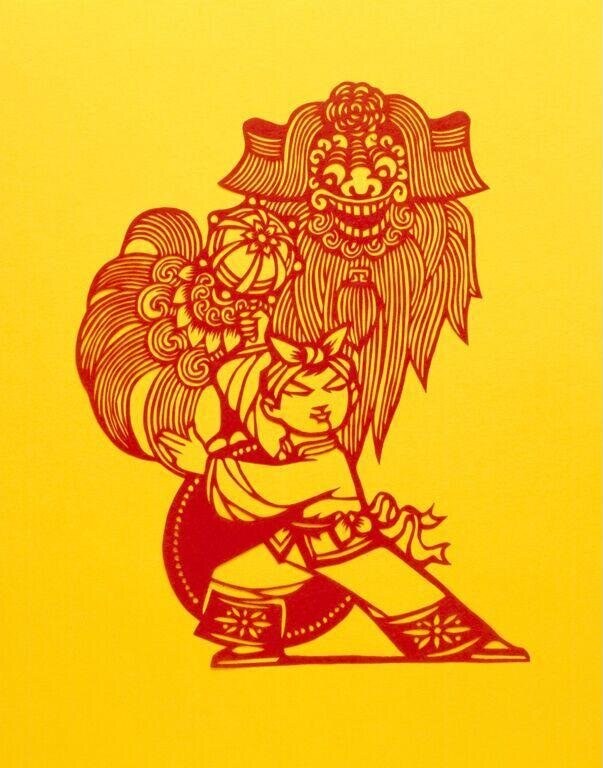
A red and gold papercut depicts a figure in dynamic motion against a bright yellow ground. The figure wears a short skirt or lower garment in deep red, with ornamental bands at the waist and ankles in gold, and appears to be in a wide-legged stance with knees deeply bent. Above the dancer rises an elaborate headdress or mask of extraordinary complexity: a large smiling face with prominent features, surrounded by radiating layers of intricately cut and scrolled paper that suggest hair, feathers, or an elaborate ceremonial ornament. The face itself is expressive and mask-like, with stylized features characteristic of East Asian operatic or theatrical traditions. The entire composition is rendered in the high-contrast red-and-gold palette typical of Chinese folk papercut, with fine linear detail throughout.
The dancing
The dancer's body is caught in a powerful, grounded position: feet wide apart, knees sharply flexed, weight pressing downward into the earth. The torso appears to flex and twist, with the arms positioned as if in active gesture, though the precise arm position is difficult to determine given the papercut's linear style. The stance suggests significant physical effort and control—this is not a light or ethereal movement but something rooted, strong, and deliberate. The relation between the small human figure and the immense ornamental headdress creates a striking visual tension: the dancer bears or wears something many times her own visual weight.
The dance depicted
This appears to depict a Chinese classical or folk dance performed with an elaborate ceremonial headdress, most likely from operatic or processional traditions. The exaggerated mask and ornate headdress are consistent with Peking Opera (jingju) or other forms of classical Chinese theatre dance. The wide, grounded stance and the apparent effort of the pose suggest a moment of intentional dramatic weight—possibly a character moment in a narrative dance, or a formal processional gesture. The papercut format itself is a traditional Chinese folk art, and the choice to represent dance through this medium suggests the work documents or celebrates a living performance tradition.
How it was made
This is a papercut (jiǎnzhǐhuà), created by cutting and layering coloured paper rather than by drawing or painting. The technique requires cutting intricate designs through folded paper so that when unfolded, the image is symmetrical and densely detailed. Red and gold are the traditional colours of Chinese papercut, associated with festivity, prosperity, and performance. Papercuts of this scale and complexity would typically be hand-cut with scissors or knives, a labour-intensive process that indicates either professional manufacture or considerable amateur skill. The dated medium suggests either folk production or professional documentation of a performance tradition.
About this work
A Chinese papercut from 1974 captures a dancer in a powerful grounded stance, weighted and deliberate, bearing or wearing an enormous ornate headdress rendered as a complex smiling mask surrounded by radiating scrollwork. The image documents a moment from classical or folk theatre dance—most likely from Peking Opera or a related tradition—and does so in red and gold papercut, one of China's most recognisable folk arts. The work records not just a pose but a tradition of costume and movement that connects formal theatrical training with popular visual culture. Papercuts were both functional (created for festivals and celebrations) and increasingly collected as folk art; this work sits at the intersection of documentation and artistic practice.
How to look at it
Attend first to the dancer's feet and legs: the wide stance and deep knee bend show a moment of deliberate effort and control, not a light or passing gesture. The stance is held, grounded, almost confrontational in its weight. Then trace your eye upward to understand what the dancer is supporting—the headdress is not a light ornament but a visual and conceptual weight. The precision of the paper-cutting demonstrates that this is not a casual or folk-naive rendering: the scrollwork, the features of the mask, the ornamental bands at waist and ankle all show professional execution. The yellow ground intensifies the red and gold, making the figure pop; this is presentation art, not documentation.
The artist
The artist is unknown, which is typical for Chinese papercut. Papercut is traditionally an amateur or semi-professional folk practice, with works created for local festivals, celebrations, or domestic use, and circulated within communities rather than through formal art markets. By the 1970s, however, Chinese folk arts including papercut were increasingly collected and valued as cultural heritage. The date 1974 suggests possible official or semi-official documentation of folk practices during a period of cultural transition.
The period
In 1974, Chinese theatre and dance were navigating the later stages of the Cultural Revolution (1966–1976), during which classical forms including Peking Opera had been suppressed in favour of revolutionary performance. By 1974, some classical forms were beginning to be cautiously revived. The creation of a papercut documenting an elaborate theatrical dance costume in this year may reflect either underground continuation of classical traditions or early official interest in their preservation. Simultaneously, folk papercut itself was being documented and valorised as authentic Chinese cultural expression.
Where it lives
The work is held in a collection identified only as 'Papercut', suggesting it may be part of a folk art or institutional collection of Chinese papercuts. The source is listed as 'va', likely indicating a specific institutional or archival source, though this cannot be confirmed from the record alone.
Dance in this work
Questions about this work
Is this a record of an actual performance, or an imaginative artwork?
Most likely both. Papercut artists typically worked from lived experience of performances and celebrations they witnessed. The elaborate headdress and costume are historically authentic to Peking Opera and related forms, but the artist has rendered them as a stylised folk artwork rather than a literal documentation. Papercuts were often created as souvenirs or records of special occasions.
What is that enormous thing on the dancer's head?
It appears to be an ornate theatrical headdress or mask characteristic of classical Chinese opera, particularly Peking Opera. The smiling face and radiating scrollwork suggest either a deity, an auspicious character, or a stylised representation of an operatic role. Such headdresses could weigh several pounds and required considerable skill and strength to wear while dancing.
Why is the papercut red and gold?
Red and gold are the traditional colours of Chinese papercut, associated with prosperity, celebration, and auspiciousness. They are also the colours of Chinese theatrical tradition and festival culture. The choice reflects both the folk art tradition and the celebratory or ceremonial nature of the dance being depicted.
More dance artwork





