49 works in this view — arrow keys or swipe to move between them.
Dance in Art
Theatre costume
Golovine, A
- Collection:
- Theatre costume
- Source:
- Victoria and Albert Museum
- Rights:
- Rights vary by item — check the source record before reusing this image. Source record ↗
- Recorded as:
- V&A — check rights per item
The costume documents a moment when Russian theatrical design, including dance costume, was treated as high art requiring the collaboration of trained designers and makers—here likely Golovine, who was a significant figure in early twentieth-century stagecraft. For dancers and historians, it is tangible evidence of how geometric modernism translated into wearable form and how early twentieth-century Russian theatre integrated the principles of the visual arts into performance design.
What you are looking at
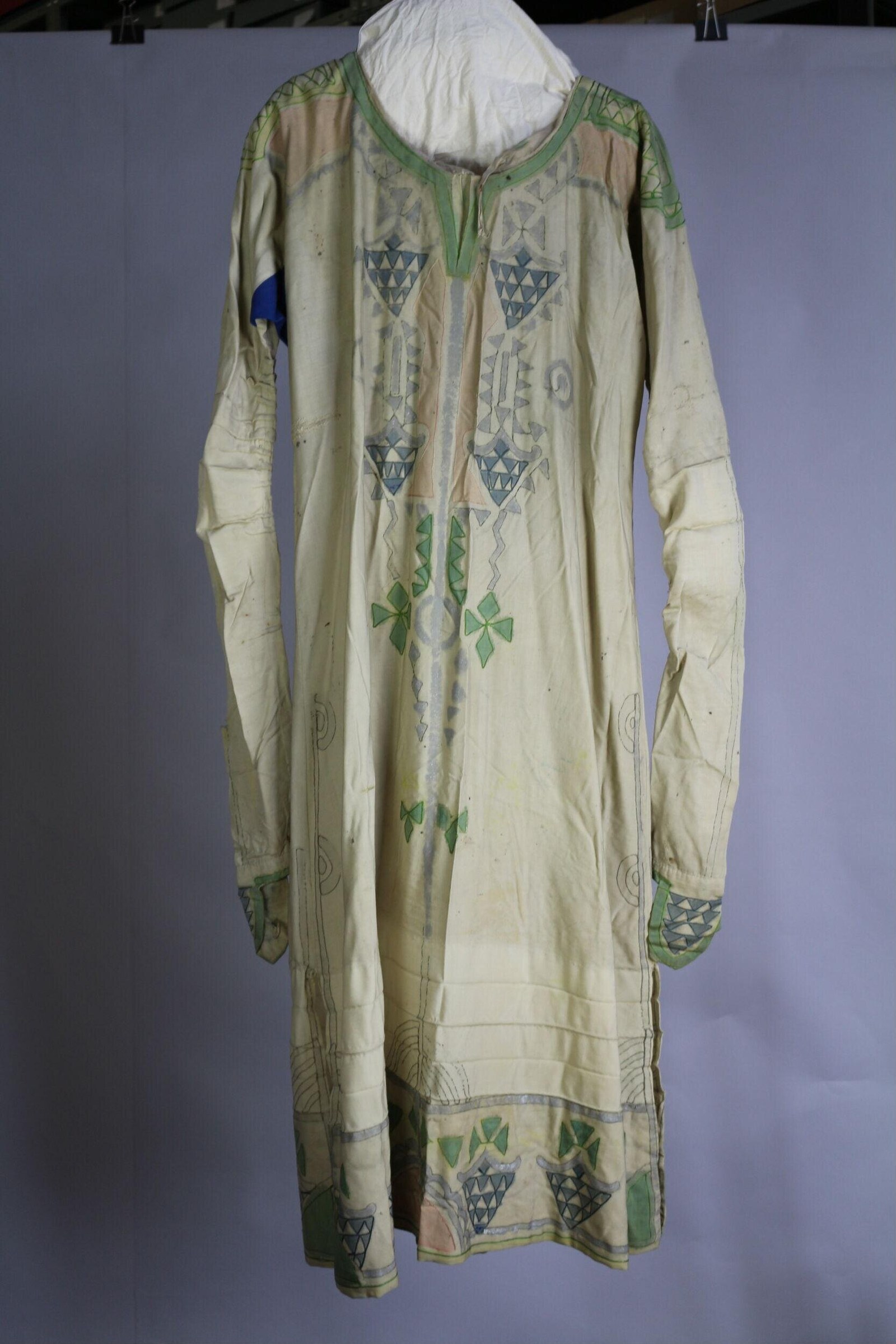
A long linen garment hangs on a display form against a neutral background, shown full-length from neckline to hem. The dress is cream or pale ivory, with a round neckline finished in green ribbon or trim and a central front opening fastened with green ties. The chest and torso are decorated with embroidered or appliqué geometric patterns in dark blue (or slate grey) and green: pairs of stacked triangular or diamond-shaped forms arranged vertically down the center front, with additional ornamental bands along the sleeves and hem. The long sleeves extend to the wrist with decorated cuffs. The skirt falls straight and simple, unadorned except for a band of patterned decoration at the lower edge that echoes the geometric motifs of the chest. A small rectangular patch of bright blue fabric is visible at the left side, possibly a later repair or museum marking. The fabric shows age-appropriate wear and discoloration consistent with early twentieth-century use. The garment's construction and trim suggest hand-finishing and careful tailoring.
The dancing
No figures or gesture are present in this image. The work is a costume object presented on a mannequin form, displayed as an artifact rather than in performance or worn context. The garment's cut and proportions suggest it was designed to allow movement in the torso and arms, with freedom in the skirt—appropriate for staged performance—but the static display offers no information about how a dancer moved in it.
The dance depicted
The costume appears to be a Russian or Eastern European theatrical garment, consistent with early twentieth-century Ballets Russes practice or similar avant-garde theatrical design. The geometric embroidery, construction, and style suggest it may have been worn in a Russian imperial or nationalist-themed production, though without documentation of the specific ballet or dance work it is impossible to identify the choreography or movement vocabulary. The garment's generous proportions and the placement of decoration suggest it was designed for visibility in a proscenium setting. The catalogue attributes the design to A. Golovine (likely Sergei Golovine, a designer associated with Russian theatrical production), which would place it within early modernist theatre practice.
How it was made
This is a textile object: a linen or linen-blend dress with hand-embroidered or appliquéd decoration in contrasting yarns or dyed linen. The geometric patterns were applied by hand or with hand-guided technique—the slight irregularities visible in the patterning and the variation in thread color suggest embroidery rather than printing. The green ribbon trim and ties are machine-sewn or carefully hand-stitched. The object has been preserved as a museum textile, showing minimal fragmentation but visible aging and minor damage consistent with theatrical use and storage.
About this work
This is a theatre costume dress from approximately 1910, attributed to designer A. Golovine and held as a textile artifact in a theatre collection (likely the Victoria and Albert Museum, based on the source notation 'va'). It represents the practice of Russian imperial or avant-garde theatre design in the early twentieth century, a period when stage costume was conceived as a total design element integral to the visual composition of a production. The geometric embroidery and careful color coordination (cream, dark blue, green) suggest a designer working with modernist principles of form and symbolic ornamentation rather than naturalistic representation. Though the specific dance work is not documented, the costume's construction and decoration place it firmly within the theatrical design practices of the Ballets Russes era and the broader Russian modernist theatre movement.
How to look at it
Examine the placement and rhythm of the embroidered ornament: it is concentrated at the center front (the focal point in performance), along the sleeves (which frame the upper body and gesture), and at the hem (which catches light and defines the silhouette in motion). The geometric vocabulary—stacked triangles, diamonds, linear bands—suggests a designer thinking in terms of abstract form rather than naturalistic detail. Note that the costume is designed to be seen from the front and at a distance (proscenium distance); the back and sides are unadorned. The bright color accents (the green ties and trim) would have been highly visible under stage lighting and would have guided the viewer's eye.
The artist
A. Golovine (Sergei Yevlevich Golovine, 1863–1930) was a Russian theatrical designer, painter, and set designer associated with the Imperial Theatres and the early modernist movement in Russian theatre. He was known for innovative costume and set design that incorporated contemporary artistic principles—Symbolism and geometric abstraction—into theatrical practice. His work helped establish the aesthetic framework of the Ballets Russes and Russian avant-garde theatre design, where costume was conceived as total composition rather than historical accuracy or narrative realism.
The period
In 1910, Russian imperial theatre and the Ballets Russes (which debuted in Paris in 1909) were at the forefront of European theatrical innovation. Costume design had moved decisively away from the naturalism of nineteenth-century theatre toward symbolic, geometric, and abstract forms. Designers like Golovine, Leon Bakst, and Alexandre Benois created costumes that functioned as integral elements of a unified artistic vision—the costume was not mere clothing but a statement of modernist form. This shift reflected broader changes in early twentieth-century art: Cubism, Fauvism, and Russian Suprematism were all beginning to shape visual culture. Dancers in this era were increasingly expected to move within costumes that privileged visual impact and artistic principle over comfort or conventional beauty.
Where it lives
The costume is held in a theatre collection, indicated in the source field as 'va' (likely the Theatre Collection of the Victoria and Albert Museum, London). It is catalogued as a theatre costume object and appears to be the sole documentation of the specific production or dance work for which it was created.
Dance in this work
Questions about this work
Who was A. Golovine?
Sergei Golovine (1863–1930) was a major Russian theatrical designer and painter. He created costumes, sets, and visual concepts for the Imperial Theatres in St. Petersburg and contributed to the groundbreaking visual aesthetic of early twentieth-century Russian theatre, including the Ballets Russes. He was influential in establishing modernist principles—geometric form, symbolic color, integrated composition—as the foundation of theatrical design.
What production was this costume worn in?
The catalogue record does not document the specific ballet, dance work, or theatrical production for which this costume was created. Without additional archival research or records from the collection, it is not possible to identify the choreography or narrative context.
Why is the embroidery geometric rather than decorative?
The geometric vocabulary reflects the modernist aesthetic of early twentieth-century theatre design. Rather than applied ornamentation (flowers, scrollwork, historical detail), the designer used abstract forms—triangles, diamonds, linear bands—that were integrated into the total visual composition of the costume. This approach was aligned with contemporary art movements (Cubism, Russian Suprematism) and signaled an avant-garde approach to theatre.
What does the blue patch on the side indicate?
The bright blue rectangular section visible on the left side of the garment is likely a museum conservation marking or repair patch applied during preservation and storage. It is not part of the original design.
More dance artwork





